Friday, October 31, 2025
Bergcast #39 - The Blu-ray Xperiment
Monday, June 09, 2025
The Legend of Nigel Kneale 2. Enemy From Space
Among the many goodies included in the set is the second part of the documentary me and Brother Tom have produced with Eklectics about Quatermass creator and writer, The Legend of Nigel Kneale.
As with the first part, included on the collectors' edition of The Quatermass Xperiment, the documentary is presented by Toby Hadoke and includes interviews with Kneale's biographer Andy Murray, Dr Tom Attah, Joel Morris, Brontë Schiltz and Jane Asher. This second part also includes two other on-screen contributors... but wait and see.
Friday, April 25, 2025
The Legend of Nigel Kneale: 1. The Creeping Unknown
Among the many, many treats listed on the Hammer site is this:
The Legend of Nigel Kneale: The Creeping Unknown. Who was Nigel Kneale? Toby Hadoke investigates the man and his influence in part one of a brand-new two-part documentary.
Produced by me and my brother Tom for Eklectics, and directed by Jon Clarke and edited by Robin Andrews, this authoritative new documentary includes expert analysis from Dr Tom Attah, Joel Morris, Andy Murray, Brontë Schiltz and some other people I won't mention just yet to add a bit of suspense.
Toby Hadoke, is of course, an authority on all things Nigel Kneale and Quatermass and I'm looking forward to his imminent book.
Monday, March 10, 2025
Terror of the Suburbs, with Matthew Sweet
| Director Jon Clarke and camera op Lewis Hobson on Ealing High Street where Autons once invaded |
| Presenter Matthew Sweet on the corner of Ealing Broadway and Ealing High Street, outside the Autons' favourite branch of M&S |
| Jon and Lewis line up a shot with Matthew |
| Lewis, Jon, expert guest Alex Moore, Matthew Sweet and me (Photo by Kitty Dunning) |
| Me looming in the foreground while the team interview Dr Adam Scovell outside Ealing Film Studios |
| Dr Adam Scovell and Matthew Sweet at Ealing Film Studios |
| Nice Vibez, Lime Grove |
| Jon records Subhadra Das and Matthew Sweet in Chiswick |
| Subhadra and Matthew in Chiswick |
| Jon records Matthew's reaction shot in front of a brick wall |
| Matthew and Jon in front of the Palace of Westminster, the south side of the river popular with alien invasions |
| Matthew and Dr Rupa Huq, MP at Portcullis House |
| Jon and Matthew in front of Elizabeth Tower |
Thursday, February 27, 2025
Power of 3 podcast #360: Terror of the Suburbs
That last element is the subject of the documentary Terror of the Suburbs, included on the new set. It's presented by Matthew Sweet and produced by me and the team at Eklectics. I'll post some more details about it once people have had a chance to watch...
In the meantime, I shared a few not-too-spoilery things with Kenny Smith for episode #360 of his podcast Power of 3. You also get to hear from high wizard Peter Crocker about exactly what was involved in restoring these old episodes.
Doctor Who Magazine's special issue on the 1970 series of Doctor Who is also on sale and includes my article on the cast and crew it shared with the soap opera Crossroads. Earlier this week, I posted a bit more about that and the fact that David Whitaker wrote 32 episodes of Crossroads.
Friday, December 16, 2022
Cleaning Up on Free Thinking
Thanks to presenter Matthew Sweet and producer Torquil MacLeod.
Wednesday, April 06, 2022
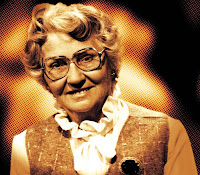
Sci-fi Bulletin interview re Mary Whitehouse
- Archive on Four: Interview: Samira Ahmed and Simon Guerrier
- Our documentary: Disgusted, Mary Whitehouse
Sunday, March 13, 2022
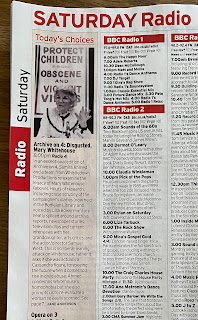
Disgusted, Mary Whitehouse: Pick of the Week
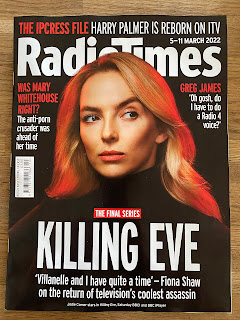
There's been a fair amount of press coverage of the documentary, too. We were mentioned on the cover of Radio Times, which also described the doc as "exceptional" (see below), and there were write-ups in BBC History Magazine, the Daily Express, Guardian, Herald, Daily Mail, Mail on Sunday, Daily Telegraph, Times, Sunday Times, and Total TV Guide.
As well as her blog post, Samira wrote a piece for the BBC website:
Friday, September 10, 2021
I’m Just the Guy Who Says Action, by Alvin Rakoff
“The past, as I said, is a sunshine memory. I ranted on. Embellishing certain characters, exaggerating minor problems, emphasising funny moments, trying hard to remain focused on storytelling.” (p. 170)
The implication, surely, is that much of the rest of the book has been gilded. And yet the thing that strikes me is how packed it is with telling, honest detail. It’s largely about the production of a live TV drama, Requiem For A Heavyweight, in 1957, and Rakoff giving Sean Connery his first leading role (with a small role for Michael Caine, too). The play, he says, is now lost to the ether: a scratchy audio recording of most of it survives, as well as some photographs and the camera script full of Rakoff’s notes on how it should be staged and framed. YouTube also has the original, US version - directed by Ralph Nelson and with Jack Palance in the lead role.
But the book is less an effort to recreate the lost production as to share a vivid sense of the thrill and terror of making it, what it cost Rakoff and his leading lady and then-girlfriend Hill emotionally, and - for all its success - the uncertain time that followed. How extraordinary the commissioning process seems today. Roughly every eight weeks, Rakoff would be summoned to see Michael Barry, “HDTel” or Head of Drama for the BBC’s sole TV station. Even the description of Barry’s office is striking:
“Curtains forever drawn. One dim bulb from a desk lamp, the only source of light. Presumably so he could more readily monitor the output from the nearby studios, relayed through the dark-wooded set in the corner. He himself wore his customary alpaca jacket over armband-hitched shirt sleeves. Complete, of course, with a tie.” (p. 151)
“He would give me a broadcast date. Nothing more. And as I would leave his office he always added, ‘A comedy would be good. A comedy would fit well into the schedule. See if you can find a comedy.’ Neither I nor any of his other subordinates managed to find many comedies. I would go away. Find a play. Buy it. Print it. Cast it. Involve a designer. Consult make-up, hair, wardrobe. Rehearse. Work out a camera script. … Then into the studios for broadcast. Live. Collapse with crew and cast for a few drinks after the show. The next day I would be back in Michael’s office and he would praise what I had done - usually - or tell me - a rarity - if he hadn’t liked it. … The meeting would again end with him telling me the date of my next commitment. And as I got to the door, the inevitable phrase came, ‘See if you can find a comedy.’ The routine was cyclical.” (p. 34)
Then, after Requiem, when Rakoff is too exhausted to commit immediately to the next production, Barry treats it as betrayal and pretty much casts him adrift - at least, for a time. Rakoff picks up with the noted film producer Michael Balcon, who seems to wield just as extraordinary power and hold just as powerful grudges.
There are plenty of insights into the mechanics of making TV at the time - the cameras, the politics, the personalities to be juggled, the impact of that work. For example, he notes how Look Back in Anger revolutionised British theatre when it was first staged by the Royal Court in 1956.
“A revolution, incidentally, started by television writers who were the first to show more interest in ‘the man on the Clapham bus’ than the ladies’ tea party at the vicarage.” (p. 111)
We follow the production of Requiem through casting and rehearsals, into Studio D at Lime Grove Studios, where there was so little space that one set had to be constructed around the moving actors as the play was broadcast live. Tension mounts as rehearsal after rehearsal fails to get this trick shot right, just one of a hundred stresses to contend with - the account of the live performance makes exhilarating reading. But it’s the details that make it so vivid: the etiquette of getting rounds in for the crew in the British Prince pub down the road, or of Connery bringing his then girlfriend to sit in on rehearsals, of Rakoff and Hill keeping emotionally distant while working together, of the crisis in their relationship.
It’s often very honest - about their sex life and about other people’s bad behaviour - and there’s an edge to some of the humour, Rakoff and Hill finding a couple of incidents comic that I felt more disturbing. But then perhaps that’s the gilding. When Rakoff is comforting his very ill wife with tales of that perfect 11-week holiday in 1960, she makes a typically insightful remark.
“Only poor people can afford [such] long holidays … Nobody wanted us back here.” (p. 170.)
See also:
- Alvin Rakoff interviewed about the book on The Film Programme, August 2021
- Jaqueline Hill: A Life in Pictures, the short documentary by me and Thomas Guerrier, in which we spoke to Rakoff at his home, is included on the 2011 DVD of Doctor Who story Meglos and the more recent Season 18 Collection.
- Jaqueline Hill: A Future in Five Minutes, a biography by my friend Louise Bremner
- Me on Sean Connery’s film roles in the 1950s, 1960s and 1970s
Monday, January 21, 2019
Victorian Queens of Ancient Egypt
![]() |
| Marianne Brocklehurst's diary |
There are details for the programme on the BBC website:
Samira Ahmed explores the profound connection between ancient Egypt and the Victorian heyday of Britain’s industrial north – in a legacy of museums and northern pride.
Being taken to see the mummies has become a rite of passage, captivating generations of children since the late 19th century. Ancient Egypt is now embedded in early years education. At more than a hundred museums across the UK, that culture helps shape the British imagination. Where did that affinity come from?
To find out, Samira follows in the footsteps of three extraordinary women: Amelia Oldroyd, Annie Barlow and Marianne Brocklehurst. Each came from a northern, mill-owning family, and each felt compelled not only to visit Egypt and to collect antiquities, but to share their treasures with those at home. Each established local museums that survive today, inspiring new generations.
Today, such museums face an uncertain future. By returning to these women’s stories, can lessons be learned from the past?
Contributors:
Katina Bill, Kirklees Museums and Galleries
Matthew Watson and Rizwana Khalique, Bolton Library and Museum Services
Danielle Wootton
Emma Anderson and Kathryn Warburton, Macclesfield Museums
Rebecca Holt, MPhil student at Oxford University
Heba abd al-Gawad, Egyptian Egyptologist
Alice Stevenson, Institute of Archaeology, UCL
Dr Chris Naunton
Producers: Simon and Thomas Guerrier
A Whistledown Production for BBC Radio 4
Thursday, September 06, 2018
John Ruskin's Eurythmic Girls, reprise
The blurb for tonight's one goes like this:
Perhaps you did music and movement at school. There was a time girls across the country learnt to dance as if they were flowers. At the start of the 20th century, Jacques-Dalcroze developed Eurhythmics to teach the rhythm and structure of music through physical activity. But the idea had earlier roots, including an unlikely champion of women's liberation.
John Ruskin - now derided by feminist critics as a woman-fearing medievalist - was at the centre of a 19th-century education movement that challenged the conventional female role in society. Amid concerns about the health of the British Empire he looked back to the muscular figures in medieval painting and the sculpture of the ancient Greeks, in their loose-fitting clothes. Perhaps the Victorians needed to shed their corsets and free their minds for learning. In Of Queens' Gardens he set out a radical, influential model for girls' education.
Samira Ahmed argues that Ruskin was an accidental feminist. To understand where his ideas came from, how they were enacted and what survives in the way girls are taught today, she ventures into one of the schools set up on Ruskinian principles, tries on the corsetry that restricted Victorian women's lives, and gets the insight of Victorian scholars.
Contributors: Matthew Sweet (author of Inventing the Victorians); Dr Debbie Challis (Petrie Museum of Egyptian Archaeology, UCL); Louise Scholz-Conway (Angels Costumes); Dr Fern Riddell (author of A Victorian Guide to Sex); Dr Amara Thornton (Institute of Archaeology, UCL) and Isobel Beynon, Dr Wendy Bird, Annette Haynes, Dr Jean Horton, Diane Maclean, Aoife Morgan Jones and Natasha Rajan at Queenswood School. Readings by Toby Hadoke.
Presenter Samira Ahmed
Producers Simon and Thomas Guerrier
A Whistledown Production for BBC Radio 3.
Thursday, August 09, 2018
Journey up the Nile, the Egyptian Diary of Marianne Brocklehurst
The museum was the idea of Marianne Brocklehurst (1832-98), the well-off daughter of silk manufacturer, banker and Liberal MP John Brocklehurst (1788-1870), and I’m investigating Marianne’s own politics and why she, and the industrial north more generally, might have felt an affinity for the Pharaohs.
Marianne apparently made five trips to Egypt, and the museum has many of the artefacts she acquired along with her drawings and paintings. In 2017, the museum published “Journey Up the Nile”, a transcript of Marianne’s diary from her first trip. It’s a nice, hardback edition on glossy paper, including many illustrations and photographs, and an introduction by honorary curator Alan Hayward that helps set the scene. (The only thing lacking is a map, so I referred to the one in Alan’s 2013 pamphlet, “The Story of the Collection – How West Park Museum Got Its Ancient Egyptian Objects.”)
The diary begins on 11 November 1873, as Marianne sets off from Macclesfield with her travelling companion Mary Booth (1830-1912), Marianne’s young nephew Alfred and manservant George Lewis. The entries are mostly short, single paragraphs, the detail in the accompanying sketches. But there’s a sense of fun and adventure, Marianne seeming to relish the small hardships.
They pass through France and Italy, losing some of Alfred’s luggage along the way, recovering it, then losing track of time – presumably because of so much travelling by night - to arrive at Brindisi a day early for their boat across the Mediterranean. There are comic sketches of people falling over themselves during the very rough crossing, which leads to their boat ending up a hundred miles off course.
Although they reach Alexandria on 28 November, it’s another day before they’re cleared to land – 18 days after setting off from home. Stuck on board for that last evening, Marianne and Mary – the MBs, as they were known – meet other tourists, including novelist Amelia Edwards (1831-92), who will follow much of their course down and up the Nile on another, grander boat.
Edwards would later establish the Egyptian Exploration Fund (now Society) and provide a legacy for the first professorship of Egyptian Archaeology – awarded to Flinders Petrie – so she’s a significant figure in the discipline. This is from before all that, but she’s hardly a young girl. She’s a well-established professional writer, and in her early 40s – as are the two MBs.
In 2016, Historic England Grade II listed the grave Edwards shares with her long-term companion Ellen Drew Brayshaw, noting its importance in LGBT history. The MBs were also long-term companions who would be buried together. What can we read into that?
“We should not take a modern attitude to two women living together,” says Alan Hayward in his 2013 pamphlet, “for in those days, when a woman’s role was to raise a family and run the home, it was the only way for independently minded wealthy women to ‘do their own thing’.”
I scoured the diary looking for anything that might hint at something more. At no point does she tell us what their relationship is – but then she also doesn’t spell out her relationship to Alfred (her nephew) or George (her servant). The assumption is that her readers will know, because this diary was likely passed between friends and not intended for publication.
She is candid about certain things, describing at some length and with much excitement how she and Mary smuggled a mummy case out of the country, bribing officials along the way, and noting the very serious punishments those involved risked by helping her. Yet she is coy about exactly how much she paid – something less than a £100 but a “good round number in sovereigns” (p. 91).
So we’re left to interpret what is left unsaid. Can we read anything into the moment that Mary “smokes a pipe over the oil can” (p. 36) with the sailors, which seems rather unladylike, or the delight the MBs take in “paying our baksheesh like a man” (p. 69)?
Other details are more sure. The four-month trek down and up the Nile is a well-established journey, the river busy with other tourists, some of them friendly and respectable, others – such as Cooks’ excursionists and some American Christians – behaving badly, carving their names in the monuments and leaving their rubbish behind them. Some things have not changed in a century and a half - just like the MBs, the Dr and I struggled to find the carving of Cleopatra on the wall of the temple at Dandara.
In other ways it's another world. There's the pith helmets and formal wear of the tourists in the pictures. There’s the risk of crocodiles, and thieves, and Marianne’s compassionate response when a trusted sailor turns out to have stolen from them.
“Let us not be hard on his memory considering that, like the rest of the sailors, his pay was only thirty shillings a month for three or four months at the most and then nothing to do or to get until the next season began.” (pp. 86-7)There is a great deal more, but I won’t share all my notes here as they’re for the documentary...
Friday, February 17, 2017
John Ruskin's Eurythmic Girls
Presenter Samira Ahmed has written her own piece about the documentary, but here's the blurb:
John Ruskin's Eurythmic Girls
![]() |
| Eurythmic dance at Queenswood School, 1920s |
Producers Simon and Thomas Guerrier
A Whistledown Production for BBC Radio 3.
Monday, June 29, 2015
HG Wells and the H-Bomb
HG and the H-BombSunday Feature
Samira Ahmed unearths the extraordinary role of HG Wells in the creation of the nuclear bomb 70 years ago - and how a simple, devastating idea led to the world we know today.
In his 1914 novel The World Set Free, Wells imagined bombs that destroy civilisation and lead to a new world order. But his "atomic bombs" - a name he conceived - are grenades that keep on exploding.
How did this idea become a reality? Samira discovers the strange conjunction of science-fiction and fact that spawned the bomb as Wells mixed with key scientists and politicians such as Lenin and Churchill. Churchill claimed Wells was solely responsible for the use of aeroplanes and tanks in the First World War. Thanks to Wells, Churchill was also ahead of many in writing about the military potential of nuclear weapons - as he did in his 1924 article for the Pall Mall Gazette, "Shall We All Commit Suicide?"
In London's Russell Square, Samira retraces the steps of Hungarian physicist Leo Szilard who conceived the neutron chain reaction. Amid the bustle and noise of the capital in 1933, he suddenly realised how to exploit the potential of nuclear energy and - because he'd read Wells - the devastating impact it would have.
But what could he do? How easy is it to keep a secret in the scientific community, with war looming? Once a dangerous, world-changing idea exists, is it possible to contain it?
To find out, Samira speaks to nuclear physicist Dr Elizabeth Cunningham; Graham Farmelo, author of Churchill's Bomb; Professor Lisa Jardine; Andrew Nahum, chief curator of "Churchill's Scientists" at the Science Museum, London; and Michael Sherborne, author of HG Wells - Another Kind of Life.
Readings by Toby Hadoke
Presenter Samira Ahmed
Producers Simon and Thomas Guerrier
A Whistledown Production for BBC Radio 3.
Monday, February 02, 2015
Modern Man at the BFI
The Future Film Festival promises to "provide opportunities to connect with the film industry, kick-start your career and develop new and existing skills with inspirational screenings, masterclasses, Q&As and workshops." So it's a bit gutting that I can't go due to other commitments. Bah.
Modern Man is the third film I've written to get screened at the BFI: Wizard played as part of the LOCO London Comedy Film Festival last year, and The Plotters was shortlisted for the Virgin Media Shorts Award 2012.
Sunday, December 07, 2014
Oliver Cromwell's Fundamentalist Queen
Samira Ahmed explores the extraordinary rise and fall of the Lady Protectress Elizabeth, wife of Oliver Cromwell - a commoner who became "queen" in the 1650s.Samira has written her own blog about the documentary, wrote a piece about Elizabeth Cromwell for the BBC's online magazine, and discussed her on the Robert Elms show on Wednesday (1 hour 9 minutes in; and she's followed by an interview with my chum Dick Fiddy from the BFI and the amazing Paddy Kingsland of the Radiophonic Workshop). The documentary is also one of BBC History Magazine's picks of the week's TV and radio.
Elizabeth lived through an extraordinary time - for women as well as men - as the country was divided by a decade of civil war in the 1640s. In the new regime that followed the execution of Charles I, Elizabeth found herself a consort like no other, an ordinary housewife elevated to Lady Protectress.
But the Protectorate, and its efforts to forge a new kind of state power based on strictly Puritan grounds, lasted only a few years. In 1660, the monarchy was restored, Oliver's allies were executed as traitors and his own dead body was dug up and hanged in chains. The widowed Elizabeth, scorned and taunted, was forced to beg Charles II for mercy.
So why is so little known about her? Helped by leading Cromwell scholars and tantalising historical documents - including a satirical cookbook - Samira goes on the trail of the fundamentalist queen, from the church where she married and her kitchen as the young wife of an MP in Ely, to the extravagant gifts that came to her Puritan court and the secrets that may lie within her anonymous grave. With Louise Jameson as the voice of Elizabeth Cromwell.
Presenter Samira Ahmed. Producers Simon and Thomas Guerrier. A Whistledown Production for BBC Radio 3.
Samira makes the point, too, that the documentary came about because I researched the life of Oliver Cromwell for a Doctor Who audio - The Settling. Grateful thanks to Gary Russell, the director-producer who commissioned me, on the condition that I'd do the reading. (Researching the prospect of the documentary also led me to look round Ely, which in turn led to the setting of another Doctor Who story - Home Truths.)
It's been a joy to make the documentary, and that's all down to the generosity of the people with whom we made it. Thanks to Samira for her faith in me and brother Tom, and to David Prest and everyone at Whistledown for so patiently shepherding us through the process. Thanks to John Goldsmith, formerly of the Cromwell Museum in Huntingdon, Traci Bosdet and Tracey Harding at Oliver Cromwell's House in Ely, and Diane Corbin at St Giles Cripplegate, and to Jane and John Trevor for letting us look round their home. Thanks to our experts: Professor Laura Gowing at King's College London, Professor Peter Gaunt of the University of Chester and the Cromwell Association, and Dr Patrick Little of the History of Parliament. Thanks to David J Darlington for assistance with bringing the 17th century vividly to life (just as he did with The Settling). And thanks to Louise Jameson for bringing Elizabeth to life.
Wednesday, November 05, 2014
Three magazines
'Oliver Cromwell's forgotten queen' says the top of BBC History Magazine. Elizabeth Cromwell (1598-1665) was arguably the most powerful woman in the country in the 1650s, but today we know almost nothing about her.
The three-page article investigates her life, as a foretaste of the documentary brother Tom and I have made with Samira Ahmed to be broadcast on Radio 3 on 7 December. (More of which to come.)
'The space traveller's guide to the Doctor's universe' boasts Doctor Who Magazine's latest The Essential Doctor Who - Alien Worlds. As well as a great feature by Dr Marek Kukula on the scientific basis (or, er, not) of the Doctor's visits to other worlds, I've written entries on the following planets: Demon's Run, Ember, New Earth, Terra Alpha, Thoros Beta, Titan III and Traken. I've also written about the unnamed planets seen in The Stolen Earth, The End of Time part 2 and Death of the Doctor.
In fact, it was fascinating to watch The Twin Dilemma the same week as the broadcast of Deep Breath. Both introduce a brash, grumpy Doctor who the companion isn't sure about - and neither are we. But the script of The Twin Dilemma gives the new Doctor no moments to shine, or be heroic, or woo us. The end of Deep Breath is a plea to give the new guy a chance. The end of The Twin Dilemma is - on the page at least - almost 'Don't like it? Tough.' (And, weirdly, the two worlds we visit in The Twin Dilemma - Titan III and Jaconda - look almost identical.)
Lastly you can read my review of The Imitation Game - the new Alan Turing biopic starring Benedict Cumberbatch - for the Lancet Psychiatry. I've previously blogged about my family connection to the code-breakers at Bletchley Park and I've wrote some Blake's 7 plays that might be of interest: The Dust Run and The Trial star Cumberbatch as a space pilot; The Turing Test is about Avon trying to pass as a human being.
Wednesday, February 05, 2014
Cleaning update!
A big thank you to everyone who has bought Big Finish's debut short film Cleaning Up, starring Mark Gatiss and Louise Jameson. All profits from the sale go into a fund to make a feature film version of Cleaning Up – a Big Finish movie. We asked Guerrier brothers Simon and Thomas how the film project is progressing. Read on...
'Brilliantly!' says Simon. 'I'm currently hard at work on the script, reworking and revising our initial treatment. It's all go!'
Thomas adds: 'We've spoken to a number of production companies and individuals who might help take the film forward – and being able to show them there's already an audience buying the short has really helped.'
'It's looking very positive,' says Simon, 'though there still a long way ahead of us. So thanks to everyone who's supported us, bought the short and spread the word about what we're trying to do. We'll keep you all posted!'
Cleaning Up is still available to buy in two versions:
'Rookie' Standard Edition for £1.99:
HD version of film
'Hitman' Special Edition for £4.99:
HD version of film, 'first cut' with commentary, behind the scenes film, trailer, image gallery, soundtrack, PDF scripts, posters and wallpaper.
All profits go to developing the Cleaning Up feature film.
Wednesday, January 22, 2014
Nominate me for a Hugo Award, please and thank you
It stars David Warner as Merlin, and the cast includes Lisa Bowerman, Lisa Greenwood, Adrian Mackinder and Matthew Sweet.
Here are instructions on how to nominate stuff for a 2014 Hugo Award. You can watch Wizard here:
We shot it in February 2013, put it on the internet in March and it's already been shortlisted in Hat Trick's "Short and Funnies" competition and is playing at BFI Southbank this Saturday as part of the LOCO festival. I've also written a pilot for a TV sitcom version, so an award would help get some momentum behind that.
Oh, and if you're nominating stuff, I also recommend my chum Eddie Robson's radio sitcom Welcome To Our Village, Please Invade Carefully, while Paul Cornell explains why you should vote for him and who else deserves a nod.
Thank you.
Wednesday, January 08, 2014
"Wizard" plays BFI as part of LOCO London Comedy Film Festival
It's one of 13 films showing in a 90-minute extravaganza, Laughing Stock: Short Comedy Film Showcase. You can buy tickets here. Me, director Tom and some of the cast and crew will be there to cheer the film along. Why not join us?
Wizard is also available to view online for free: