Showing posts with label 007. Show all posts

Saturday, November 15, 2025

War Drums of the Blackfoot, by Terrance Dicks

This is the first of Terrance’s books to be published in my lifetime, on 12 July 1976. The indicia says it was published simultaneously in Great Britain by Allan Wingate (Publishers) Ltd and Tandem Publishing Ltd, in hardback and paperback respectively.

I suspect the print runs were not huge. While first editions of Target’s Doctor Who paperbacks are relatively easy to come by and it is the hardbacks that are rare, I’ve only been able to find a hardback edition of War Drums of the Blackfoot. I’ve also spoken to collectors who’ve been at this for longer than me, and they haven’t traced a paperback either.

Perhaps there’s more going on in this than simply the number of copies printed. Readers may have tended to keep hold of their Doctor Who paperbacks, building up a collection, whereas the Mounties books were more readily discarded. Even if readers grew out of Doctor Who, those books could be passed on to school fetes, bring-and-buy sales and second-hand book stalls and shops, where a subsequent generation of fans — including me — eagerly gathered them up. Thus these books survived. 

It may even be that discarded Mounties paperbacks ended up on those stalls, and I didn’t notice — or care, because they weren’t Doctor Who. I don’t remember seeing them but might have barely spared them a glance as I looked for the good stuff. If so, I played a part in unsold, second-hand Mounties getting binned. Sorry, everyone.

Hardback editions survive, I think, because they were largely published for and bought by libraries, which tended to hold on to their books. My copy of War Drums of the Blackfoot was, says a stamp on the title page, “Discarded by Havering Library Service”. It’s in pretty good condition, the dust jacket largely intact except for what look like chew marks in one corner. It’s not well thumbed and dog eared like some of my well-loved Doctor Who books.

The brick red spine as on the other Mounties books — still evident here on the back and on a stripe on the spine once covered by a library sticker — has faded to pallid orange. The front and back covers haven’t faded. This is a book that spent considerable time on a bookshelf, not being opened and read.

While the Doctor Who books went through multiple reprints and new impressions, sometimes within months of first publication, the Mounties books have never been republished. Several people have responded to these posts of mine saying that, though they know Terrance’s Doctor Who books very well, they had no idea these existed.

Yet, as Terrance worked out the plot of War Drums of the Blackfoot, three months ahead of publication of the first book in the series, he was optimistic that the Mounties would do well, as we can see from his earliest surviving notes. Thrillingly, these notes also tell us a lot about his creative process.

Terrance Dicks's handwritten notes, dated 6 October 1975, for the third Mounties novel
Monday Oct 6th 1975

Mounties III Preliminary notes

1) Fake Mountie murders Indians

2) Missing uniforms

3) Yankee coats incident. Mounting hostility and hysteria

Climax — ‘The Treaty’

(Later Books about — (1) Denbow and (2) Dubois) More role in this.

Fred Denbow and Henri Dubois were introduced in the first Mounties book, The Great March West, as colleagues and friends of hero Rob MacGregor. At this earliest stage of plotting the third book, Terrance wanted to build up their involvement so that they could each be the focus of further novels in the series.

His next notes are dated Thursday, 9 October, by which time Terrance had a title, “Wardrums [one word] of the Blackfoot”, and a basic structure, with a sentence summarising each of 10 chapters plus an epilogue to feature a final twist — much the same structure as the second novel, Massacre in the Hills. He also specified that the novel was to take place prior to 25 June 1876, the date of Custer’s notorious “last stand” — which surely meant he intended to include that key historical moment in a later book.

Over the next few days, Terrance developed each one-line summary into a paragraph per chapter, up to and including Chapter 7, each given a separate page of his spiral-bound notebook. On Tuesday, 14 October he added the note to himself that there should be, “Continuous conflict, tension, excitement, action. Hold back plot as much as possible.” 

He also calculated an approximate wordcount, based on an average 10 words per line, with 32 lines per page over 144 pages equalling 46,080 words. This is considerably more than the roughly 30,000 words Terrance produced for each Doctor Who novelisation at this time. But I don't think this greater wordcount meant he intended the Mounties books to be for older readers, not least because Doctor Who and the Revenge of the Cybermen and Doctor Who and the Genesis of the Daleks, written either side of this novel, are so grim and violent. 

Besides, the published version of War Drums of the Blackfoot isn’t as long as Terrance initially predicted. It comprises the usual 128 pages of an Allan Wingate / Target book of the time, whereas Doctor Who and the Genesis of the Daleks, at a slightly longer than usual 33,549 words, warranted 144 pages. (I’ll have more to say on wordcounts when I post about that novelisation, with data care of the dead useful Based on the Popular BBC Television Serial by Paul MC Smith.)

Anyway, having estimated wordcount, Terrance then stopped making notes and got on with bashing out a first, uncorrected draft. This was completed by 17 November, which means he was writing roughly 1,000 words a day. The book as published comprises 12 chapters and no epilogue, so he didn’t stick too rigidly to that first outline.

Once again, he seems to have drawn from the non-fiction history of the real-life Mounties, Maintain the Right by Ronald Atkin (1973). One crucial element, first detailed on p. 27 of the novel, is the poor state of the Mounties’ uniforms, which comes right out of Atkin:

“In fact, the quality of the uniforms was a continuing disgrace during the Force’s early years. In 1876, in an attempt to cut costs, the Canadian government had the police clothing and boots made of inferior materials by inferior craftsmen — the inmates of Kingston Penitentiary in Ontario. One constable reported that when he got his prison-made boots wet he was unable to remove them when they dried, so he had to soak them again before being able to get them off.” (Maintain the Right, p. 126).

Atkin also tells us about 25 year-old Ephraim Brisebois, in charge of the Mounties’ F Division, who was, in August 1875, tasked with the construction of a new fort.

“Inspector Brisebois made persistent attempts to have the new fort named after himself, even writing ‘Fort Brisebois’ at the head of all outgoing correspondence and on bills and invoices.” (MtR, p. 98).

Terrance refers to the real-life Brisebois in his notes but in the novel it’s a fictional Inspector Bellamy who wants the new fort named in his own honour (p. 13). In Atkin, we’re told work to build the fort was contracted out to the firm of one IG Baker (p. 98). In the novel, Bellamy has the Mounties doing the construction — as further sign of his self-serving nature.

In reality and in fiction, Commissioner Macleod over-ruled the inspector and named the new fort “Calgarry” — two Rs — giving the modern city of Calgary its name. In the novel, that’s because Macleod was born in a place of the same name on the Isle of Skye (p. 125); in reality, the gothic mansion known as Calgary Castle is on the Isle of Mull and Macleod had been a guest there. Terrance either misread what Atkin said or chose to simplify reality for the benefit of his readers.

Unlike the first two novels, there’s no “author’s note” here to tell us that the story is based in real history, which suggests that Terrance was conscious of being freer here with the sources. He took the problem of the poor uniforms and the problem of the vain inspector and imagined what happened next.

On meeting the “pompous and unpopular” Bellamy, Rob is amazed to find the inspector wearing a “handsome blue cloak” — part of the uniform of the US cavalry. Bellamy says, “complacently”, that his own cloak is “threadbare” and American uniforms have been delivered to him by mistake, so “I saw no harm in wearing this” (p. 14). Rob replies crossly that if the Indians see him in US Cavalry uniform, they are liable to attack…

Rob is, as usual, correct. What’s more, the Indians have been attacked by Mounties so turn on Rob and his friends. That’s what we see in the cover artwork, once again by Jack Hayes. It is not a hundred miles from the cover of the second Mounties novel: Rob on horseback in the centre of frame, staring coolly back at the advancing, aggressive Indian(s). 

The Mounties trilogy by Terrance Dicks
Cover art by Jack Hayes

Being closer in on the action this time, we see Rob’s face more clearly, which I think makes the cover more effective. It might have helped if the Indian’s arrow and the line made by his arms pointed at Rob’s face, to direct our focus — but perhaps that was thought too violent for young readers. Otherwise, it has the dynamism Hayes could convey so well, Rob’s horse rising up on its rear legs while he remains calm in the saddle. The whole composition is full of strained muscles and dramatic tension.

But am I imagining that Rob’s hat was added later, and doesn’t quite sit right on his head? The hat anyway makes Rob less relatable than the bare-headed young man of the first book. I’m not sure how well it would connect to the boys this was aimed at. It lacks what is achieved in the cover of the first book, a kind of “Who’s this cool guy I’d like to be?”

The text, though, works hard to ensnare us. First there’s the injustice of bad guys dressed as good guys as they carry out a crime. Then Rob, our hero, has to put up with a dangerous, vain idiot in command. Soon the plot kicks in, Rob setting out to find the needed evidence that some third party is stirring up trouble between Mounties and Indians. 

This plot seems to have been borrowed from the 1973 Doctor Who story Frontier in Space (script editor T Dicks), in which a third party is fomenting war between humans and Draconians. That, in turn, was surely borrowed from the James Bond film You Only Live Twice (1967), in which the Americans and Soviets teeter on the brink of war. In each case, the third party playing off the two sides turns out to be an old foe of the hero — Running Fox (from the first Mounties novel), the Master and Ernest Stravro Blofeld.

“See how it works? Fake Mounties killing Indians, fake Blackfoot attacking white men. Much more of this and we’ll all be at each other’s throats, They’ll just be able to stand back and watch us kill each other.” (p. 70)

Villains dressing up as, variously, Indians and Mounties, is also a reversal of what happens in one of Terrance’s favourite childhood books, Kim by Rudyard Kipling, where the young hero moves fluidly between British soldiers and native Indians (in India this time) by changing clothes and make-up. I think Terrance’s version of the Mounties’ Commissioner Macleod may even owe something to Colonel Creighton in Kim, a four-square British officer who knows when to turn “a discreet blind eye” to the natives, such as when the Indians here share some illegal firewater when celebrating their victory (p. 122).

Rob is, like Kim, a Friend of all the World, good at getting on with people from any background or culture. His valiant actions lead to Chief Crowfoot agreeing to a treaty with the white authorities (here, very much a Good Thing). Before that, Rob’s mission depends on the help of a villainous character from the first novel, the whisky trader Dempsey, with the plot hingeing on whether he can really be trusted. Effectively, it’s a test of Rob’s optimism and instincts, the very kind of hero he is.

The sub-plot, in which Rob’s friend and colleague Fred Denbow goes undercover as a posh, rich English idiot but gets caught by villains who aren’t funny at all, is a little like what Harry Sullivan gets up to in Terrance’s Doctor Who story Robot, though it’s also fairly standard stuff for this kind of adventure. For example, see John Steed going undercover as a man called Goodchild and then having to submit to the dentist’s chair in Terrance’s first work for TV, The Avengers episode The Mauritius Penny (1963).

The point is that this third Mounties novel is a mash-up of stuff from other adventure fiction peppered with details from real history. I don’t think the details all come from Atkin; Terrance must have been reading more widely. Fred’s quest, for example, means travelling the country.

“He ate so many free meals he hardly needed supplies. At every line camp, every round-up chuck wagon, every isolated ranch-house, he was invited to ‘Light down and set’, the traditional greeting invitation to the hungry stranger.” (p. 82)

This tradition and “Light down and set” aren’t in Atkin; they must be from some other historical source. One of the people Fred speaks to refers to the villains as “some mighty mean looking jaspers” (p. 83). I know that last word as a term for wasps, from growing up in Hampshire (it’s also used in Fingers in the Sparkle Jar by Chris Packham, who grew up not far from where I did). Whether or not Terrance meant it in that sense, where did he get it from?

Then there are the words and phrases that he doesn’t use here. Terrance makes no play on the real-life towns that feature in the plot, Lethbridge and Benton — the names of regular characters from Terrance’s time overseeing Doctor Who, who feature in several of his novelisations. In some later original novels, Terrance couldn’t resist the odd in-joke. Here, I think he was careful not to break the illusion, and to make the setting of the Mounties novels real. 

That meant avoiding cliches. The workers on cattle ranches Fred encounters are “cow-hands” (p. 86), never — in any of these books — cowboys. In places, Terrance even spells out the cliches he’s avoiding:

“You’ve been reading too many dime novels. Most Western gunfights happen over a bar-room table — and if you can get your man in the back, so much the better.” (pp. 60-61)

I think perhaps he also, here, corrects a cliche from the previous two books, in which he sometimes referred to the Indians as childish or child-like. Yes, the Indians here can be simplistic:

“To them the red coat was the Mounted Police. The possibility of trickery hadn’t even occurred to them.” (p. 33)

But in this novel it’s the villains who have “an almost childish sense of the importance of fair play” (p. 110) and are “like kids” as they dress up as Mounties and Indians (p. 113). Then, at the end, the villains’ plot is exposed and they are made to strip off their disguises.

“The Indians, always appreciative of a good joke, began to guffaw among themselves, and even women and children appeared from nowhere to see the fun. Soon the mercenaries were standing shame-facedly before their captors in an assorted of patched and filthy underwear.” (p. 121)

This is fun but lacks the punch of the second novel, which ended with what we feel is a gross miscarriage of justice and then a final twist. At the end of that book, I was left eager to find out what happened next in Rob’s relationship with the half-Indian Jerry Potts. Potts hardly features in this one. There is no consequence to the shock ending of that previous book and no twist at the end of this one to anticipate the next.

I don’t think Terrance could have ended on a cliffhanger as these books are meant to stand on their own. It is just all a bit neat and easy. What makes us want to read on is rough edges and things not being quite right. It may be that Terrance ended things on this happy note because he knew the Mounties were not going to have more adventures. 

In April 1976, he sent the first two Mounties books to Ronnie Marsh, Head of Serials at the BBC, suggesting a TV version co-produced with Canada. But he included the books and made the suggestion in a letter about something else entirely and I am not sure he meant it too seriously. There is no record of a reply. 

Then, in July — the same month this third novel was published — Terrance pitched an entirely different Wild West series to Carola Edwards at the same publisher. This would have ventured into much more adult territory, written under a pseudonym to distance them from the books that Terrance wrote for children. Again, there’s no record of a reply and nothing came of the pitch.

Instead, Allan Wingate / Target commissioned Terrance for ever more Doctor Who titles. Among them, I think, are some of his best work. Yet he still hankered after his own original series; his biography in the backflap of this book speaks of his developing interests in mysticism and meditation, which relate to a project he worked on that never materialised; I will detail that in the biography.

Then, in September 1976, Richard Henwood got back in touch. Henwood had, of course, set up the Target range, commissioned Terrance to write his first novelisations and come up with the idea for the Mounties series. Now, as group publishing manager at Blackie & Son in Glasgow, Henwood wanted to discuss new ventures.

But woah there, those ventures are a long way off for Terrance yet. First, there are a whole slew of Doctor Who books, starting with one of the best… 

*

These long posts on the 236 books written by Terrance Dicks take time and incur expenses, and I can’t afford to press on without help. Last week’s detailed post on Doctor Who and the Revenge of the Cybermen has had hundreds of views but resulted in zero contributions.  

Throw some cash in the hat and next week you get Doctor Who and the Genesis of the Daleks, Terrance’s tenth novelisation. The Doctor speaks German, Harry wants a meal before he’ll try to save Sarah’s life, and Sarah is buried under stiffening corpses.

Oh, and Terrance explains what’s up with Davros and makes the continuity fit with the Daleks’ first  TV adventure… Is that not worth a few quid?

Thursday, November 13, 2025

Kim, by Rudyard Kipling

Kim, by Rudyard Kipling, Penguin Twentieth Century Classics paperback
I said a couple of years ago that the experience of reading A Gentleman in Moscow by Amor Towles was a bit like a conversation with my late father, as it was the last novel he finished reading and the last book he recommended to me before he died. I’ve felt something similar reading Kim by Rudyard Kipling. 

As with Bellarion by Rafael Sabatini, this was a childhood favourite of Terrance Dicks, about whom I am writing a biography (in case I’ve not mentioned that fact). Kim was also a favourite of my late grandfather, who served in India in the 1930s. He enthused to me more than once that he’d been in Lahore and seen Kim’s gun.

First published in 1901, Kim is the classic tale of a streetwise young orphan boy who we first encounter, in the opening sentence and “in defiance of municipal orders”, sat astride the great gun Zam-Zammah, which is mounted on a brick platform outside the Lahore Museum. We’re then told that whoever holds the gun holds the Punjab, so that it is “always first of the conqueror’s loot”, and that 12 year-old Kim has taken his seat on it by dethroning another boy.

In just these first three sentences, we see Kim defy instructions in a region clearly subject to strict controls; this region is subject to conflict and changing regimes; there is some parallel implied between such conflict and Kim’s own spats with other children. Character, place, context, analogy, intrigue — deftly hooking our interest.

A big appeal of this book, I think, is the way it so simply and vividly conjures a sense of India. There are no long speeches or info-dumped bits of narration to explain what things are, how they work or what the author thinks of it all. Instead, it’s conveyed by a steady flow of small nuggets, almost like asides. These engage all the senses: colour, smell and texture, as well as the idiosyncrasies of the spoken word — the way one character says “thatt” with a closing double-T, or “veeree” and “effeecient”.

This immersive world we hear and smell and taste is lively and often comic. Yet Kim navigates the complex bustle of it all with pluck and skill, an Indian Artful Dodger. At first that seems to be because this is the world he grew up in as an orphan; his engaging cheekiness is a strategy to survive, “Friend of all the World” (the phrase used about him a lot) because he has no family to fall back on.

But then, a few chapters in, he learns his past: Kimball O’Hara is the white son of a dead Irish soldier and — to the Indians — a Sahib. Though he still lives among Indians, and often passes for one, even his closest Indian friends acknowledge this difference. On learning of Kim’s background, the old lama to whom he has been chela or assistant insists that the boy must now have an education, and of the highest quality. This is more than selfless piety; there is something magical in what happened next. Until now, the old man has has needed Kim to beg food and lodgings for them both; now the lama convinces Colonel Creighton of the British Army that he can pay for the best schooling money can buy — and the money duly arrives.

Creighton is another benevolent figure, though very different in background and attitude to the lama. Hetakes Kim under his wing, organises school and extracurricular lessons in spycraft, but also turns an indulgent eye when need be. This happens not least in school holidays and when Kim’s formal schooling ends, whereupon he slips off his restrictive English clothes, adopts his former attire as a native and heads off for more adventures with the lama. 

Such changes of outfit, referred to as disguises, are highly effective. Even the shrewd lama doesn’t recognise Kim when he is thus transformed. On another occasion, Kim helps an agent working for the British to escape from enemies in close pursuit by hurriedly whipping up some make-up from left-over ash and other oddments.

This kind of thing is a staple of adventure fiction. Sherlock Holmes is also a master of disguise — he can pass anywhere in the capital and is apparently a Friend to all of London. Or there is James Bond, who, in short story “For Your Eyes Only”, can pass fluently as an American so long as he doesn’t use the word “actually”. In the Bond film You Only Live Twice, screenplay by Roald Dahl, Bond is made-up in yellowface so he can live undercover on an island in Japan within plain sight of the baddies.

Admittedly, the bad guys don’t seem remotely fooled and there’s an attempt on Bond’s life on his first night on the island. Likewise, in his introduction to my Penguin Twentieth-Century Classics edition of Kim, Edward Said is not convinced by Kim’s own prowess at disguise, or by claims of real-life white protagonists doing this sort of thing.

“Was there ever a native fooled by the blue or green-eyed Kims or [TE] Lawrences who passed among the inferior races as agent adventurers? I doubt it” (p. 44)

Mission to Tashkent by FM Bailey, OUP paperback
This reminded me of real-life agent Colonel Bailey, undercover in Central Asia just after the First World War, with the Bolsheviks in hot pursuit:

“I decided to go to the house of an engineer named Andreyev whom I had met once or twice in the early days of my time in Tashkent and who, I thought, would be sympathetic. The house stood in a small garden. I walked up and rang the bell. The door was opened by a girl whom I had also met previously. I hoped she would not see through my disguise of beard and Austrian uniform. She gave no sign and said she would call Andreyev. I said to him in Russian: ‘Do you know who I am?’ He replied in English: ‘I suppose you are Colonel Bailey.’ ‘It is clever of you to recognize me,’ I said. He replied: ‘The girl who opened the door told me who you were.’ This was bad new as she was famous for being the most unrestrained chatterbox in the town.” (FM Bailey, Mission to Tashkent, p. 134)

That real-life memoir is packed with incidents in which things go badly wrong, or don’t work out as planned, or chance conspires against Bailey and his compatriots. He damages his leg; he is told what he needs is a massage, but the only masseuse is a terrible gossip who will surely blow his cover; he perseveres with a limp but it makes him distinctive. In a lot of this, Bailey scrapes through as much by luck as judgment.

In Kim, chance is at the service of our hero. By chance, he happens into the very regiment in which his late father served, which by chance includes officers who knew Kimball O’Hara Senior and feel an obligation to his son. On several adventures, he by chance bumps into people he already knows who can help him. A secret message is given to him just in time not to fall into the hands of an enemy; he delivers it just in time and to the right person. It has exactly the expected effect.

It is all a bit straightforward in a book so full of colour and incident, and so many richly drawn characters. Kim has two plot threads going on at once: he aids the old lama in looking for a river as seen in a dream, and he is educated as a British subject and potential spy. While Kim’s three years at school mean a pause in his travels with the lama, there’s little sense of the two threads, the two very different worlds Kim is part of, ever being in conflict. That’s partly because Kipling glosses over Kim’s schooling, more interested in what he gets up to during the holidays and afterwards. (My sense from Stalky & Co is that Kipling saw school as something to be endured rather than enjoyed.)

In fact, there’s no sense here of any innate conflict in the fact of the British being in India. When we met an Indian officer who was an eye-witness to the real-life uprising of 1857 (here, the “Mutiny”), he speaks of a “madness” that consumed his fellows so that they killed the Sahibs’ wives and children. It was an aberration, without cause. There’s no suggestion, no contrary voice, here or anywhere else in the novel that perhaps not everyone is happy with the British presence in India. Agents of other nations, such as the French and Russians, must be stopped, but the British are entitled.

Without that tension, there is nothing to stop Kim from achieving both his aims: the lama finds his river and Kim serves the mother country by foiling a Russian plot, providing evidence on paper of what the villains were about. The sense is that he will continue to flourish in both worlds. I wonder what became of him: aged 15 years and eight months when the novel was published in 1901, he would have been 63 at the time of Partition in 1947. What kind of eye-witness account would Kim have offered?

In his introduction, Edward Said compares Kim to contemporary novels such as Hardy’s Jude the Obscure, in which the protagonist has optimistic dreams and ideals to begin with but is crushed by grim reality. Kim undergoes no such disillusionment. Indeed, he goes to posh school, is trained and works as a spy, and yet remains largely unchanged. At the end of the novel, he is still the cheeky boy who sat astride the gun at the start; he’s just learned a few more tricks.

In opening, I said that the novel simply and vividly conjures its setting, but in being so uncritical it is highly simplistic. It badly lacks some voice of dissent, some challenge to the worldview. In stark contrast to the perils of real-life Mission to Tashkent, in Kim the Great Game of Imperialism in India is literally that — a game in a kind of playground version of India, with dressing up and puzzles as diversions from boring old school. 

I can also see why that proved so intoxicating to generations of readers, not least those directed into certain kinds of schools to be shaped into certain kinds of servants of Empire. The idea that they might escape for occasional larks, that they might endure the process unchanged, that the world awaiting them could be exciting and fun…

It’s not true. But it’s a very good trick.

(I’ve further thoughts on why this book appealed so much to Terrance Dicks in particular, and what he drew from it in his own writing and in editing other people’s work; I’ll save that for the biography…) 

See also:

Tuesday, October 07, 2025

Secret Classrooms, by Geoffrey Elliott and Harold Shukman

First published in 2011, this absorbing history of the Joint Services School for Linguists (JSSL) describes how, during the 1950s, some 5,000 young men underwent intensive teaching in Russian, the aim to produce translators for signals intelligence (Sigint) as well as interrogators, field agents and spies.

That bit in Doctor No (1962), when we see the cardigan-wearing men and women in London listening in on coded signals and realising Strangways has been murdered? That’s where these people came from.

The book was inspired by a piece by Alan Bennett in the London Review of Books, in which he happened to mention that, as a National Service conscript on the Russian course in the early 1950s, he’d been required to clean the urinals of a mess with his bare hands. Another conscript, Geoffrey Elliott, thought “Hey, me too!” and, with historian Harold Shukman — another veteran of the course — set out to tell the full story.

That origin story gives something of the flavour of this book, full of telling detail. Such drudgery contrasts with the big names involved. The “kursanty” — Russian for students — included many who later forged careers in words: as well as Bennett, there were Jack Rosenthal, Michael Frayn and Dennis Potter, in an adjacent cabin at the JSSL school in Bodmin to his later producer Ken Trodd. Also, not mentioned in the book, Terrance Dicks was at JSSL in Crail, Scotland, around 1958. 

But it wasn’t just writers.

“JSSL’s pupils went on to scale many commanding heights. Professors of Russian, Chinese, Philosophy, Psychology, Economics, German, History, Japanese, Politics and Drama at leading universities, ambassadors to Argentina, China, Italy, Libya and the former Yugoslavia, authors, a member of the Royal Academy, novelists, playwrights, poets, screenwriters, actors, leading members of the Bar, economists, Heads of Oxbridge colleges, public school housemasters, officials of the Royal Household, historians, rare book dealers, journalists, including several Moscow correspondents for Reuters, the BBC and Fleet / Street, churchmen — a bishop among them — diplomats, a Director of Public Prosecutions, Controller of Music at the BBC, the British Government’s senior interpreter over many key Cold War detente years, the current proprietor of the New Statesman, the editor of New Society, an authority on medieval German manuscripts, officers in the Secret Intelligence Service (SIS), ‘perhaps the best Rugby coach Wales ever had’, the Coroner of Greater Manchester, the Governor of the Bank of England, a Discalced Carmelite Friar, a professional bridge player, and many officers, including a Director and Deputy Director, of Government Communications Headquarters” (p. 13)

It’s a whole generation of boffins, “an unusually large number of them bespectacled” as the authors say (p. 6) of ranks they were themselves part of. They also refer to, “JSSL’s unmilitary, bottle-eyed swots in their baggy uniforms” (p. 40).

The book describes a rigorous educational regime for these dorky swots, with long days spent cramming lists of obscure words, and classes using the “direct method” of teaching — ie all spoken in Russian — with constant conferences, exercises and tests. They read Crime and Punishment, they put on plays, they did dictation during lunch. Sometimes against their best efforts, it got into their heads. Decades later, Sir Peter Hall could remember Lermontov’s “The Officer Cadet’s Prayer” by heart, and Alan Bennett the Russian for “rolling barrage” (p. 222).

There was an extraordinary incentive to work. Those who failed were RTU’d or returned to their former units, which was no small threat given the chance of active service in such places as Cyprus or Korea. Even so, “pupils were bright and instinctively rebellious” (p. 12), while conscripts who showed prowess in fighting and traditional army skills were exempt from JSSL. It must have been “a temptation for a regimental commanding officer, or his naval and air-force counterparts, to fob off on JSSL anyone who looked or indeed was odd, or likely to be an unmilitary nuisance” (p, 47). 

Among this Awkward Squad was Jeremy Woolfenden, who I read about in Some Men in London. Here we learn he wore odd socks “to irritate people on the Tube”, is said to have quipped, “We can’t all be brilliant but I find it helps’ and, when challenged on the paucity of his accent, claimed to speak the language of the Moscow racetrack (p. 162).

That all gives the impression of Carry on Sergeant only with nerds. But there’s something richer, stranger and more tragic in the story here, le Carre through the eyes of the League of Gentlemen.

Much of that is because the staff were just as much misfits as the kursanty, many of them exiles or refugees from across eastern Europe. The characters we’re told about include Mitek Gigiel-Melechowicz, who lost both hands and an eye in the war, but could still work a piece of chalk — or glass of vodka — with scissor-like attachments in his stumps (p. 161). Young Mr Ross enthralled students with first-hand accounts of the siege of Leningrad where he had been captured by Germans and then escaped to Denmark (p. 80). Or there’s

“The tall, sad-eyed Alexei Ivanovich, always impeccably turned out with his trademark bow-tie” (p. 135)

Elegance in exile, I thought, like a former lord of time in his velvet jackets and frilly shirts.

Much of JSSL was overseen by the extraordinary Liza, as the kursanty almost certainly did not call Elizabeth Hill to her face. Her mother had been Russian nobility and her father a Lancing-educated Scottish businessman who fled the Russian revolution. Liza is an enthralling character, blustering, self-aggrandising and over-exited but inspiring adulation in her students (p, 156). She also had a lifelong companion in Doris Mudie, who invited Liza back to her large family house in Vincent Square, London, with the immortal words, 

“Why don’t you come and live with me there and do your studies. Don’t worry, I’m not a lesbian.” (p. 17).

There’s plenty here on Liza’s battles with other colleagues and with the students, determined to ensure they exert themselves. It’s irresistible stuff, such as when another exile, Alexandra ‘Sasha’ Chernysheva, fell out with Liza. 

“The proximate cause to judge from the latter’s memoirs seems to have been that Alexandra had wandered into the complex electromagnetic field of emotions that made up the relationship between Liza and her ‘Sister in Chief’, Doris Mudie, whom Liza supported financially and morally with unremitting commitment. He was always at pains to find, and invent, a role for Doris, who fluttered helpfully in the wings of Salisbury Villas, making recordings and copying texts and diffidently giving small group classes in phonetics, even though most suspected she actually spoke little or no Russian.” (p. 138)

I’d so love to read more, but Jean Stafford Smith’s biography, In the Mind's Eye: The Memoirs of Dame Elizabeth Hill, is eye-wateringly expensive. And I have a hundred other things to be reading and writing first.

At the end, the authors sum up that the course provided value for money for the British government, and had lasting positive effects on the kursanty — instilling confidence, drive, a love of language and so on. But I’m especially taken by the idea that understanding Russian meant understanding what the enemy was up to, enabling swift and efficient response. That meant the kursanty who found jobs within the intelligence system helped to prevent escalation — and war.

In effect, these non-soldiery soldiers, unsuited to conventional fighting, were an extraordinary weapon. Don’t underestimate boffins with their books.

Wednesday, December 11, 2024

Farewell Crown and Good-bye King, by Margot Bennett

After so enjoying Margot Bennett’s 1952 crime novel The Widow of Bath, I plunged into her next novel, a thriller first published in 1953. It’s not nearly as good, yet full of things of interest.

The plot is quite involved so I’ll endeavour to explain the set-up. In the first chapter, we meet wealthy Barry and Vanessa Bone as they return home late from a posh party, arguing about the cheque for £2,000 that Barry has just given Roger Maple. The money, insists Barry, is as an investment in a new railway in an eastern European country called Ardania, where copper has been found; Maple is a friend of the local king.

A young woman called Kate Browning returns home from the same party and admits to her sober, level-headed sister Julia that she overheard Maple and the Bones, got mixed up in their conversation after she claimed to know the king as a friend of a friend, and has herself invested £100 in the scheme. Yet Kate believes that the money is an investment in a deal to distribute Ardanian oil.

Vincent and Frances Roydon were also at the party. Vincent is features editor of the Vigilant newspaper, which is ironic as he, too, has been hoodwinked by Maple, investing £250 that he can ill-afford in what he thinks is a paper-making scheme to exploit Ardania’s plentiful soft woodlands.

In the second chapter, we meet Maple himself, calling in on his old friend Duncan Stewart, an impoverished documentary film-maker who finds £250 to invest in what Maple describes as a scheme to dam Ardania’s Lixaman Falls and supply hydroelectric power across the border. 

By now the reader is sure of what Duncan only suspects: that all of this is a scam. Maple conspicuously leaves the remains of a letter from a mystery woman, Elvira, in Duncan’s wastepaper bin and then heads off to meet his wife, Jenny Maple, so they can leave the country.

He promptly disappears. Jenny tells Duncan that her husband stood her up but she refuses to go to the police, even as days turn to weeks without word from him. Duncan instead meets the other hoodwinked investors and together they investigate what has been going on. Their first move is to try and meet up with Ardania’s former king, now living in London under the name Mr Forster and busy trying to agree the sale of his unrivalled collection of paintings by Vermeer…

That is just the start. This is all fiendishly complicated and yet the mystery at the heart of it I very quickly guessed, not least because the fictional, mittel-European country of Ardania put me in mind of The Prisoner of Zenda. As with The Widow of Bath (and the Sherlock Holmes story The Adventure of Silver Blaze), the behaviour of a dog is an important clue — in this case, the telling feature is that the dog does bark. But I think the whole thing might have been more effective if the dead body found in water late on in the novel happened much earlier on, with these people then all involved in solving a murder, not just trying to retrieve their investments.

Even so, the novel is full of brilliant details and Bennett shows her usual sharply observational eye. Roger Maple, before he disappears, is a beguiling rogue with a neat line in tradecraft. For example, he advises Duncan Stewart not to buy beer on credit from his local shop:

“It gives you a reputation of being hard up, and in your own street, too.” (p. 22)

It doesn’t matter that Duncan is hard up; the important thing is appearance. Maple instead recommends being bold and try cashing a cheque for £100 in the same establishment to give a contrary impression. Then there’s the artful way Maple gives the names of his other investors — Bone, Browning and Roydon — to sufficiently impress Duncan that he wants to put in money himself, while thinking this is his own idea (p. 28). In doing so, the author also provides Duncan with leads to follow when Maple disappears, bringing the different investors together to compare stories and so form a bond. That is elegantly, effectively done.

Speaking of bonds, I wondered at first why Duncan was so easily taken in by Maple, given he’s such an evident rogue. How did these two so very different men ever become friends? Just as I wondered this, the answer came: on p. 34 we’re told that they were in the army together. The implication is that this formed an unshakeable bond between two people otherwise from completely different worlds. Now I wonder how relatable that would have been to readers of the time, so soon after the end of the war and with National Service ongoing. I’m aware that the services threw together people from different backgrounds and classes who might never otherwise have met. But I’d never thought of the lasting relationships so created, akin to friends made on holiday that you can’t then shake, but with a stronger, faced-death-together connection.

Another contemporary insight is Duncan’s own frustrations. As a filmmaker, he’s keen to find truth, avoid cliche and to document ordinary, real life. There's a sequence late on where he’s being briefed on an advert for serial. When he offers his view on how to lift this above cliche, he is told “This is meant to be an advertising, not an art film” (p. 166) — though the implication is that his suggestions will be taken on and will prove effective.

This and the sequence where Roydon is faced with the sack, apparently on the whim of the publisher, may reveal something of the real-life experience of the author, or her husband who was editor of Lilliput between 1943 and 1950, when Margot wrote regularly for it. How much could the Bennetts do what Roydon does here, his threat to take a scoop to a rival publication earnings him promotion and a raise? My guess is that this was wish fulfilment, even revenge for real life.

On another occasion, Duncan rails against the nannying welfare state, in much the way as might the protagonist of novels from the same year such as Ian Fleming’s Casino Royale or Nevil Shute’s time-travelling In the Wet.

“‘I can’t leave the country, drive a car, open a shop, buy a pound of butter, not without permission. There are places where I can’t cross the road until a policeman lets me. I know I’m a man and not a unit,’ he said satirically, ‘because I’m allowed to register a vote for Holborn Borough Councillors. I’d like to do something more. I’d like to find Roger and not just run bleating to the police. I’d like to be a man on my own.” (pp. 62-63)

But Duncan isn’t alone; the whole wheeze of the book is that it’s an investigation by a group of amateur detectives, all from different backgrounds but linked by common cause. Though Duncan crave adventure of a John Buchan/Richard Hannay sort, it is Roydon who enjoys racy antics abroad.

There are lots of fun supporting characters, best of all Derek Vaughn, the burglar battling with his own conscience. Here’s a typical monologue from him, all sex and violence and comedy:

“When I was a lad, I was one of the roughest types on God’s earth. I’ve done five years for rapping a harmless old woman on the head. But I used my time to educate myself, and before the end I was the prison librarian. Some of the least educated men used to be great readers They’d get me to mark off the dirty bits for them, and even if it was just the lights going out or a description of a woman’s brassiere they’d read it till the page dropped off. That way, sir, I gradually got a lot of them interest in literature for its own sake.” (pp. 73-74)

Something of this echoes in a later sex scene just kindling as a chapter ends:

“She drew his hard, reluctant body closer to her and held his head against her soft, generous breasts. She soothed him with her loving, expressive hands until he was utterly relaxed in the ambience of her kindness. He was weak, and knew for the first time the peace that comes from abandoning the painful disguise of strength.” (p. 217)

How different, I thought, to the gruff, masculine perspective of bonking in Fleming or Shute, sex as surrender rather than attack. And yet, this sex is also victory, an accomplishment and something got away with for the lover who is married to someone else. 

That is more interesting than the way the novel ends for Duncan, rejected by one woman so he immediately proposes to another. We leave him and his fiancee on an ostensibly happy note, but the cold exchange of one woman for another simply doesn’t sit right. The Widow of Bath neatly tied up all the threads of its plot and added an unsettling coda to haunt us after the close of the book. The ending here is is unsettling because it is unsatisfactory, not quite tying things up. The basic trick behind this novel isn’t as clever or as satisfying as her last book, and it’s not quite so well done.

Bennett followed Farewell Crown and Good-bye King with two novels both published in 1955 which I’ve already read: unconventional mystery The Man Who Didn’t Fly and the science-fictional The Long Way Back; my friend Matthew Sweet calls the latter her masterpiece. I’ll be back to read what’s considered the best as well as the last of her detective novels, Someone From the Past (1958).

Tuesday, November 05, 2024

Karla’s Choice - a John le Carré novel, by Nick Harkaway

“In the early spring of nineteen sixty-three, there was a rumour — unconfirmed and a little scandalous — that George Smiley might almost be happy.” (p. 26)

I was going to ask for this for Christmas and then couldn’t wait: a new le Carré novel despite the author no longer being in the field, and a new adventure for spymaster George Smiley, for all he long ago retired.

Whereas Silverview (2022) was written by le Carré and finished after his death by his son, the novelist Nick Harkaway, this is an entirely new novel by Harkaway. Or rather, it isn’t, because it’s been devised to fit neatly between two of the old classics, The Spy Who Came in from the Cold (1963) and Tinker, Tailor, Soldier, Spy (1974). As well as owlish George Smiley, it features lots of familiar characters from both those books — such as Control, Toby Esterhase, Peter Guillam, Bill Haydon, Alec Leamas, Connie Sachs and Ann Smiley — and makes subtle play with the fact we know what is to be befall some of them in events to come.

Of course, this isn’t a new phenomenon. People other than Arthur Conan-Doyle were writing Sherlock Holme stories while Doyle was still alive. Kingsley Amis wrote Colonel Sun (1968) four years after the death of James Bond creator Ian Fleming. New stories continue to be written about Bond and Holmes and whoever else, some continuing their adventures into the present day, other working as period pieces, looking back to the time when the original adventures were set. (See, to choose an example entirely at random, Sherlock Holmes and the Great War.)

That’s the big point of difference here: le Carré was grappling with the contemporary world, all gritty, cynical realism. Karla’s Choice is a historical novel, conjured as much from depictions of the previous books on TV and in film. It is a pastiche.

I think it’s a good one: it feels authentic and I suspect would work well if you (re)read the Smiley novels in order, inserting this one into place. The familiar characters are well captured, Harkaway acknowledging in his both author’s note and acknowledgements the debt he owes to the various actors who’ve realised the characters on screen. At the same time, new characters, whose fates we can’t be sure of, are also nicely delineated and feel in-keeping.

In the opening pages, Harkaway accepts that the very idea of a new Smiley novel not written by his dad will be unthinkable to some. He then invites us to see, with him, how well he’s achieved his aim. That’s clever: co-opting us, perhaps even seducing us despite ourselves. We become part of the game.

And that matches the plot. Susanna Gero, a Hungarian refugee with a new life in London working for a literary agent, answers the door of her office to a strange man — who has orders to kill her boss. Susanna’s quick-thinking and brave response leads to attention from the Circus, and soon she’s embroiled in the secret world. George Smiley should not be involved as he recently retired, following the events of The Spy Who Came in from the Cold. But he and Susanna find that once ensnared with the ‘grey mistress’ of the service, it is all-but impossible to escape…

As well as authentic, it’s an enjoyable, engaging story — and, in its last section, extremely tense. The period setting with Smiley in his prime works better, I think, than seeing the character living on agelessly into the modern age, almost but not quite giving his view on Brexit, as per le Carré’s A Legacy of Spies (2017). 

But at the same time something is lost in making Smiley a figure from history. There’s no longer that tantalising sense of this all being real and now and incredibly relevant, of le Carré using a fictional spy story to raise the curtain a bit on what's really going on. 

There’s one moment where we come close, an echo of today in this echo of the past. As the stakes get ever higher, Smiley considers what difference it will make to the wider world if he is successful in besting his opposite number, the Russia spymaster known as Karla. 

“Would Moscow abruptly suffer a shortage of brutal and brutalised men, thinking to make good whatever sinkholes were in them by destroying the West? By finally achieving Peter the Great’s ambitions and standing Russia at the pinnacle of the world? Would the Cold War, with all its terrible arsenals and its power to compress and unshaped ordinary lives, come to an end? Would the nuclear demon go back to hell, and the fear of a Russian land invasion sweeping everything before it, not stopping until it reached Normandy and Lagos and Palermo, fade into history because Karla fell to Smiley’s unknightly lance?” (p. 220)

And then, in the end, there is the choice Karla makes that gives the book its title. It is not what Karla does but the thought of how Smiley will need to respond that is what resonates.

See also me on:

Friday, August 09, 2024

David Whitaker postscript / Terry Nation party

You can now download for free the four-page postscript to my biography of David Whitaker, detailing some of the things I've learned since the book was published last November.

The postscript is included in The Who Shop's exclusive paperback editions of the book, and will be added to future versions of the standard paperback at some point.

To accompany the release of the postscript yesterday, I posted a thread to both X (formerly Twitter) and BluSky, and here it is in full:

Writer Terry Nation and four Daleks at Lynsted Park c. 1970
Terry Nation and pals at Lynsted Park, source

Writer and Dalek creator Terry Nation was born on 8 August 1930. OTD in 1964, he hosted a big birthday party at his newly acquired home, Lynsted Park — an Elizabethan mansion in Kent.

You can watch footage of Nation interviewed at home by Alan Whicker in 1967 on the BBC website. But my interest is in that party.

This party haunts my imagination, symbolic of Nation becoming a big showbiz success story after years of toil in light entertainment.

But, like most of these things, the more I’ve looked into it, the richer and stranger the story gets.

I wonder about the logistics. Did Nation provide everyone’s drinks? Was good laid on as well? Given Lynsted Park was quite remote, was there a lot of drink-driving back to London?

But also, who was at this party? While in the Doctor Who production office, Nation sent an invite to actress Carole Ann Ford. (The office kept a copy: Nation to Ford, 31 July 1963, WAC T5/648/2 General)

Nation was at the time hard at work writing The Dalek Invasion of Earth, the serial that would see Ford leave Doctor Who after a year playing the Doctor’s granddaughter Susan.

On the DVD / Blu-ray commentary for The End of Tomorrow (the fourth episode of The Dalek Invasion of Earth), Ford and her colleagues recall Nation’s lavish birthday bash.

In fact, Ford remembered that Nation’s grand new house was in a bit of a state. In particular, she recalled that the swimming pool couldn’t be used; it was full of rubbish. 

Co-star William Russell said Nation told him that he hadn’t bought the house because he was suddenly rich from inventing the Daleks (whose debut story had concluded earlier that year).

Instead, Nation said he’d taken out an ‘enormous mortgage’ as a spur to keep busy writing. It was a means to success, rather than a marker of success having been accomplished.

Who else was at the party? Given that Ford and Russell were there, Nation probably invited Doctor Who’s other stars — William Hartnell and Jacqueline Hill.

Hill’s husband Alvin Rakoff told me he remembered going to Lynsted Park but wasn’t sure if it was for this particular party.

Producer Verity Lambert also remembered being at the party, according to the DVD/Blu-ray commentary. 

Nation’s invitation to Ford said story editor David Whitaker could help her find the house, implying Whitaker was there, too.

At the time, Whitaker was working with Nation on the new Dalek TV story. They were also co-writing The Dalek Book for publication in September. (And Whitaker was novelising the first Dalek TV story.)

Given all these Doctor Who luminaries at the party, they surely tuned in to watch that evening’s episode — the first instalment of The Reign of Terror by Dennis Spooner.

(To this, my esteemed publisher Stuart Manning added: "Hazel Peiser, the partner of would-be Doctor Who Meets Scratchman director James Hill, recalls attending a party at Nation's mansion where the guests watched Doctor Who go out on TV. James was working on The Saint around that time, so it probably checks out.")

Spooner shared an agent with Nation, who’d recommended him to Whitaker. Two days before the party, it was confirmed that Spooner would join the BBC staff to shadow then succeed Whitaker.

The chances are that Spooner was at the party, too. In his biography of Nation, Alwyn Turner says Roger Moore also attended *one of* Nation’s parties at Lynsted Park, wearing a blue jumpsuit.

I like to imagine them all there together: the current Doctor Who, the future James Bond plus Jackie Hill — who was responsible for Sean Connery’s first big break. For more on the latter, see my post on I’m Just the Guy Who Says Action, by Alvin Rakoff

At the time of the party, Moore was the star of The Saint, for which Nation wrote (for higher fees than Doctor Who). A week after the party, Whitaker met Saint script supervisor Harry Junkin. 

A week later, Whitaker met with Leslie Charteris, creator of The Saint, to discuss a potential musical. Nothing came of these meetings but they were surely instigated by or through Nation. 

(Whitaker refers to both meetings in letter to his new agent, Beryl Vertue, at Associated London Scripts, on 14 August 1964, a copy held in Doctor Who production file WAC T5/648/2 General)

In throwing the party and in putting Whitaker and Spooner up for potential jobs, Nation was sharing his largesse. He could afford to be generous — couldn’t he?

As I imagine that party, I wonder what was going through Nation’s mind and how much he felt able to enjoy it himself. He’d certainly had a good few months since the debut of the Daleks.

‘The Daleks have transformed Mr Nation’s life,’ reported Andrew Duncan in Women’s Mirror just over a year later on 30 October 1965, ‘and he could eventually make £1 million from them.’ (NB, he hadn’t yet.)

Then Duncan quoted Nation’s own insecurities about this success. ‘I’ve got this enormous fear that one day a man is going to come and take back all the money.’

Saturday, May 18, 2024

Holy Disorders, by Edmund Crispin

First published in 1945, this is the second of the detective novels starring Oxford don and amateur sleuth Gervase Fen. Following the events of The Case of the Gilded Fly, we rejoin composer and church organist Geoffrey Vintner, now in a London cab with a loaded revolver. He also has a telegram from Fen:

"I AM AT TOLNBRIDGE STAYING AT THE CLERGY HOUSE PRIESTS PRIESTS PRIESTS THE PLACE IS BLACK WITH THEM COME AND PLAY THE CATHEDRAL SERVICES ALL THE ORGANISTS HAVE BEEN SHOT UP DISMAL BUSINESS THE MUSIC WASN'T BAD AS ALL THAT EITHER YOU'D BETTER COME AT ONCE BRING ME A BUTTERFLY NET I NEED ONE WIRE BACK COMING NOT COMING FOR LONG STAY GERVASE FEN." (pp. 3-4)

We learn that a local organist has been attacked and knocked unconscious, and that Vintner has also received an anonymous letter threatening that he will "regret" any trip to Tolnbridge. So, gun in hand, he heads to Tolnbridge (in Devon), stopping first at a London department store to acquire a butterfly net. There, he is set-upon by a would-be assassin in the midst of the sports equipment. In the ensuing battle, runaway footballs cause chaos on the lower floors of the store.

All this is within the first 10 pages, a mini-adventure like something from a silent comedy setting us up for the main event. As before, this is an arch and witty detective story, but much more in the John Buchan mould than its predecessor. One element of the plot involves a teenage girl drugged with marijuana to do the bidding of the villains, while another involves witch trials from 1705 and a modern-day coven led by a villainous priest, but really this is a shocker about Nazi spies working undercover in England. Oh, and Vintner meets a young woman in Tolnbridge and immediately falls in love.

For all it's fun, and peppered with literary allusions and jokes, the last few chapters are really suspenseful - Fen is kidnapped, badly beaten by the villains and there's added resonance here in the fact that these Nazis ruthlessly use gas to dispose of their victims. Rather than ill-fitting the light comedy / cost detective story stuff, this real-world horror works extremely well. The eccentric, idiosyncratic Fen is nonetheless a hero, still cracking jokes as the villains rough him up, in a manner that reminded me of James Bond in Casino Royale. There's something, too, of the plucky spirit of Went The Day Well? (1942).

 "'Do talk English,' said Fen, with a touch of acerbity. 'And try to stop imagining you're in a book.'" (p. 218) 

Wednesday, January 17, 2024

Love and Let Die, by John Higgs

I really enjoyed this wide-ranging ramble through Bond, the Beatles and the British psyche. It charts the interweaving histories of the Fabs and 007, not just in their 1960s heydays but up to the present and beyond, exploring disparities and connections, and how our interpretations have changed. In detailing shifts in what Bond and the Beatles mean, it's a history of our changing mores and anxieties. It's a fun and provactive read - a book about connections that really connects.

"That's as bad as listening to the Beatles without earmuffs," quips Sean Connery's Bond in Goldfinger (1964), a moment before someone hits him. Yet less than a decade later, ex-Beatle Paul McCartney and ex-Beatles producer George Martin provided the soundtrack for Bond movie Live and Let Die (1973). I've long thought this was evidence of seismic shifts in contemporary culture over a very brief period, but not got much further that that. This is the territory Higgs dives into in his book, with lots of fresh insight and stuff I didn't know, for all that the subjects are so familiar.

How strange to realise that I've been part of these historical changes. I was at university in the mid-1990s when the Beatles enjoyed a resurgence in things like the Anthology TV series, and well remember debates had then about who was best: the Beatles or the Stones. How disquieting to realise, as Higgs says, that we don't make that comparison any more, without ever being aware of a moment when things changed.

Higgs is also of his (and our) time in rejecting ideas that I can remember used to hold considerable sway, such as that John Lennon was the 'best' Beatle, or the band's driving creative force. As the book says, there's growing recognition of what the four Beatles accomplished together rather than as competing individuals. There's something of this, too, in the way Higgs positions Bond to the Beatles. Initially, they're binary opposites, Bond an establishment figure Higgs equates with death, the Beatles working-class rebels all about life and love. By the end, it's as if they synchronise.

This might all sound a bit highfalutin but the insights here are smart and funny. As just one example, here's what Bond's favourite drink reveals about who he is.

"Bond's belief that he knows exactly what the best is appears early in the first novel Casino Royale, when he goes to the bar and orders a dry martini in a deep champagne goblet. Not trusting the barman to know how to make a martini, he gives him specific instructions. 'Three measures of Gordon's, one of vodka, half a measure of Kina Lillet. Shake it very well until it's ice cold, then add a large thin slice of lemon-peel.' When the drink arrives, he tells that barman that is is 'Excellent,' then adds, 'But if you can get a vodka made with grain instead of potatoes, you will find it still better.' Most people who have worked in the service industries will recognise a customer like this." (pp. 242-3)

Amazing - Bond as an umarell

I especially like how free-wheeling and broad this all is. There's stuff on shamanic ceremonies from the ancient past, stuff on Freud and the fine art world and Putin. At one point, Higgs talks about the damaging effects of fame in disconnecting a rock star (or anyone else famous) from everyone else.

"Drugs and alcohol appear to mask this disconnect, but in reality, they exaggerate it - cocaine in particular acts as fascism in powdered form. It erodes empathy and keeps the focus on the ever-hardening ego." (p. 294)

It probes the less palatable bits of popular history, grappling head on the complexities of our heroes' objectionable behaviour and views. Our heroes are not always good people, yet by framing this all as a study of how attitudes and culture have shifted, the book avoids making them all villains. 

I nodded along to lots of perceptive stuff, like the thoughts on why Spectre (2016) didn't work precisely because it used screenwriting structures that usually do well in other movies. But I'm not sure Higgs is always right. He argues that a derisive response to a particular CGI sequence in Die Another Day (2002) led to a serious rethink by the Bond producers, which included sacking Pierce Brosnan. I suspect a more pertinent reason was that - as I understand it - Brosnan injured his knee while filming the hovercraft chase and first unit production had to be postponed while he underwent surgery. That would have been expensive and an ongoing risk for an ongoing series of action movies. The fantasy of a Bond who is, over 60 years of movies, always in his prime, must square up against the practicalities of ageing. And that's in line with what Higgs argues elsewhere.

But I don't make this point to criticise. It's more that I found myself responding to the book as if it were a conversation, inviting the reader to engage - and argue. Most potent of all is the final chapter. Having delved so deeply into the past, the author maps out how Bond should develop from here. Yes, absolutely, a younger, millennial Bond who'll appeal to a new generation, and one big on fun and consent, and whose partners don't all die. But also -

[Thankfully, Simon is dragged off-stage.]

Saturday, August 19, 2023

The Sandbaggers: Think of a Number, by Donald Lancaster

I've long been on the look-out for this original novel based on the ITV spy series The Sandbaggers (1978-80). A chum lent it to me last week and I've whizzed through the 125 pages. It's a pacey, gripping shocker, all gruff men being cross about their nasty, dirty world.

The plot involves a phone call from Switzerland, a Russian agent called Lekarev asking for help from SIS director of operations Neil Burnside, the central character of the TV series and a man usually behind his desk in Whitehall. Against his own better judgment, Burnside is sent out to Switzerland to meet this Russian agent who may want to defect - but who may be up to something else entirely.

It becomes clear that Lekarev is a very senior Russian agent, one of the so-called 'Numbers'. In fact, he's number 50, with responsibility for infiltrating the British Government. He knows which members of the Cabinet are actually Russian agents. Rather than allow this to come out, the Russians want him dead - and so do the British. And since Lekarev might say something to Burnside, orders are issued to kill Burnside, too. His own underling, Willie Caine, is dispatched to do the job.

But what is really motivating Lekarev and who are the third party, prepared to shoot people in broad daylight?

Over the years, I've read various reports of this novel, variously critiquing its logic or how much it matches the TV series. I think Donald Lancaster - a pseudonym for thriller writer William Marshall - has done pretty well matching the grim mood but in a location beyond the modest budget of the show. (This was my brief when I wrote a tie-in novel for Primeval.)

By sending Burnside out on a mission, Lancaster ups the stakes with the effect that this feels a bit like a series finale. Right to the end, I couldn't see how Burnside could possibly get out of his predicament - or Lancaster save him without cheating. But the solution is ingenious and I just about buy it.

What's harder to buy is the idea of a Cabinet full of Russian agents who in turn dictate the orders given to SIS. The TV show made an asset of keeping things mundane and drab and boring, tension conveyed by people anxiously waiting for telephones to ring. Think of a Number is much more in Bond territory with this high-level conspiracy. And then it does little with it: we're meant to believe that, while not part of the conspiracy, Burnside's superiors go along with their orders and the imposed death sentence. It's trying too hard; it's too daft.

Saturday, March 12, 2022

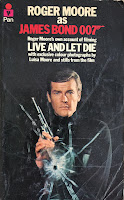
Roger Moore as James Bond

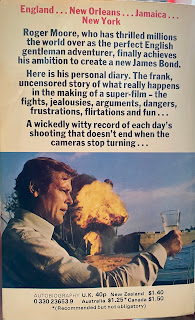
"The frank, uncensored story of what really happens in the making of a super-film," promises the back-cover blurb on Roger Moore as James Bond (aka Roger Moore's James Bond Diary). The star takes us through his 84 shooting days on his first Bond film, Live and Let Die, from Sunday 8 October 1972 when he leaves England for New Orleans to being told, if the rushes turn out okay, that he is done. 

On 14 October - Day 2 of shooting - Moore turned 45, the age I am now. There's a lot here about his aches and pains, his need of dental work, the various therapies employed and it's odd to think of myself, old and broken as I am, in better fettle than  Bond. There's also his anxieties and homesickness, and all the business that goes alongside making the movie itself.

"Daily more of the mechanics behind the mystique that is Bond become clear. The actual shooting, the rapport between my countenance and the camera, forms only a fraction of a field of operations which is a constant source of surprise." (Day 10, p. 27.)

The extra-curricular work includes endless press interviews, Moore is increasingly impatient when asked the same question each time: how will his Bond be different from Sean Connery's? There are endless photoshoots, appearances, charity galas, bits and pieces. Then there's the pop concert he goes to, where its announced to the audience that the new Bond is in their midst - and no one seems to care. He's self-effacing about this, and often very funny.

Yet Moore's wife Luisa is annoyed by how much this all encroaches into time he could spend with his children. Then there's the awkwardness of his various love scenes: how Luisa treats him on the days he's got sex on the schedule, the etiquette of what you say to the other actor during and after this stuff. It's Moore's diary, his version of events, but I often found myself wondering how it was for them

There's lots, too, that is amazing to see in an official, licensed release. In that sense, the book reminds me of Alan Arnold's absolutely extraordinary Once Upon a Galaxy: A Journal of the Making of The Empire Strikes Back which I now want to read again. Moore is candid about other actors fluffing their lines, mucking up shots or weeping. He cites various mistakes made by producer Harry Saltzman (such as, on page 32, making the wrong call on what the weather would be like, and so losing a day's shooting). There's stuff about Moore's children, such as his son needing an enema for trapped wind, that is personal, embarrassing and hardly relevant to the making of the film. But Moore seems to delight in this kind of thing: the gulf between movie fantasy and prosaic reality.

I wonder how much the cast and crew really enjoyed his constant pranking, which sometimes seems a bit cruel. I'm surprised, too, how little the other producer, Cubby Broccoli, features. Is that because he wasn't on set, or because he kept out of Moore's way, or because Moore had nothing funny or scathing to say about him, or because he knew better than to do so? Again, that's what make this so intriguing: Moore is sometimes brutally candid but we're not getting the whole story.

As early as day 5 we're told of plans afoot for the next Bond film, The Man With the Golden Gun, to begin shooting 18 months later in August 1974, and we really feel the weight and power of the Bond machine. But there's little on how much of a risk this all was, Moore the second attempt to keep the franchise going with a new leading man after George Lazenby had not turned out as hoped.

"The build-up of publicity and advertising for the film is fascinating. I was asking Harry [Saltzman] about the sort of money the Bonds have made in the past and he told me the biggest grosser was Thunderball which has done 64 million dollars to date. Diamonds are Forever, the last before Live and Let Die, had already grossed 48 million and it is only on its first time round [the cinemas]. OHMSS was the lowest and even that grossed 25 million dollars. I just hope ours will be as successful." (Day 52, p. 132.)

There's little sense he felt under pressure, I think because he could see the script and production were all good. But I wonder how Saltzman and Broccoli were feeling, especially given other tensions in the air. This is a film tapping into something of its moment. For example, early on, Moore was horrified to hear Saltzman shouting the N-word on set.

"He was not trying to start a race riot but simply calling to our English props man [by the] nickname he has answered to since the days of silent cinema. I pointed out that it might be better to to find him another name here in the racial hotbed of Louisiana so we have settled on 'Chalky'. As Bond, I make love to Rose Carver, played by beautiful black actress, Gloria Hendry, and Luisa has learned from certain Louisiana ladies that if there is a scene like that they won't go to see the picture. I personally don't give a damn and it makes me all the more determined to  play the scene." (Day 11, p. 31.)

There was more on this the following day: 

"Paul [Rabiger, supervising make-up] agrees with Guy [Hamilton, director], Tom Mankiewicz [writer] and myself that it would have been more interesting if Solitaire, our present leading lady, had been black as she was in Tom's original screen play, but United Artists would not stand for it." (Day 12, p. 33.)

A few days later, Moore reports on an argument on set, the black stunt team having objected to scenes being shot with white stunt performers blacked up (Day 17, p. 44). Two days after this, yet another photocall was the cause of further disagreement when Yaphet Kotto - the actor playing the villainous Mr Big - raised his fist in a black power salute.

"Whether he was serious or not I don't know but the sequel was a scorching row. [Publicity director] Derek Coyte pointed out that the pictures would rouse resentment from the rabid whites and could be seen as an endorsement of black power by militant blacks. We are making anything but a political picture but Derek said the photographs syndicated far and wide would involve us in a controversy which could do nothing but harm. Yaphet was incensed. At midday he and the black stunt men lunched together and during the afternoon Derek Coyte was ostracised by blacks who had previously been pally." (Day 19, p. 50.)

The next day, the black stuntmen were airing their grievances on local TV (p. 51). And these tensions were not confined to Louisiana. Returning to the UK, Moore shares a letter sent to him by a woman from North Wales, outraged by the sight of him pictured with Gloria Hendry as seen in the Daily Express (Day 54, p. 136).

Moore is unapologetic. It strikes me that George Lazenby had seen Bond as reactionary, but there's something here of Bond as progressive, just as they've tried to push things in the recent Daniel Craig films. Hardly perfect, but attempting to steer the juggernaut. 

I think there's something in that, too, when Moore first hears the theme tune for the film. In Goldfinger, Bond mocks the Beatles. Now a Beatle has written his title song, and Moore's response is telling:

"It is a tremendous piece of music and I will stick my neck out and say that three weeks from its release it will be number one in the charts. It's not last year's music, it's not even this year's music, it's next year's." (Day 66, p. 154.)

Back cover of the book Roger Moore as James Bond, with blurb and photo of Moore drinking white port in front of an explosion

Thursday, December 09, 2021

James Bond in the Lancet

The new issue of medical journal Lancet Psychiatry includes my essay, "Was it obvious to everyone else that I'd fallen for a lie?" on James Bond, and also Len Deighton and John le Carre. I wrote it before I'd seen No Time To Die.

You need to be signed up to read the whole thing, but the teaser first paragraph goes like this:

"When actor Sean Connery died in October, 2020, media coverage focused on his success as the secret agent James Bond. The franchise is still going strong, with Bond now played by Daniel Craig and No Time To Die, the latest film, now in cinemas. That enduring appeal is partly due to the movies consciously keeping up with the times and reflecting contemporary trends. Yet Connery's Bond films are still screened on prime-time TV in the UK; remarkable, given that the first of them, Dr No, is nearly 60 years old and invidiously features White actors made up to look Asian. The best of Connery's Bond films, Goldfinger (1964), was even back in cinemas at the end of 2020. They are exciting movies, and sexy and fun, but their persistence is down to something more profound. The world of espionage portrayed by mid-20th century writers was deeply concerned with scientific and political issues concerning individuality, identity, and the human mind..."

Simon Guerrier, "Was it obvious to everyone else that I'd fallen for a lie?", Lancet Psychiatry vol 8, issue 12, pp 1040-1 (1 December 2021)

Monday, October 04, 2021

Big Sky, by Kate Atkinson

I've been gadding about this week, braving the petrol crisis to venture to Cambridge and Liverpool, accompanied on the road by Jason Isaacs reading Big Sky - the fifth and, to date, final Jackson Brodie novel. Isaacs is perfect for this: he played Brodie in the TV series and - unlike readers of previous books in the series - knows how to pronounce words such as "Niamh". He's also good at making various characters distinct, which is important in a novel that depends on the interlinking relationships of a whole crowd of different, well drawn people.

In the years since Started Early, Took My Dog, time has moved on and yet little has changed for Jackson Brodie. He's still a private investigator, still haunted by the murder of his sister which compels his efforts to find and save other missing women. And yet his caseload is all sweating small stuff: following a married man and his girlfriend on dates; doing background research on some people; running round after his ex and their now-teenage son.

Lots of it involves people we've met before: that ex, Julia, is from the first book and she's been a constant presence. There's the return of Reggie Chase from book three, now working in the police but denying that's down to Jackson. We call back to events and people from previous adventures, because part of the thing is that Jackson lives in the past, but also trauma lasts for a lifetime. In addition, there's a more meta textual thing going on. Julia plays a pathologist in a TV series about a police detective, and at one point a cast member asking Jackson's advice for a scene. Then there's Jackson's continued reference to his own "little grey cells", linking him to Poirot (just as, a few sentences before introducing us to Poirot, Agatha Christie mentioned Sherlock Holmes). It's Jackson, and this whole endeavour, as part of a continuum, of death as entertainment.

To be honest, death takes quite a time to put in an appearance. Nothing much happens for a good few hours of the audiobook - we trail after Jackson and other characters going about their various lives, some of which intersect. But there are hints of something darker under the surface and as we pick over details, Jackson's instincts are shown to be absolutely, horribly right. There are a lot of women in danger...

I found the first half of the book mostly fun if a little too on the nose - anyone in favour of Brexit is crass and a bit (or a lot) racist, and there's lots of Jackson being grumpy about modern life. A running gag is that we get a character's train of thought and then someone else telling them to get a move on or to focus on matters at hand, as if the characters are sniping at their author's flights of fancy. As I said of the previous novel, this kind of thing can all feel a bit self-indulgent. But I think it's works better in this case, not least because this groundwork binds us to the various characters before the plot kicks into gear and things get  properly thrilling and tense.

What follows is often brutal - children in danger, some horrible deaths, and a seemingly endemic violence against women and girls. Atkinson has lots to say on the subject, but woven through the novel and from various perspectives so it never feels like a lecture. It is harrowing and compelling.

That makes it sound like an angry novel, and it is in places. Yet it's also often funny, and the over-riding emotion is melancholy - for lives lost and blighted, for the harm done by callousness and greed, for the long shadow it all casts over everything.

In that, and in its thrilling tension and it feeling like it had something to say, it chimed with No Time To Die, which I went to see on Saturday and really liked - but want to see again before committing my little grey cells.