Showing posts with label science. Show all posts

Wednesday, December 03, 2025

The Disappearing Future, edited by George Hay

“A thirteen-course brain banquet” boasts the back cover of this 160-page anthology from 1970, comprising six short stories and seven essays — four of the latter republished from elsewhere. 

It is, promises the cover, a “symposium of speculation.” That’s in line with editor George Hay’s firmly held view of the valae of science-fiction as a kind of blueprint for tomorrow — or, as the Science Fiction Encyclopaedia puts it, 

“that sf provides an armamentarium of mostly technological tools for coping with the future, and that a – or even the – main role of sf was to educate us for that future”.

This was the basis on which Hay helped to establish the Science Fiction Foundation, originally at North East London Polytechnic, and the journal Foundation. (The Encyclopaedia says that this was in 1972, but on 10 June 1971 Hay sent a letter on SFF-headed paper to Barry Letts, producer of Doctor Who…)

A second blurb on the inside first page here suggests that this is exactly what the book will contain: “versions of the future we are now storing up for ourselves” sourced from “practising scientists and well-known sf authors”. Hay — I’m sure he wrote this, for all he refers to himself in the third person — goes on that,

“we have recently begun to to criminally destroy our ancient life-giving relationship with external nature … The Disappearing Future insists that Mother Earth is urgently giving us, her children, the red alert, and that we have very little time left in which to take even evasion action. The decision is ours.” (p. 1)

That sense of urgency, that sense of the whole Earth as environment and as nurturing mother, is surely an example of the impact of the “Earthrise” photograph taken in December 1968 by the crew of Apollo 8, seeing the world as a whole, single organism, as explored in Robert Poole’s book Earthrise. So it’s odd that, having brought up Mother Earth and imminent environmental catastrophe on p. 1 of this anthology, pretty much nothing further is said on the subject.

In his foreword, Hay tells us that the theme on which he submissions was, “the future, as the writer saw it, as derived from present events and trends”. He wanted a mixture of fiction and non-fiction to allow ideas to be explored in detail without holding up the action (or requiring clunky exposition). But he also says that this book is a response to the “paucity” of so many other tired and cliched anthologies of SF, not least in the shadow of the Moon landing,

Now that space has finally cracked open, now that we know we can make it” (p. 9)

If not the whole-Earth environment, then, the promise is of a practical, useful ideas about what happens next, how we prepare for and embrace the future. Something to build on and with — or, if you will, a foundation…

But what follows is nothing of the sort. 

The anthology opens with “The First Forecast of the Future” by Professor IF Clarke, Head of the Department of English Studies at the University of Strathclyde — and, er, not a scientist. It’s a short history of predictions, mostly focused on the anonymously written The Reign of George VII, 1900-1925 (1763), with references to Ini by Julian von Voss (1810) and the work of Jane Webb (he doesn’t mention the title but he means The Mummy! A Tale of the Twenty-Second Century (1827)).

Well, yes all right, it’s not really about what the future might hold, but gives us some context for how long we’ve been thinking this way. Fine.

Next up is “The Show Must Go On” by David I Masson, in which a character called Piitasan — his name taken, I think, from the marxist Karl Peterson — wanders through urban streets full of squalor and violence. He shares his views on the economics of labour as he steps over a “meths drinker”, ignores a rape in progress, refers to “spastics” and “mongols” and things then don’t end well for him. There’s some sort of analogy in this nasty mess, something a bit Clockwork Orange but not as fedt or insightful. It just left me feeling grubby.

Ophthalmologist and media boffin Kit Pedler’s “Deux Ex Machina?” was apparently first published in the Listener. It’s a bit dry and technical, positing some ideas about the future of robots, or “biological mimics” / “biomims” as he calls them, because why use the perfectly good and understood “android”? He doesn’t use “Cyberman” either; his biography mentions his work on Doomwatch with “Jerry” Davis, but not that they met on Doctor Who

Then we get “Political Science — Mark II” by John W Campbell, which Hay’s foreword suggests has been published elsewhere but doesn’t say where. This is more editorial than essay. Campbell starts by laying out his own scientific credentials:

“I have over the east few years brought up the subject of psi, and the facts of dowsing, and protested that scientists refused to apply the scientific method of open-minded experiments — and have been lectured by many kindly people on the subject of how little I understood” (p. 32). 

Yes, the “facts” of dowsing. But this is just the preliminary to his main point, which is to object to the vote taken by members of the National Academy of Sciences, decided 200 to 10, against making “scientific studies of genetic differences of intelligence among racial groups” (p. 33). Campbell thinks people voted out of fear of embarrassing results — which suggests he already felt he knew what those results would be. As with psi and dowsing, he seems to see the value of science as validating what he thinks or would like to be true. And it’s not really about the future at all.

The Thorns of Barevi” by Anne McCaffrey is the sole contribution from a woman. It is told from the perspective of Cristen Bjornsen, a young woman from Denver who was abducted by alien Catteni and spent some time as a slave on the planet Barevi. In the nine months she has been there, it has been warm like summer on Earth, but the story begins with her worried that this will change as she only has the one outfit.

“Her sleeveless, single piece tunic was made of an indestructible material but it would not be very warm in cold weather. The scooped neckline was indecently low and the skirt ended mid-way on her long thighs.” (p. 35)

She then eats a red-coloured pear, with,

“its succulent juices dribbling down her chin on to her tanned breasts” (p. 36)

This is especially odd as the story is told in the third person from Cristen’s own perspective; this is how she sees herself.

Then she meets an alien Catteni who is humanoid, and “almost good looking” as he has an aristocratic nose and not the “thick, blubbery lips” of others of his kind. “She’d heard rumours…” she begins to tell us while admiring this handsome specimen, but we’re not told what part of his anatomy she has heard rumours about (p. 38). It’s not exactly subtle in the racial coding.

They run away from some other Catteni, taking refuge in a “flitter”. The handsome alien then says he hasn’t had a Terran before and, as if out of curiosity, rapes her — Cristen attempting but failing to resist his advances. 

“Her struggles only seemed to aid his efforts and just as she was certain she would be split apart, a surging emotion far more powerful and overwhelming replaced fear and pain” (p. 43).

Afterwards, they talk a bit and then, on more friendly terms, have sex again. End of story. I’m not really sure what this has to say about the future; I don’t really want to think what it says about the author.

Next up is “Sleep, Dreams and Computers" by Dr Christopher Evans, originally published in the Sunday Times Colour Magazine. He dismisses three theories about why we dream — to rest, to enter some realm of the fantastic, to be free of societal pressures and rules (the reason dreams are of use in psychoanalysis). Then he puts his own theory, based on a computer going offline from the exterior world to back up and sort data. It’s a compelling idea but not really about what the future holds.

Christopher Priest’s short story “Double Consummation” is based on a fun reversal where, in the Britain of the future, the social norm is not to have lasting or monogamous relationships. A man who works in politics is surprised to be dumped by one of his girlfriends, then finds out his other girlfriend has not taken her pills, is now pregnant and wants to get married — which he fears will end his career. It’s neatly set up and the ending works well, but it’s yet another story about sex without consent (in this case, concerning contraception). 

“The Temple Scientists” by Edward J Mishan — LSE staff member and author of The Cost of Economic Growth — muses on the differences between SF and FS, the latter his term for “future society” stories. I didn’t feel there was much of an argument here, really, more technicality than thesis. But it’s the only contribution, apart from George Hay’s foreword, to address other contributions: Pedler’s essay is “stimulating and thoughtful (and occasionally cynical)”, Masson’s short story “barely qualifies as SF” and Chapdelaln’s — which we’ve not got to yet! — is “perhaps too clever”.

“The Sunset Perspective” by Michael Moorcock is another outing for his achingly trendy / sexy time agent Jerry Cornelius, a character introduced in 1965 novel The Final Programme. Here Jerry struts around in “brown velvet bellbottoms” (p. 79) and “black car coat” (p. 80), while tackling an incursion in time that makes people revert to old, superstitious ways. For example, at one point he finds Miss Brunner — also from that first novel — busy burying a goat.

“He watched as she mumbled to herself, hitching her Biba miniskirt up to her thighs and urinating on the new mound of each” (p. 81)

I do not claim to be an expert on the logistics of miniskirts, but wouldn’t it already be around her thighs? Jerry then tries to help this victim of the time incursion in a manner thematically consist with other stories in this collection:

“He flung himself on top of Miss Brunner and began to molest her” (p. 87)

The story, set in the future, is peppered with headlines and fragments of news from the New York Times of 16 October 1969 and the November 1969 edition of Flying Review International, which I think was meant to convey a connection between the then-now and the future. Some 55 years later, it does not have quite the same effect, but gives an indication of exactly when this was written.

“Future Recall” by James Blish is an essay that largely refutes Hay’s whole thesis that science-fiction can and does prepare us for the future. I liked this a lot: it is engagingly argued and full of top facts — that the term “gas giant” is Blish’s own coinage (p. 102). Blish, whose novels I have long enjoyed, is full of shrewd insight. For example, he speaks of a vogue for mysticism in science at the time he was writing.

“When astronomers only a few years ago discovered the strange celestial objects called pulsars, the first explanation they suggested and published was that they might be navigation beacons for an interstellar civilisation. Had pulsars been discovered in 1935, a scientist here and there might have hoped that that was what they’d turn out to be (they didn’t), but he’d never dare to say so aloud.” (p. 103)

This is followed by “Someday You’ll Be Rich!” by Perry A Chapdelaine, about a PhD cyberneurologist who tries various different schemes to make money, and comes up with a means of rapidly churning out long strings of text using up every combination of keys on a typewriter, so that he can claim copyright on all stories as yet to be written. It’s a bit over-cooked and over-long, but striking to read now in the age of interminable techbro lifehacks and AI.

In “About Five Thousand One Hundred and Seventy Five Words” by Samuel R Delaney, originally published in Extrapolation (ed. Thomas D Clareson), the author presents a brilliant, original view of science-fiction based on the way meaning emerges incrementally as we read each word at a time. Every new word conditions what has come before, he says. If we’re introduced to a science-fiction object or idea — a thing that we know is invented — that shapes our sense of everything else in the story, even if it is part of our recognised world. It’s a really compelling idea, engagingly argued and great fun; that perfect mix of clever and funny and boggling. Hay admits in his foreword that it is “somewhat off-course” from the remit of the book; I rather wish more of the book was like this one.

Finally, “Welcome to Wesbloc/Wesbloc” by Anthony Haden-Guest is a report by the teaching machine Merlin:Merlin in the future city of Ecumenopolis, the gag largely being that many things in the future are named after things from the past — one computer called Orwell, another Lenny Bruce. But it ends with the teaching machine looking backward to “now”, so we get more contemporary headlines and fragments of real news, at the time a connection to the present, but in retrospect a weird snapshot of a historical moment. 

All in all, it’s a very odd collection that doesn’t really deliver on what Hay says in his blurb and foreword that he set out to do. It’s too open, too lacking in discipline, and far too often too nasty. Nerds, get over yourselves. 

Yet it has provided a blueprint for the future. Samuel R Delaney’s piece has got me thinking hard about the way meaning is constructed by the precise deployment of words. That has already changed the way I am reading Doctor Who and the Planet of the Daleks. I think it will shape how I read and how I write from now.

Friday, July 04, 2025

Learning to Think, by Tracy King

Covering of Learning to Think by Tracy King, showing photo of small, smiling girlI’ve been blown away by this extraordinary, powerfully moving book, having met the author briefly at an event earlier this year. The subtitle says it’s “A memoir about” and then there are a series of crossed-out words: hardship, education, hellfire and family before it settles for “a way to break free.”

The blurb tells us more:

“Tracy King grew up on an ordinary council estate outside Birmingham. Her home life was filled with creativity, curiosity and love, but it was also marked by her father’s alcoholism and her mother’s agoraphobia.

“By the time she turned twelve her father had been killed, her sister taken into care and her mother ensnared by the promises of born-again Christianity.”

Roughly the first half of the book covers the author’s childhood and this series of traumas as she felt and understood them at the time. She’s very good on telling detail about people and place, so we know these individuals, we like them. We share their joys and small victories, we root for them, and feel their suffering and loss as awful things unfold. We are appalled by what happens in the trial of the people involved in killing her father.

In the second half of the book, we see the effect his death and these other things then have over the following years. It all casts an oppressive shadow but something else is also going on: the combined impacts of a love of reading and an interest in computers (both instilled by her late father), the opportunities offered by libraries and college, and then a rewarding job. At a key moment, she stumbles on a second-hand copy of The Demon-Haunted World by the astronomer Carl Sagan and it lights something inside her: a way of seeing and tackling the world that I think Sagan would call science but Tracy calls critical thinking.  

Then, in the last, enthralling part of the book, Tracy applies critical thinking to that key trauma in her past life: the death of her beloved father. She reads the police report and dares to seek out and interview people involved, including the man who killed him. The result is suspenseful, brave, compassionate — and quite brilliant. 

There’s no single, definitive account of what happened that night — not, as she says, without CCTV or her having being there herself — but she sifts the sometimes conflicting evidence and collates the most probable version. This is more than a coldly logical process; it’s driven by empathy and understanding. I’m reminded of something I was once told at school, that “courage” literally means “of the heart”.

Much of what she describes here — not just about her father but other things such as the way education authorities treated her and her sister — is gruelling, often shocking. Yet the book is about her coming to terms with this stuff and the sense at the end is that the process brings her some peace.

At one point, she probes accounts of her father’s last moments, and whether he died instantly or not. She’s haunted by the suggestion of people there watching and doing nothing to help.

“There was nothing anyone could have done to save his life, Does it matter that a dead person was left alone for ten minutes? Is there dignity after death? Without a soul, a spirit, a ghost, does it matter whether anyone was with him while he lay on the cold concrete in the rain?

Of course it matters.

We can bear witness to his death now, through thee pages. Every reader is there with him. We outnumber the bystanders.” (p. 280).

What a privilege it has been to stand with her, to be part of that congregation.

In the epilogue, she links her past experience to the situation now, with school “refusal” (a term she critiques), increasing levels of poverty, and the closure of libraries and other kinds of support and opportunities that were so crucial to her. For all this is a memoir, it’s a book about how we move forward from where we are now. I urge you to read it.

Friday, June 20, 2025

Ocean: Earth's Last Wilderness, by David Attenborough and Colin Butfield

This was a bigger hit with my teenage son than Other Minds by Peter Godfrey-Smith, which I think he found a bit too abstract too often. But I found bits of this harder to grapple with because so much of it is about wondrous things we cannot see - a series of visually arresting examples to explain the state of the ocean and what we're doing it, good and bad. We've not yet watched the accompanying film and I suspect, as with other books-of-TV-shows, that this one works best as an aide-memoire to what the reader has already seen.

It's largely directed at the huge harm done by industrialised fishing, especially bottom trawling, which is so destructive and wasteful - the damage visible from space. I suspect some of the visuals will be harrowing.

Attenborough makes good use of his years of experience, stepping forward as a witness of human-inflicted harm to the planet: he has seen the changes and effects he describes, and can compare the images he captured decades ago so shed light on where things are now. That then continues in the case studies, talking to people with long experience of particular places, who can tell us what it was like to scuba dive there or what local industry used to be like. That's important; at one point the book talks about the problem of people accepting the state of things now as normal rather than wrong.

What really sticks in my head is the evidence, from several different cases around the world, that the ocean can recover - at some speed - if given the chance. There are some extraordinary examples recounted. I was especially wowed by the success of the Sussex Kelp Recovery Project, off the coast of Selsey and Shoreham where I spent holidays in my childhood. It's so vividly described, I could see myself barefoot on those beaches littered with kelp from a storm, and then diving in the depths to see the replenished riches of the underwater world.

Whereas Earthrise was pessimistic, this compelling story is full of hope.

Thursday, January 02, 2025

Doctor Who Magazine #612

The new issue of the official Doctor Who Magazine is officially out today (though, via SIDRAT capsule, some subscriber copies arrived last week / last year). 

The cover shows the Second Doctor playing his recorder which also doubled in several stories as a telescope. I mentioned this recently to a mate who thought I must have gone mad but you can see a good example at 13:57 into The War Games in Colour - watch carefully, and you see the Doctor replace the top after use.


This has also prompted me to post my 2019 interview with Frazer Hines about the costumes he wore as Jamie McCrimmon, companion to the Second Doctor.

On pages 36-39 of the new DWM, there's my latest "Script to Screen" feature, this time on Babystation Beta - the space station seen in 2024 episode Space Babies. It's a companion piece to the coverage of that episode I wrote for issue #604 in May. In this case, I spoke to art director Jon Horsham and VFX supervisor Jim Parsons, as well as director Julie Anne Robinson.

Also this issue, my former script editor Jacqueline Rayner says some nice things about my 2011 audio Doctor Who story The Cold Equations. If that's of interest, in 2021, I was a guest on the Gallifrey's Most Wanted podcast talking about this story and the trilogy it was part of.

Friday, October 25, 2024

The Intelligent Woman’s Guide to Atomic Radiation, by Margot Bennett

“Informed public opinion is infectious, even to governments.” (p. 149)
Thursday, 30 July 1964 saw publication of two paperback “Penguin Specials” from Penguin Books both looking at the same subject. At four shillings, Nuclear Disaster by Tom Stonier,
“was based on his 1961 report to the New York Academy of Sciences which dealt with the biological and environmental effects of dropping a 20-megaton bomb on Manhattan”. Geoffrey Goodman, “Obituary — Tom Stonier”, Guardian, 28 June 1999.
Alongside this, at a slightly cheaper three shillings and sixpence, Margot Bennett’s The Intelligent Woman’s Guide to Atomic Radiation is, according to the back-cover blurb, a “first reader in the most uncomfortable subject in the world”. 

The title is surely a riff on The Intelligent Woman’s Guide to Socialism and Capitalism by George Bernard Shaw, first published by Constable & Co in 1928 and republished in 1937 as an inexpensive two-volume paperback — the first Pelican Book — under the revised title The Intelligent Woman's Guide to Socialism, Capitalism, Sovietism & Fascism

Of course, that was timely given the ongoing civil war between Republicans and Fascists in Spain, and the growing power of the Nazis in Germany. I’d be surprised if Margot Bennett wasn’t aware of the book, given that in 1937 she was in Spain. It was the year that Margot Mitchell (sometimes known as Margot Miller) married English journalist Richard Bennett while both were working for the Government — that is, Republican — radio station. Bennett, who also worked as a nurse, had been machine-gunned in the legs the previous year and at the time of her engagement had recently broken her arm when the ambulance she was in crashed under shellfire.

There’s nothing very militant in her book on atomic radiation, written 27 years later. “Politics is not the concern of this book,” she tells us in her introduction (p. 10). The focus is instead on the cause and effects fallout,
“addressed more to women than to men [because] the mother is far more intimately concerned with the health of the family than the father. It is the mother who sees that the children have green vegetables and milk, and who nurses then when they have measles.” (p. 11)
This still holds, she says, even if the mother has a career; a woman with no family, “still has a tenderness to children that is different in quality from the feelings of a man.”

It’s not exactly the most feminist stance but this is a politically active woman writing in the mid-1960s for a small-C conservative readership, the emphasis on presenting just the facts rather than on what we should think. The book concludes on a broad political note:
“Science affects us all; so far, overwhelmingly to our advantage. If there are times when we feel this is not so, as members of a democracy we have some kind of duty to find out what is happening.” (p. 154)
But there’s no sense of a particular party or ideology being favoured. We’re left to make up our own minds.

The domestic perspective — the way radiation affects milk and green vegetables, and our children — might imply this is rather lightweight or condescending to the ordinary housewife. Nothing could be further from the truth. Indeed one contemporary review thought it was, 
“little more than another text book, and heavy going at that.” (Robin Turner, “Nuclear penguins and others”, Birmingham Post, 8 August 1964, p. 5.)
A more generous review found it,
“Thought provoking … easily read but thorough” (John Berrie, “Woman’s angle”, Nottingham Evening Post and News, 7 August 1964, p. 10.)
It’s certainly thorough, covering the ground in detail in just 154 pages (not including appendices, glossary and index). After the introduction, the first three chapters give us a grounding in the physics involved in atomic radiation — “Inside the Atom”, “Neutrons and Nuclear Energy" and “Fission, Fusion, and Fallout”. We then switch to biology for “The Message in Our Cells”.

Chapter 5, “The Subtle Enemy”, then applies the physics to the biology to explain the damage atomic radiation can do to us and to future generations. The next chapter, “The Influential Friend”, puts a counter case, outlining all the beneficial ways atomic radiation can be applied. “Pollution and Protection” addresses what can be done to mitigate potential fallout. Bennett then provides a conclusion, making the case that even statistically “negligible” numbers of people wounded or killed would still be tragic for those concerned.

A lot of this is very technical. Promotion for the book at the time said that Bennett wrote in “plain English” (for example, “For Your Bookshelf”, Halifax Daily Courier and Guardian, 31 July 1964, p. 4). Even so, I found it quite hard going and made slow progress. 

Two things really bring it alive. First, Bennett peppers her book with vivid real-world examples of the way radiation can affect people’s lives. Hauntingly, she details the stages of radiation sickness suffered by early pioneers, from skin rashes and hair loss through anaemia, sterility and useless, deformed fingers to the fatal cancers (pp. 96-97). Or there’s the awful story of the Radium Girls (pp. 100-101). 

I’d be interested to know more about the Russian scientist who claimed to be able to cure the effects of radiation on DNA via a simple pill (p. 114), or about the Scottish boy discovered playing in a “pile of radioactive dust” and the factory making luminous dials that proved so radioactive that the Radiological Protection Service had the whole site buried (both stories p. 146). Frustratingly, there are no notes or bibliography to guide us to more information.

Secondly, throughout the book Bennett uses relatable, often domestic analogies to explain the complex ideas. She likens electrical charges — the way positive and negative attract one another but two positives or two negatives repel — to attraction between people, where a talker will fall for a listener (p. 17). She describes atoms of different elements as being like different breeds of dog (p. 22). Compounds and molecules are likened to marriages (p. 24).

Sometimes those analogies show how far we have come. On page 83, she refers to the cumulative effect of exposure to radiation over “the long days of our lives — 20,000 days if we live to be about sixty”, which doesn’t seem very long at all. (Bennett lived to 68).

But on the whole the effect is to make a complex, technical subject more tangible. The central, political idea here is the responsibility to be better informed: nuclear weapons are devastatingly powerful, but knowledge is also power — one to hold the arms race at bay.

*

Obligatory Doctor Who bit

Since the book was published at the end of July 1964, Bennett must have delivered the manuscript no later than, I’d guess, the end of May. Given the technical detail, it can’t have been a quick book to write. As well as the time taken to research it, a note just ahead of the introduction tells us that, 
“Everything factual has been checked by scientists whose knowledge is far more than equal to the task” (p. 7).
We’re not told who these scientists were or what the editorial process involved, but writing and editing surely took some months, which means work on the book overlapped with Bennett’s conversation(s) with BBC story editor David Whitaker about potentially writing for Doctor Who. As detailed in my post on Bennett’s novel The Furious Masters, that seems to have happened in late February 1964. She was being considered to write a story comprising four 25-minute episodes as a potential replacement for what became Planet of Giants — but nothing further is known about what her story might have entailed, or whether she even submitted an idea.

I partly read this book in the faint hope of finding some clue as to what she might have discussed with or submitted to Whitaker. The short biography of Bennett on the opening page is suggestive:
“She likes variety in writing and is now doing something in Science Fiction,” (p. 1) 
That “something” may have been The Furious Masters, published four years later. Or Bennett may have completed work on her study of atomic radiation and then turned to Doctor Who, only to discover that she was now too late and Planet of Giants was going ahead after all…

Then there’s one of the allusions she uses. At the end of her introduction, Bennett says that there’s no point wishing that the atom had never been cracked open.
“Man can’t afford to retreat; it is by discovery and invention, from fire and flint axe onwards, that he has survived. The axe is dangerously sharp, and the fire has grown as hot as the sun.” (p. 13)
Unlike most of the analogies she uses, this isn’t contemporary or domestic — it’s making a link between modern technology and the ancient past. 

The first ever Doctor Who story, broadcast 23 November to 14 December 1963, involves a tribe of cave people where authority is dependent on the ability to make fire (I think this owes a debt to The Inheritors by William Golding). “Fire will kill us all in the end,” opines the Old Mother of the tribe.

In the next story, we see something of this prophecy come to pass when the TARDIS materialises in a petrified forest that Barbara initially thinks is the result of a “forest fire”. It turns out that the devastation is the result of a neutron bomb, leaving the ground and atmosphere “polluted with a very high level of fallout”. Beings called Daleks are among the survivors.

I’m not the first to suggest that the Doctor Who production team deliberately juxtaposed the role of fire in the prehistoric tribe and the role of nuclear weapons on this futuristic world as part of a wider ambition to have the time travellers witness key moments of societal change. And it’s exactly the same connection made by Margot Bennett.

Did she and David Whitaker discuss it? And who exactly informed whom?

Friday, October 18, 2024

Rubáiyát of Omar Khayyám

Title page of "Rubáiyát of Omar Khayyám, Rendered into English Verse by EDWARD FITZGERALD, With an Introduction by Monica Redlich, THOMAS NELSON & SONS LTD, London Edinburgh Paris Melbourne Toronto and New York"
LXXI

The Moving Finger writes; and, having writ,

Moves on: nor all thy Piety nor Wit

Shall lure it back to cancel half a line,

Nor all they Tears wash out a Word of it. (p. 92)

Or, to put it another way, you can’t rewrite history — not one line.

In 1859, a reclusive, privately wealthy scholar called Edward Fitzgerald anonymously published 250 copies of a pamphlet containing his translation in English of 75 four-line rhyming poems, a form known as “rubāʿī”, attributed to a Persian poet, Omar Khayyám, in the 11th century. No one paid much attention to this pamphlet until, in 1861, the lawyer and literary scholar Whitley Stokes happened across a stack of copies at a bookstall near Leicester Square, where the original price of five shillings had been reduced to a penny. 

Having bought one, Stokes showed it to his friends, including the poets Algernon Charles Swinburne and Dante Gabriel Rossetti, who duly bought their own copies. Swinburne’s account of what then happened (apparently from p. 188, vol 6, of The Swinburne Letters) is quoted in my copy of the Rubáiyát:

“Next day we thought we might get some more for presents among our friends, but the man at the stall asked twopence! Rossetti expostulated with him in terms of such humorously indignant remonstrance as none but he could ever have commanded. We took a few, and left him. In a week or two, if I am not much mistaken, the remaining copies were sold at a guinea.” (p. x)

Word gradually caught on. Fitzgerald produced an expanded, second edition containing 110 of the four-line poems in 1868, and further revised editions, each of 101 of these quatrains, in 1872, 1879 and 1889 — the latter published after Fitzgerald’s death.

By the end of the 19th century, “more than two millions copies have been sold [of the Rubaiyat] in over two hundred editions” (according to a facsimile of the first edition published c. 1900). It became “one of the most admired works of Victorian literature” and “in the first half of the 20th century was arguably the most influential [long poem] in the English language”, according to Melvyn Bragg, introducing a 2014 episode of In Our Time on The Rubaiyat of Omar Khayyam

Photo of pale, blue weathered book, no title visible
Hector Hugh Munro adopted the pen-name “Saki” after the cup-bearer in the Rubaiyat. Various dining clubs were established in honour of Khayyam: writers JM Barrie, Arthur Conan-Doyle, Thomas Hardy and AE Housman were all members of one. Housman’s friend, the mathematician John Edensor Littlewood bought a slim, pocket-sized volume containing both the first and forth editions as a present for my great aunt on her 11th birthday in 1938, which is the copy I’ve just read.

In 1961, David Whitaker drew from this book when he wrote the BBC children’s serial Garry Halliday and the Secret of Omar Khayyam, broadcast at Saturday teatimes over seven weeks in early 1962. I’ll dig into that more when I write up my notes for the corresponding entry in my Garry Halliday episode guide. But for now, it’s enough to recognise that this little book was still resonant a hundred years after Whitley Stokes first discovered it on that bookstall. 

But why was this slim book of poems such a massive hit in the late 19th and early 20th century? 

It’s effectively a day in the life; the opening rubāʿī describes the start of new day in the early part of the year, the dawn sun touching the Sultan’s Turret in an unnamed Persian town, a cock crowing and — in subsequent quatrains — a group of people waiting eagerly for the tavern to open. The poet wanders this town, enjoying a cup of wine and musing on the nature of existence. 

XLVII

And if the Wine you drink, the Lip you press,

End in the Nothing all Things end in—Yes—

Then fancy while Thou art, Thou art but what

Thou shalt be—Nothing—Thou shalt not be less.

(First edition, p. 56)


XXIV

Ah, make the most of what ye may spend,

Before we too into the Dust descend;

Dust into Dust, and under Dust to lie

Sans Wine, sans Song, sans Singer, and—sans End!

(Fourth edition, p, 76)

There was, at the time Fitzgerald published his first edition, a long-standing interest in Persian culture and the wider Orient, not least because of British imperial interests across the east and into India. The Persian language was used by the East India Company in provincial governments and courts until the 1830s. Sir William Jones’s various translations and his A grammar of the Persian language (1771) influenced the generations that followed. For example, the Jones translation of the 8th century Mu’allaqat inspired Alfred Tennyson to write his Locksley Hall (1835). Tennyson was, in turn, a friend of Edward Fitzgerald.

That context is useful but doesn’t explain the particular appeal of the Rubaiyat. What made this text stand out?

Note that in the two quatrains quoted above there’s no mention of an afterlife. The In Our Time episode on the Rubaiyat and Sadeq Saba in his 2010 documentary The Genius of Omar Khayyam explore this issue of godlessness. Fitzgerald published his first edition in 1859, the same year that Charles Darwin published On the Origin of Species, at a time when there was already much interest in “long time” — ancient, geological history stretching back millions and billions of years, far further than accounted for by a literal reading of the Bible. These ideas were controversial. On In Our Time, the suggestion is made that Fitzgerald couldn’t have published a work of his own (supposed) agnostic, perhaps even atheistic, musings without inviting scandal; Khayyam enabled him to do so at a safe remove. Readers could also engage in such ideas without breaking from the Church.

I can see, too, that there’s an appeal in the world conjured here: a rich culture different from that of the late Victorians, and seemingly more free. The In Our Time episode talks about the wider allure of Orientalism to the late Victorians, notably in the sensuous hedonism of the harem. I don’t think there’s much licentiousness in the Rubaiyat, beyond the idea that the poet says to drink and enjoy wine while we can. But there’s an allure in any different, rich culture in which we can escape and be immersed — like the appeal of Middle Earth or sci-fi or Regency novels. Once entranced, there’s always more to steep yourself in: the history and rules, the minutiae, the power politics in wrangling among other true believers. (The same might be true of the football terrace, too.)

There are often good reasons why someone actively seeks such escape. In Our Time cites Fitzgerald’s close friendship with Professor Edward Byles Cowell; the first edition is in part a translation of the Persian quatrains Cowell found while in Calcutta and sent to Fitzgerald, their correspondence apparently suggestive of how keenly the two men felt their separation. We can read something into this, just as readers of the Rubaiyat could read their own hopes and desires into the tantalising world it conjured. It’s a frame in which things are possible that would not be dared outside.

But maybe the appeal isn’t nearly so immersive. This kind of “enjoy life while you can” stuff is not a world away from “live, laugh love”. That such aphorisms here derive from some ancient, eastern scholar confers authenticity and value to what a cynic might otherwise see as greetings-card wisdom. And there’s also something haunting in this voice from what’s now almost a thousand years ago exhorting us to enjoy our existence and to live while we can.

In fact, we’re not sure Omar Khayyam really said the things attributed to him. It’s not just that many of the surviving quatrains in Persian give no indication of author, but Fitzgerald took a very free hand in translating the texts he had to hand, reordering and rewording them, grafting in bits that sound like the Book of Common Prayer (compare the last quatrain I quoted to the famous “dust to dust...”) and Shakespeare. That might not resonate so much with us now as it did with late Victorian readers. Moulded in their own language, no wonder they felt that this text out of the long past spoke to them so directly.

The real Omar Khayyam — full name Ghiyāth al-Dīn Abū al-Fatḥ ʿUmar ibn Ibrāhīm Nīsābūrī — is no less fascinating than this mythic version. 

“Better known for his poetry, it often surprises many to learn that Omar Khayyam (1048-1131) was one of the greatest of all medieval mathematicians,” says Jim Al-Khalili in his book Pathfinders — The Golden Age of Arabic Science (2010). He cites Khayyam’s work on cubic equations in Treatise on Demonstration of Problems of Algebra, including “both algebraic and geometric methods for solving them systematically and elegantly, using the method of conical sections (which involves slicing through a cone at different angles to produce different types of curves such as circles, ellipses, parabolas and hyperbolas)” (p. 122).

I’m familiar with conic sections being used to make sense or orbits, whether those of celestial bodies or the rockets and craft trying to reach them, and wonder how much of Khayyam survives in the mechanics of the space age.

Khayyam was also part of a team that, with cutting-edge technology such as the astrolabe, calculated the length of the year with much greater accuracy than the contemporary Gregorian model; indeed, the Jalali calendar devised by Khayyam and his colleagues was still in use into the 20th century. In addition, Al-Khalili quotes a long passage from one of Khayyam’s other surviving works, more reliably attributed to him than his poetry, extolling the virtues of seeking the truth — and acknowledging that people will mock you for doing so. It’s quoted at length because it expresses a sentiment that Al-Khalili recognises now, the voice of the exasperated scientist ringing down to us through the ages.

Handwritten note in ink in the inside page of a book: "Ann from Uncle John 12.7.38"
I can see why this little book of poetry, written by an influential mathematician, would have appealed to JE Littlewood, and why he chose it as a gift for an 11 year-old. It bears a simple, four-word inscription, “Ann, from Uncle John”, and the date. But what he was giving her was a guide to life, and a frame in which unconventional ideas and conversations are possible. And that was important because, as the inscription shows, he’d not yet admitted what was known within the family: that Ann was his daughter.

But perhaps I’m just the latest in a long line to read into this little book what I want to see. 

Thursday, October 03, 2024

Doctor Who and the Time-Travelling Almanac, by me


It seems like only a week since my last book was out. But today sees publication of Doctor Who - The Time-Travelling Almanac, billed as the official guide to the Doctor's year. It is written by me and illustrated by brilliant Emma Price.

What is an almanac anyway? Why do we have August? How do the histories of the Beatles and the Doctor overlap?

Where exactly did the Doctor mean to take Romana instead of that beach at the start of The Leisure Hive? What are the tides on Kastarion 3 like?

All this and Dalek horoscopes, banana penguins, the best time of day for Sea Devils to invade and much more... 

HARDBACK
ISBN: 9781785949173
Length: 256 pages
Dimensions: 224mm x 23mm x 143mm
Weight: 355g
Price: £16.99

PAPERBACK
ISBN: 9781473533943
Length: 256 pages
Price: £8.99

Monday, September 16, 2024

The Voice of the Dolphins, by Leo Szilard

Prompted by Richard Flanagan's Question 7, I sought out this "science-fiction" anthology by the Hungarian physicist Leo Szilard (1898-1964). He's an extraordinary figure, the man who conceived and patented the idea of the nuclear chain reaction, inspired by The World Set Free by HG Wells (in which Wells coined the term "atomic bomb"). In 2015, I made a documentary about this, HG and the H-Bomb, where we spoke to Liza Jardine about her memories of "Leo", a good friend of her father's. But I didn't know that Szilard himself wrote sci-fi.

It's a short, quirky collection, comprising the following:

pp. 7-12 "Nightmare for Future Reference" (1938) by American poet Stephen Vincent Benét (1898-1943), from the Selected Works of Stephen Vincent Benét

  • Some time in the future, the unknown narrator addresses an 18 year-old who was one of the last to be born before, during the Third World War, the birth rate collapsed. 
pp. 13-68 "The Voice of the Dolphins" (1960)
  • Written sometime after 1998 (p. 35), an account of the years 1960-85 and the way intelligent dolphins helped end the nuclear stalemate (for more on which, see below).
pp. 69-79 "My Trial as a War Criminal" (1947), reprinted from The University of Chicago Law Review, vol. 17, no. 1, Autumn 1949.
  • During the Third World War, a virus kills American children and the country surrenders to Russia, whereupon Szilard, Henry L Stimson, President Truman and James F Byrnes are put on trial for their roles in the Manhattan Project.
pp. 81-94 "The Mark Gable Foundation" (1948)
  • In 1960, the narrator is put in suspended animation and woken in 2050, where no one has teeth and women choose to impregnate themselves with the seed of a small number of celebrities. The narrator is now such a celebrity.
pp. 95-100 "Calling All Stars" (1949)
  • A radio message from the planet Cybernetica warns of odd readings detected in the atmosphere of the planet Earth, from which the cybernetic people deduce biological inhabitants, evolution and nuclear war - and warn others to be wary.
pp. 101-107 "Report of 'Grand Central Terminal'" (1948), reprinted from The University of Chicago Magazine, June 1952.
  • A report by aliens on their exploration of the extinct planet Earth, and their deductions about the life forms that once lived here based on aspects of Grand Central Station, such as the coin-operated toilets.
pp. 108-111 "Kathy and the Bear" (no date)
  • The author relates two meals with four year-old Kathy and her mother at a hotel, and the child's conversations with a bear skin hanging there.
pp. 112-126 "The Mined Cities" (no date), reprinted from Bulletin of the American Scientists, December 1961 - vol. XVII, No. 10.
  • A conversation between "A" and "B" in 1980, looking back on a convoluted system to avoid nuclear annihilation by having Americans mine a Russia city and be ready to blow it up (and themselves), and vice versa.
The title story seems to have been prompted by real-life John C Lilly claiming, in the year the story was written, that "dolphins might have a language of their own" (p. 15). We learn from Szilard that one of the few recommendations of the President's Science Advisory Committee to bear fruit is "a major joint Russian-American research project having no relevance to the national defense, or to any politically controversial issues" (p. 14). Instead, the Biological Research Institute in Vienna, established in 1963, focused on dolphin intelligence.

The institute quickly established that dolphins are highly intelligent. We learn, from a book published in 1998, that,
"the dolphins, who grasped mathematics, chemistry, physics and biology with ease, found it difficult to comprehend America's social and political system" (p. 35)
With the dolphins' help, the Vienna Institute develops a cheap food that has the side-effect of lowering birth rates and so solves the problem of over-population. From the licence paid on this best-selling food stuff, the institute has the financial backing to reshape the world. We follow the various, complex schemes and politics. Then, with the nuclear threat averted, questions are raised as to whether the dolphins really were intelligent - implying that the American and Russian scientists between them have duped and saved us all.

Within this fun wheeze, Szilard tells a sprawling future history, predicting the revolution in Iran if not the exact date, and poking fun at various subjects, often with the eye of an outsider. With its new-earned wealth,
"The first major investment made by the Vienna Institute was the purchase of television stations in a number of cities all over the world. Thereafter, the television programs of these stations carried no advertising. Since they no longer had to aim their programs at the largest possible audience, there was no longer any need for them to cater to the taste of morons." (p. 18)
I wonder if he had advert-free BBC Television in mind as the saviour of humanity. There are jibes on the way the two-party system in America favours minority rule since a few per cent of voters with some strongly held view on a particular issue can determine which of two candidates wins (p. 33). On the same page, he cites "Szilard's diary, recently published by Simon and Schuster" - that is, some 40 years after this was written - to show he was right all along about allowing China to join the United Nations.

There's something similar when an extended footnote details the way in which an article by Szilard in the February 1960 issue of the Bulletin of the Atomic Scientists was initially misunderstood.
"After his death, Szilard appears to have received some recognition, however, from his Russian colleagues, who names a small crater after him - on the back side of the moon." (p. 28)
Even the way he refers to the far side is a joke. In fact, there is a Szilard crater, named in 1970 and on the near side of the moon.

The playful and mischievous tone continues through much of what follows. In "My Trial as a War Criminal", the Russians develop a virus that predominately kills children. This was never to be used, and only kept in case of emergency. A later, more advanced virus was intended for use in war.
"It would not affect children at all and would kill predominately men between twenty and forty. Owing to the premature outbreak of the war, however, the Russian government found itself forced to use the stocks which it had on hand." (pp. 69-70)

This is grim humour from a man so closely associated with the development of nuclear weapons he then failed to contain, and well understood the bureaucracy involved in unleashing weapons of mass destruction. There's a similar caustic wit as he considers the option of a new life in Russia, having already lived in Hungary, Germany, England and the US. 

"When you are above fifty you are no longer as quick at learning languages. How many years would it take me to get a sufficient command of Russian to be able to turn a phrase and to be slightly malicious without being outright offensive?" (p. 71)

The twist at the end of the tale is that Szilard and his fellows escape the inevitable guilty verdict when the Russians fall victim to their own virus. That's a consistent idea in this book. These weapons are not something we use on other people; whoever unleashes them, we all lose.

The last story, set in 1980, was first published in The Bulletin of the American Scientists in 1961, and includes "B" asking "A" who first thought up the convoluted idea of "mined cities".

"B: Szilard had proposed it in an article published in The Bulletin of the American Scientists in 1961, but the idea may not have been original with him. His proposal was presented in the form of fiction and it was not taken seriously." (p. 120)

The argument then follows, and repeats almost word for word, some of what was covered in "The Voice of the Dolphins" - which Szilard then acknowledges, but says is a complete coincidence.

"A: I read The Voice of the Dolphins when I was ill in the hospital; I remember that it contained many rather crazy prediction, but what they were, I do not recall." (p. 126) 

It's a daft book full of complicated, intricate ways to prevent nuclear annihilation - none of them madder than the real predicament facing the world. I've read and heard a lot about Szilard and his rather odd perspective and humour - he was, says Richard Flanagan, one of the Hungarian scientists known as "the Martians" because they were so odd.

The blurb for this book refers to his "wry sense of humour and a heartfelt fear for the future of mankind". More than anything, there's a playfulness here, following any daft idea to its logical end. But what did Einstein, or President Truman, make of this strange fellow and his extended flights of fancy. I suspect he was exhausting.

Thursday, March 07, 2024

Uncivilised, by Subhadra Das

“The museum is a powerful and extraordinarily malleable cultural sorting house. [Museums] are places for demonstrating that the West is best, regardless of what the West has actually been up to. For example, when we hear the story of how Napoleon’s troops in Egypt at the turn of the nineteenth century resorted to using dynamite to blow up a large, basalt statute of Rameses II, we needn’t worry in the way we do about the Taliban [destroying the Bamiyan Buddhas]. Even if they did blow up the Egyptian sculptures, Napoleon’s motive was to get them into the French national collection. They would be safe there.” (p. 188).

Subtitled “Ten lies that made the West”, this insightful and often funny book is full of historical details that challenge all kinds of presumptions. The ancient Athenians, for example, wouldn’t recognise our political system as democracy. Their whole system was about governing themselves; we elect other people, usually from the elite, to do so on our behalf.

Or there’s what Magna Carta did — or rather didn’t — do to fundamental rights here and abroad. I’d never even heard of the contemporaneous Charter of the Forest, which now seems a far more radical document, providing rights for ordinary people to land and resources; some of its provisions were still in force until 1971.

Over the course of 10 chapters, Subhadra unpicks a series of assumptions about the “civilised” and the “savage”, such as the superiority of the written word over the spoken, or the roots of political frameworks or psychological insights. In doing so, she shows how art, science and history are bound up in and blinded by a constructed, self-aggrandising narrative. 

Subhadra addresses numerous elisions from the historical record that serve to feed this false story. Repeatedly, women and non-white people and cultures have been left out of the story. I was fascinated to learn that Abraham Maslow’s work on the hierarchy of needs and on self-actualisation, which I studied as part of my training to be an adoptive parent, owes a great deal to his time among the Siksiká people in Northern Alberta — now the Northern Blackfoot Confederacy. Maslow later said he’d been inspired by news of the Japanese attack on Pearl Harbour; Subhadra uses Maslow’s own work and accounts from women who knew him to set the record straight.

I should declare an interest in that I know Subhadra and get a credit in the acknowledgements (I had to check with her what for). The Dr is also cited as a source at one point. Some of what’s covered here I’d already heard, having seen Subhadra’s stand-up comedy act and heard her Boring Talk for the BBC on Jeremy Bentham’s “Auto-Icon”.

But there’s a great deal here that was completely new to me — a richer, stranger more diverse history than the one I thought I knew. What a delightful way to discover the myriad ways in which I’m wrong.

Monday, December 18, 2023

Connections with James Burke

I've really enjoyed this new six-part series on Curiosity Steam, with my hero James Burke returning to the subject of the unexpected history of change. There are two big differences between this and the 1978 series Connections that Burke made for the BBC, which I blogged about a decade ago. (Since then, it's been released on DVD by Simply Media in 2017 and is, er, currently all on YouTube).

First, that original series had - like lots of the BBC's science documentaries then and now - a lot of Burke out in the field, striding through picturesque locations to illustrate his thesis. Here, things are on a smaller, less expensive scale with the older Burke on a virtual set, his arguments illustrated by what looks like stock footage and bits of CGI swirling around him. At some points they use CGI to animate him - he even dances (!) - and there are also some props, such as when he dons the Macktinosh waterproof coat he's telling us about. But the effect of all this is to underline that these are basically lectures. It's all more TED talk than Brian Cox out on a mountain pointing at stars.

Nowhere is this more starkly evident than in Episode 5, where Burke discusses the usefulness of the vacuum flask. He makes his case then turns and points behind him, as in the screenshot above. We get a CGI animation of a rocket blasting off - a fun gag and call-back. In the original, out on location and perfectly timed to the launch of the Titan-Centaur rocket carrying Voyager 2 in space, it creates an iconic bit of TV:

(Burke's old programmes are full of extraordinary, ballsy stuff like this. He explains gravity while sat on a roller-coaster, and hands the Apollo astronauts a plastic bag they all recognise and asks them to explain how this was used as a toilet in space.)

Secondly, each episode in the new Connections begins with a change that hasn't happened yet: a prediction of the near future. The old BBC series used connections to explain how we got to be where we are; this new series is about where we're going.

To give a sense of the format, Episode 1, Seeing the Future, begins with Burke talking about the potential of quantum computing to crunch such vast sets of data that it will be able to predict the future to a high degree of accuracy. We then duck back in time to 1814 and the Emperor Napoleon Bonaparte's toothpick. Animation in a style slightly reminiscent of Monty Python shows Napoleon escaping from Elba.

An example of the animation from
Connections with James Burke

The fun is in seeing how Burke will get from this toothpick to quantum computing in a series of logical steps. Those steps are often surprising because of unintended consequences of a given change or new invention. Sometimes it's a less direct connection. For example, Napoleon's toothpick was supplied by George Bullock, and Bullock's brother William didn't just ship stuff out from the UK but also brought stuff home, organising exhibitions of exotic stuff in "living museums". To ship such stuff from far-off locales, Nathaniel Bagshaw Ward perfected the "Wardian case", which meant plants survived long journeys. That, in turn, meant Robert Fortune could smuggle tea plants out of China and help set-up tea plantations in India, with a profound impact on trade.

We're then on to the ships used to carry these good quickly - the clippers using sail and then the iron ships powered by steam. Then we're onto the same ships carrying palm oil, and it's use in soap, and the way that was packaged and branded... On and on it goes, a hop-scotch through time, with regular recaps of the connections so far.

Episode 2, The End of Scarcity, predicts the universal replicator by following the chain from Louis XIV's wig.

Episode 3, In the Net, predicts humans merging with the internet and Episode 4, None of This is Real, predicts avatars that are indistinguishable from humans, with AI as the gatekeeper to knowledge - the latter reached by following a chain from shipworm.

Episode 5, Designer Genes, gets to the titular editing of who we are from coffee beans in Leipzig, and the final episode, Limitless Energy, predicts energy autonomy based on perovskite solar cells leading to a post-scarcity society with no need for climate change or war - all from the starting point of a potato.

Burke is an engaging and often funny speaker, with just the right tone of irreverence for these leaps of imagination. For example:

"In 1852, one of [William Bird] Herapath's students notices, as you would, that if you add iodine to dog's urine, if the dog has already been fed quinine - okay, okay, but this is what geeks do - then you get needle like crystals." (None of This is Real)

These crystals polarise glass, leading to the invention of both polarised glasses and the polaroid camera.

But there's plenty of serious stuff behind these arguments. A key theme is the way science can open up opportunities and provide benefits for all. In discussing the steps that lead to designer genes, he notes that two brilliant women responsible for key connections along the way, both died while young. Given that the end point is about improving health, he asks what Ada Lovelace and Rosalind Franklin might have gone on to contribute if they'd lived longer.

That, I think, is another key difference from the original series, which I felt assumed a male viewer, Burke speaking to his peers. This is all much more inclusive and I don't think Burke is now talking to his own generation. Instead, he addresses those who will follow, encouraging them to take part in the bright future he sees ahead. That's what really strikes me about this series: it's optimism for where we go next. 

See also:

Thursday, November 24, 2022

Countdown to the Moon #771

This afternoon, I had a long chat with Nathan Price on his Countdown to the Moon project, discussing Artemis, the TV coverage of Apollo and then all sorts of other stuff. I've had lots of this kind of thing rumbling through my head for a while, so enjoy my attempts to put it into some kind order...

The things I held up at the beginning are:

The Moon - A celebration of our celestial neighbour (ed. Melanie Vandenbrouck, 2019), which accompanied the National Maritime Museum's exhibition The Moon

Doctor Who: Wicked Sisters (2020), in which Dr Who meets early lunar colonists all making the "great leap" in giving up their Earth citizenship. Oh, and some Sontarans.

Wednesday, June 22, 2022

CERN: Science Fiction and the Future of Detection and Imaging

I've had the most amazing few days in Geneva as a guest of Ideas Square at CERN. It's the first time I've been out of the UK in three years, and I was jangly with nerves for a good week before setting off; I'll be jangly with excitement about it all for some time to come.

During lockdown, my friend Dr Una McCormack roped me into some online sessions where sci-fi writers (hello!) were brought in to help / hinder the work being done by students from round the world in attempting to imagine the future impact of technology. This week, a bunch of us assembled in person, got a tour of the Large Hadron Collider and other CERN bits and bobs, and had lots of really interesting chat about, well, everything really. There was high-end physics, and high-end gossip, and high-end physics gossip.

I've returned home with pages and pages of notes in my notebook - bits of new ideas, lists of things to read or look into, random bits of detail. For example, one thing that boggled my brain was that work on constructing the CMS detector (one of a number of detection instruments located round the Large Hadron Collider) was delayed by the discovery of Roman ruins on site which then had to be painstakingly excavated. I'm taken by the Nigel Kneale-ish thought of ancient ghosts being picked up by the sensitive detectors...

Then there was the fact that when building this underground facility the team had to dig through a subterranean river. To do so, they dug down to the level of the river, then froze it and dug through the ice, constructing a concrete-lined shaft through the middle before letting the ice thaw. Ingenious!

And how extraordinary, how liberating, to discover that in visiting the CMS we had crossed the border into France without a moment's thought, let alone all that mucky business with passports. Coming home, there weren't enough ground crew to let us off the plane so we sat stewing for 45 minutes. There must be a better way of doing things, I thought. Which was exactly the sort of thing these few days have been about.

Here are a few pictures...

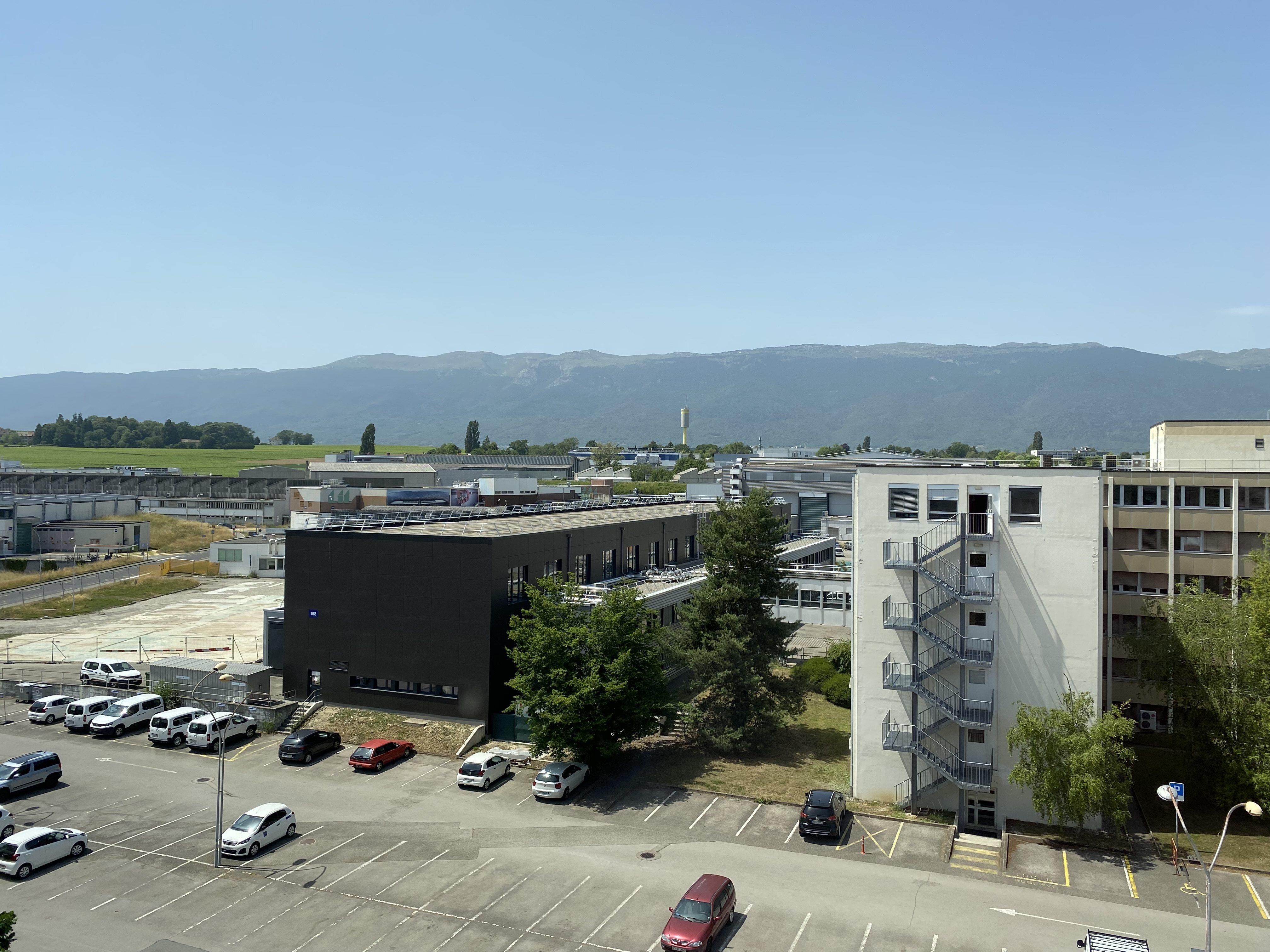
View of mountains from CERN hostel

Geneva tram, for my father-in-law

More mountains, plus v hot writer

Tour of the CMS facility;
photo of detector like a gothic rose window

Going underground

Warning signs to give one pause

The LHC creates a magnetic field;
look at its effect on these paperclips!

Doctor U and her plucky assistant

New hat / cool museum

Hot, hot evening, and yet snow on the mountains

Marie Curie clearly delighted to meet me

Very heavy lead,
so dense it would shatter to dust if dropped
Arty reconstruction of CMS, using mirrors
 (cf Maxtible in The Evil of the Daleks)

Old-skool, pretty wiring in old device

Where the web,
and so much of my life, began

Cool retro tech in a garden

More cool, retro tech

The Champions
(ie me, Una McCormack and Matthew De Abaitua)