Showing posts with label dr. Show all posts

Tuesday, December 30, 2025

Doctor Who and the Pyramids of Mars, by Terrance Dicks

The four-part Doctor Who story Pyramids of Mars was originally broadcast in October and November 1975. It was then repeated, in a one-hour omnibus version, on Saturday, 27 November 1976, where it was watched by 13.7 million people — the largest audience ever achieved by Doctor Who to that point. 

(Since then, just five episodes have beaten that record, all in autumn 1979 when ITV was affected by industrial action.)

The novelisation was published simultaneously in paperback and hardback three weeks later on 16 December, so the repeat would have been fresh in the minds of readers who received this book for Christmas. They would have been conscious of quite how much Terrance added to the version on TV — much more than in his previous novelisations. I’ll dig into what he adds and why presently.

The cover is, I think, one of the best by Chris Achilleos. The focus is the monster — or robot Mummy — standing impassively upright, its legs breaking out of the lower edge of the frame. The closest reference photograph I’ve been able to find crops the lower half of the Mummy, so Achilleos may have worked from a separate photograph to provide more of the body.

Photo care of the Black Archive

ETA, Paul MC Smith sourced this, care of the tragicalhistorytour.com:

The Mummy is flanked by portraits of the Doctor and Sarah Jane Smith, their expressions suggesting a deadly serious book.

The slightly stippled portrait of the Doctor is similar in composition to Achilleos’ previous illustrations of this incarnation, the hat on his head with brim angled upwards to the right, one loop of scarf under his chin. But the glowering countenance is unlike the beaming, even laughing, versions we’ve seen before. Whereas in the reference photograph the Doctor is staring away into space, here he glowers at the Mummy.

Photo care of the Black Archive

Sarah also looks in towards the Mummy, but points her rifle over its shoulder, pointing away to something out of frame. 

Photo care of the Black Archive

She is slightly angled compared to the reference photograph; this, the rifle and overlap all add dynamism to the whole, so the cover is at once serious and exciting. A white oblong arranged vertically behind these three characters helps connect them — separate photographs made into one entwined image, a cruciform with the vertical Mummy. 

But without that oblong, I think there’s a triangular structure to the arrangement of the three characters, fitting for a story about pyramids. Was that the original plan, and then Achilleos thought it looked wrong within the wider rectangular frame? If so, did he add the oblong to square the whole thing off?

The sepia tinge suggests an old-fashioned photograph and helps to convey a story set in the past (in 1911). The radiating orange background is suggestive of the heat of Egypt, or perhaps the landscape of Mars, though at best the connection is subtle. The bright, white heart of this energy is slightly off centre, to the right of the Mummy’s head, again creating a more dynamic, three-dimensional effect. The title and border are deep purple, adding to the sombre tone. 

Inside the book, there’s the usual list of titles “Also available in the Target series”, which for the first time includes Doctor Who and the Giant Robot, published 18 months previously. As discussed before, I think the late addition of that book to the schedule meant it got missed from these lists. But here it is at last, alongside The Making of Doctor Who, which was published the same day as this novelisation. 

A third book by Terrance also published on this day, The Doctor Who Dinosaur Book, isn’t listed. I think this and some other things suggest that the book was a late commission, written after this novelisation. I shall dig into that in a subsequent post.

By now, there were so many Doctor Who titles from Target that some were left out to fit the list on one page. I wonder how decisions were made as to what to omit. Among those missing are Doctor Who and the Planet of the Spiders by Terrance, and Doctor Who and the Doomsday Weapon and Doctor Who and the Dinosaur Invasion both by Malcolm Hulke, who I’m sure would have taken the omission gracefully.

Then we get into the book itself. As usual for Terrance, the novel comprises 12 chapters but here there are also a prologue and epilogue, both of them additions to what is seen on TV. The prologue draws from a single line of dialogue in Part Two:

DOCTOR WHO:

He destroyed his own planet, Phaester Osiris, and left a trail of havoc across half the galaxy. Horus and the rest of the Osirans must have finally cornered him on Earth. 

From this, we get three pages of epic legend, the kind of big mythic stuff more commonly seen in and around 21st century Doctor Who. As we get into Chapter 1, Terrance continues to embellish what we see on screen.

Marcus Scarman, for example, wears a suit and public school tie despite the heat in Egypt. This, we’re told, is because,

“The year was 1911, and Englishmen abroad were expected to maintain certain standards.” (p. 10)

In fact, stage directions in the camera script for Part One tell us Scarman wears a “Wykehamist tie” — that is, in the brown, navy and red of Winchester College. But Terrance makes it a point of character and context, and refers to the tie again on p. 45, where it help us to recognise Professor Scarman when he reappears in the story. 

In the TV version, Scarman is the first person for millennia to enter a particular “blind pyramid” somewhere in the region of the real-life Saqqara. Indeed, Part One begins with stock footage of the distinctively shaped stepped pyramid there, which my late friend John J Johnston identified in his comprehensive article on the story:

“Establishing shots of the Fifth Dynasty pyramids of Abusir and archaeological excavations at Saqqara … hailing from the documentary The Catacombs of Sakkara, first transmitted under BBC2’s Chronicle strand on 11 April 1970, which focused on the work at this most ancient of sites by W B Emery, then Edwards Professor of Egyptian Archaeology and Philology at University College London.” John J Johnston, “Excavating a Television Classic: Pyramids of Mars (1975)”, Mummy Stories 

In the book, it’s a “Black Pyramid” (p. 10) and in “Sekkara” (p. 57), the spelling as per the camera script — where the smaller typeface suggests that the place name was a late addition, perhaps after the production team had secured the stock footage.

We learn from Terrance of the “long years” Scarman has spent tracking down clues to the location of this hidden pyramid, “many” fellow archaeologists having scoffed at him. We’re also told how Scarman bribed his local guide Ahmad,

“whose love of gold had finally overcome his fear” (p. 10).

This, we’re then told, is Ahmad’s,

“fear that he was blaspheming the ancient gods of his people” (p. 11).

There’s some local colour, with “half-naked Egyptian labourers squatted patiently by the tethered camels” (p. 10), a pen portrait akin to the stock footage to establish setting. I don’t think this is any worse than, say, in The Daemons (1971), when the stock archetypes of an English village know the pagan legends related to the local barrow and are variously frightened or scornful.

We get a bit more detail in Chapter 2, where Terrance provides a potted history of another Egyptian, Ibrahim Namin, “High Priest of the Cult of the Black Pyramid” (p. 19). Namin has served the cult his whole life, the latest in a line of ancestors in the same role, stretching back millennia. Having heard of Scarman’s expedition to the Black Pyramid, Namin and his fellow priests descend on the site and kill Ahmad and all the labourers — a detail not shared on screen.

At this point, Namin and his cult are loyal to the other “Great Ones” and keen to keep Sutekh securely imprisoned in the pyramid for all time. They know the consequences of failure:

“In the Secret Writings of his cult it was laid down that the Pyramid must never be broken into or the most terrible disaster would overwhelm the world” (p. 20).

It is only on entering the desecrated pyramid that Namin is taken over by Sutekh, who softly explains that there has been a misunderstanding and promises that Namin and his priests will be “exalted” for loyal service — to Sutekh. Terrance tells this from Namin’s perspective, where this all seems very reasonable. He therefore switches sides.

We then learn how Namin has loyally followed Sutekh’s instructions, packing up artefacts from the pyramid and shipping them in crates first to Cairo and then England. He also posed as Scarman’s servant to obtain the professor’s luggage from a hotel in Cairo.

This extra detail makes for an unusually long chapter for a novelisation by Terrance, comprising 15 pages. With the lore-filled prologue, there’s a lot of added material in this first section of the book. We don’t reach the moment that marks the end of Part One on TV until p. 44 — more than a third of the way through the book. Based on his previous novelisations, it’s unusual for Terrance to embellish what happened on screen to such an extent. Why did he feel the need here?

Well, Terrance addressed this very issue when he was the guest of the newly formed Doctor Who Appreciation Society at an event held on 29 April 1976 — when he was surely still writing this book:

“Mr Dicks explained that in books more explanations are necessary and any loose ends, which would pass by on television, must be tied up for the printed page. He quoted the forthcoming adaptation of Pyramids of Mars — which he himself is penning — as an example. In it the whole [backstory] about the character of the Egyptian Namin and his relevance to the plot will be explained. Explanations are taboo for television drama.” (JJ Bentham, “Terrance Dicks report — part one”, TARDIS vol. 1 no. 8 (July 1976), p. 17.)

Pyramids of Mars is a great, atmospheric story on TV, propelled by forward momentum. It works on visuals and feel. But in adapting it for the page, Terrance found — I think more than with most other Doctor Who stories — that its shortcomings in logic were rather exposed.

Why, when people have got into his prison in Egypt, does Sutekh send them and a whole load of artefacts back to England? It’s not explained on screen or in the book. 

(I can suggest an explanation: Sutekh needs them to set up various technical means to free him, but doesn’t want to do that in Egypt where local people know his name; better to do it well out of sight, and he’s just possessed a man who owns a private estate where such operations can be carried out in secret.)

Why does Sutekh appear in the TARDIS at the beginning of the story, not least given that — according to the Doctor — “nothing can enter” the ship? Is Sutekh even aware he has done so, given he doesn’t speak of it later? 

(A few people have been in touch to suggest this is the TARDIS overlapping with Sutekh trapped in the Vortex at the end of the story. That would make a neat bootstrap paradox but is, I think, complicated by the trip to 1980 midway through the story; it is a closed loop then, then it isn’t, then it is. Yes, we can marry up that idea of trapped Sutekh invading the TARDIS with his return to the series in 2024, but my focus here is on what Terrance did and didn’t address in his novelisation.)

Why do both the Doctor and Sarah Jane don outfits suitable for 1911 before they know that’s where they’re headed? Even the on-screen explanation makes little sense: Sarah is wearing an Edwardian dress but the Doctor says it belonged to his companion Victoria, who was from 1866. It looks great — and the Doctor’s first ever frock coat became a signature look for this and later Doctors. But the logic is at fault.

Ibrahmin Namin, kneeling, in front of the servant of Sutekh, in his black "burnished globe" helmet and rubber fetish gear
Something similar is going on when Sutekh sends the possessed Marcus Scarman to the house in England and he arrives as a “black-robed figure” with a “shining globe” for a head (p. 43); a “burnished globe” in the script. On screen, I think the idea was to up the stakes at the end Part One by having the nominal villain, Ibrahim Namin, killed off by an even worse, alien monster. It wouldn’t be quite so scary, or linger in the minds of viewers for a week, if this were Marcus Scarman from the off. On the page, without the cliffhanger, it is odd.

Then there are the remarkable coincidences all through the story. Why do events take place on the site of the future UNIT HQ — last seen in Robot almost two years previously? Or there’s Laurence Scarman having conveniently “invented the radio telescope forty years early” (p. 39). In fact, it’s more like 20 years early, with Karl Guthe Janke’s array dating from 1932. (Presumably, out of shot behind Laurence’s cottage, there’s a large set up of dipoles and other technical gubbins for this contraption to work.)

How convenient that the Osirans broadcast a warning in a cipher of English, enabling the Doctor to translate it by assuming that the most commonly occurring letter is “E” (p. 41). (It’s the most commonly occurring letter in other languages, too, such as French, German, Italian and Spanish, too, but “A” is more common in Icelandic, Polish, Portuguese and Turkish. In Finnish, the most frequently occurring letters are “A”, “I”, “N” and “T” and then “E”. My point is that no thought has been given to the Osirans writing in, say, Egyptian hieratic or demotic, let alone hieroglyphs. The logistics of translation are very different to decoding a cipher. 

The production team seem to have been aware of some of the contrivances here, as we can see from the Doctor’s response to a convenient hiding place in the Scarman house:

Again, the smaller typeface suggests a late addition, the nonsense perhaps picked up in rehearsal.

These are all issues of the TV story. The issue in a novelisation is how much to fix this stuff. The more you tinker, the more you alter the on-screen story or hold up the action — and it is then a less faithful translation of what occurred on screen. I think Terrance’s approach is the right one, adding some backstory to the beginning to give the whole thing some weight and history, and then breezing through the rest with relatively small fixes that don’t disturb the flow.

So, for example, we learn how Sarah happens to know, very conveniently, about the 740 gods listed on the walls of the tomb of Thutmose III (that is, the real-life KV34) — a relatively obscure bit of information with which I used to impress Egyptologists when the Dr worked at the Petrie Museum. Terrance tells us, twice, that Sarah knows this because she once researched Egyptology for an article in an educational magazine (p. 41 and p. 83). He also has the Doctor chuckle at this display of one-upmanship from Sarah — so it’s not just a fix, but reveals a fun side of their relationship, too.

Then there’s what Terrance does with the Doctor and Sarah being chased by slow, lumbering Mummies, which they could surely outrun. With Sarah, he simply hangs a lantern on the problem:

“Somehow it had got ahead of her” (p. 33).

With the Doctor, he increases the burden of carrying wounded Dr Warlock. On screen, Warlock is played by the relatively slight Peter Copley. Here,

“Warlock was a big heavy man, and with such a burden even the Doctor couldn’t move very fast” (p. 33).

Terrance sets this up earlier on, introducing Warlock as “a burly figure in country tweeds” who “shouldered his way” rudely into a room:

“Namin looked thoughtfully at the ruddy-faced balding figure in front of him. A typical English country gentleman, with all the unthinking arrogance of his kind.” (p. 22)

Making Warlock more physically powerful ups the tension, and makes it more difficult for the Doctor to carry him, but also Namin’s perspective of Warlock is revealing of character.

When the possessed Marcus Scarman confronts Warlock and asks him about the Doctor, Terrance adds a bit of explanation as to why Warlock doesn’t simply share what he knows with his old friend:

“I’d just been shot when I met him, so my memory’s a bit hazy” (p. 53).

Terrance is especially good at adding connections between these various characters. On screen, Warlock lives in the nearby village and “Professor Scarman is my oldest friend”. Here, Warlock is also a “good friend” to poacher Ernie Clements (p. 53), occasionally buying a rabbit or partridge from him. Ernie also lives in a cottage in the village (p. 82).

Clements’s first name isn’t used on screen but does appear in the script. Here, he’s got some pride, preferring to think of himself as a kind of unofficial gamekeeper rather than poacher (p. 49). He’s intelligent, too, working out the contours of the invisible barrier round the estate (p. 50). Like Harry Sullivan before him, he’s allowed to swear, with a single “ruddy” (p. 55).

Clements also knows “old Collins”, the servant at the house. We’re told Collins wears “the formal black clothes of an upper servant” (p. 21) — my italics — and has been in service all his life. Just before Collins is killed, we’re told he’s known Marcus Scarman since childhood (p. 26), a bit of human connection that makes us feel more of his death.

Terrance also explains Clements shooting a man in cold blood: initially feeling a “sudden surge of furious rage” at the murder he has witnessed, then,

“He was suddenly appalled by what he had done” (p. 58-59).

Our understanding of Clements adds to the effect of the poacher then being hunted — an irony Terrance doesn’t spell out but I think is implicit in the script. On screen, his predicament is played a little for laughs; here, he gets more respect.

Laurence Scarman doesn’t get these added biographical details, but doesn’t need them; he is perfectly written and played on TV. We learn a bit more about his family: his father was a big game hunter (p. 68), explaining why there are “several” guns on the property (p. 42). But Terrance makes Laurence’s death distinctly more horrible:

“With horror Laurence saw that his brother’s hands were black and charred. Their touch seemed to burn, he felt smoke rising from his jacket. ‘Marcus’, he choked, ‘your hands…’”

On screen, Laurence clearly says “Your hands” because they are hurting him; here, there’s maybe a sense that he’s concerned for his brother’s hands being in such a state. Then, on screen, we cut away while Marcus is holding Laurence’s shoulders. Terrance adds an extra gruesome touch, as Marcus,

“shifted his grip to Laurence’s throat” (p. 86).

There are several examples of this kind of addition to the horror. When Sutekh is seen in the TARDIS and the controls spark, Sarah wonders, “Was the TARDIS on fire?” (p. 16). When a Mummy traps its foot in one of Clements’s snares, it snarls (p. 49) — an odd response for a robot. Unlike on TV, there is a ferret in the cage in Clements’ hut (p. 83). Whereas events on TV take place in the daytime, night falls on p. 42. And when the Doctor enters the time-tunnel to Sutekh’s pyramid, he loses consciousness (p. 95), suggesting a more taxing, less instantaneous trip. 

When, possessed, the Doctor returns up the tunnel sitting “cross-legged like a Buddhist in meditation” (p. 103), whereas on TV he is standing, his eyes staring blindly upwards. On the next page, Terrance describes the Doctor as a “mindless puppet”, but he doesn’t go into further detail, whereas in previous novelisations he’d shown disquiet at stuff about mind control. Perhaps through over-use it had lost its horror.

The depiction of the Doctor is doing something new. The TV story begins with the Doctor brooding in the TARDIS; here, Terrance conveys this but notes how at odds it is with the Doctor’s “usually cheerful features” (p. 13). On TV, Laurence asks if his hunting rifle could be of use and the Doctor responds, “I never carry firearms.” Terrance extends that and makes it more emphatic:

“Certainly not… I never carry fire arms” (p. 41)

But he also has the Doctor ready to defend himself with a fallen branch as a club (p. 35), and has him speaking “practically” (ibid) and “impatiently” (p. 36), so he’s more brusque and potentially violent than normal. Perhaps that’s to be consistent with, as on screen, the Doctor’s cool response to the murder of Laurence Scarman. But it’s not the only odd thing. On screen, the Doctor knows about “sweaty gelignite”; here he explains how it's used in fishing (p. 83) — an odd thing for him to know. When Sarah makes a reference to the events of Death to the Daleks (1974), his response is terse:

“The Doctor was in no mood to discuss his adventures, particularly those which had taken place in other incarnations” (p. 110).

Yet there are signs that this is the same, jolly character as before. He chuckles at Sarah while searching for explosive, he calls Laurence “old chap” more than once (p. 67 and p. 69), and there’s an odd, repeated gag where, despite the crisis, he rushes off to recover his hat and scarf (p. 36 and p. 93). It’s oddly goofy behaviour, more like Terrance’s Robot than TV Pyramids of Mars.

More than anything, Terrance underlines that this is the same Doctor from previous other adventures when introducing him. First, there’s a variation on familiar words:

“Through the swirling chaos of the Space/Time Vortex, the strange continuum where Space and Time are one, there sped the incongruous shape of a square blue police box, light flashing on the top”. (p. 13)

I’d query the use of “square”, but the “swirling chaos” is interesting. On screen, the police box spins through a simple starfield. Did Terrance imagine swirling chaos would be more dramatic, or more in keeping with earlier depictions of the TARDIS in flight? Could he have meant to link this to Sutekh, god of chaos, as the TARDIS spins into his grasp?

The opening TARDIS scene on TV references UNIT, the Brigadier and Victoria, and Terrance concisely explains all this stuff, as well as what the TARDIS is (p. 14). He also includes a footnote to another of his own novelisations, Doctor Who and the Loch Ness Monster (p. 16).

Some continuity he cuts. There’s no mention of Sarah being from 1980, as on screen. At the end, the Doctor doesn’t mention having once been blamed for starting a fire in 1666. But notably, there’s a historic moment here. On p. 97, for the first time, Terrance refers in print to Gallifrey, planet of the Time Lords, giving — as per the TV story — its galactic coordinates and location in the “constellation of Kasterborous”. 

Terrance would go on to novelise all the 20th century TV stories set on Gallifrey — The Deadly Assassin (20 October 1977), The Invasion of Time (21 February 1980), Arc of Infinity (21 July 1983) and The Five Doctors (24 November 1983, and based on his own script). His later, original Doctor Who novels dig ever more into Time Lord mythology. For all he co-wrote The War Games and script edited The Three Doctors, this is where that starts, with him grappling with history and the Proper Nouns.

As on screen, Sutekh refers to the Time Lords as a “perfidious species” (p. 104) but Terrance adds a slight qualification from the Doctor:

“I come of the Time Lord race, but I renounced their society” (p. 97).

Technically, race isn’t the same thing as species; it’s a more cultural than biological distinction, and now an outmoded term. This, I think, plays into ideas later suggested in both The Deadly Assassin and The Invasion of Time, that there are many different peoples on Gallifrey, the Time Lords just one social order.

Sarah, meanwhile, is, “a slender, dark-haired girl” (p. 14) — not, as in earlier novelisations by Terrance, simply “dark”. As well as drawing on the magazine piece she wrote about Egyptology, she also recalls “childhood visits to the Science Museum” (p. 37) in London; there’s an analogy later,

“like a child on its first visit to the Science Museum” (p. 62),

as if this is a universal rite of passage. The Doctor doesn’t know how good a shot Sarah is (p. 88), but she seems highly competent, knowing to “cuddle” the rifle butt into her shoulder (p. 91) when readying her aim. She dismisses the Doctor’s mention of Madame Antoinette as “cheerful nonsense”, as if she doesn’t take his name-dropping too seriously. But there’s a touching moment, as he goes to face Sutekh, where they both acknowledge that he might not come back (p. 94).

Sadly, this is followed by the distracted, careless Sarah getting captured — explaining a detail that is missed from the TV serial, but not the most heroic moment. Likewise, when Sutekh appears in the TARDIS at the start, Sarah screams (p. 16).

Terrance describes this vision of Sutekh as “half human, half wolf or jackal” (p. 16), and later refers to,

“Sutekh’s true visage, the snarling, bestial jackal” (p. 115).

This isn’t quite right: the production team on the TV story seem to have made a point not to make Sutekh’s exposed head like that of an animal on Earth. While other Egyptian gods had heads like recognisable animals — jackal-headed Anubis, hippo-headed Tarawet, falcon-headed Horus — the strange, square-eared “Tythonian beast” of Sutekh/Set has not been matched to a real creature.

As on TV, Sutekh refers to the “main pyramid” on Mars (p. 105), suggesting a community of pyramids, plural — thus giving the story its title, even though we see only one. It’s a shame there’s no description here of what exactly is sitting up there on Mars: is it a relay station, or was it once a whole populated town?

Again, Terrance is good on small detail: he explains why the possessed Marcus thinks nothing of the police box in his house (p. 62), and when the Doctor reaches the tomb in Saqqara we’re told the tapestry is still smouldering (p. 95). But it’s odd that Terrance has the paralysed Sutekh able to turn his head and then swing back (p. 96), as if the only part of him fixed in place for eternity is his bum.

The TV scripts are peppered with rich vocabulary, but “stertorously” (p. 34) and “vitreous (p. 84) are both Terrance’s. Even so, some of the descriptions aren’t quite right. He speaks in one instance of the “machine-like persistence” of the Mummies (p. 67), which is hardly surprising given that we know they are robots. 

There’s something odd, too, when the Doctor races back to the TARDIS on Mars and Sarah has to shout “Wait for me!” and leap through the closing doors behind him (p. 117). Would he really leave her behind? On the same page, we’re told they “journey back to the Earth of nineteen eleven”. But the vital plot point of there being a distance of eight light minutes between Earth and Mars hinges on this all happening in the same relative time: the TARDIS can make the trip in an instant, so gets ahead of Sutekh. It suggests Terrance hadn’t understood the physics of the story. 

Likewise, on TV Sarah refers to “tribophysics”, the real science of friction. Terrance renders it “triobyphyics” (p. 107), which I think translates roughly as the physics of 3 and 2. Again, the suggestion is that he thought this was something invented for the TV story.

There’s some handwaving over the physics of the organ on which Namin plays in Marcus Scarman’s house, which we’re told is performed as a “kind of prayer, a tribute to his gods” (p. 16). On TV, the organ in the script means an organ in Dudley Simpson’s incidental music, giving a particular flavour to the extradiegetic sound. Here, the organ is clearly diegetic — heard by characters in the story. Sarah even hears it inside the TARDIS (p. 17), and it serves a purpose in masking the Doctor’s footsteps (p. 42). 

So is the organ used in summoning Sutekh, or making a link to the time-tunnel? Is it an ordinary organ, and particular kinds of music have this effect on the Vortex? Or has Ibrahim Namin specially built an organ with some kind of technical, physicsy qualities? Is that why he had to come to England? We are not told.

The significance of this organ is also uncertain. As usual, Terrance capitalises words of import: Mummy (p. 34), Casket (p. 65), Warhead and Phase One (both p. 89). But the room of the house with the organ in is both organ room (p. 118) and Organ room (p. 121).

Then we get to the end. As on TV, the Doctor traps Sutekh in the time tunnel, effectively weaponising time to age a god to death. A fire duly breaks out in the house, and history seems back on course. On TV, the Doctor cracks jokes and he and Sarah hurry back to the TARDIS. Here, we get a scene inside the TARDIS with Sarah mourning the loss of the people who have died and wondering if word will get out to the wider community. It’s a brilliant idea, continuing the themes of the TV story, as to whether she and the Doctor have left a footprint in history.

There’s then an epilogue, set “Later, much later” (p. 122) in which Sarah visits the offices of the local paper in the village near UNIT HQ to look up reports from the time. That qualification “much later” suggests this is not around the time of the next TV adventure, ie The Android Invasion, but some way beyond that. When this book was published, Sarah had just left the TARDIS for the last time on TV, so I imagine her dealing with her grief after being abandoned by following up on loose ends.

There are some lovely touches here. We learn Collins’s first name, Josiah, and get a sense of Sarah acknowledging what she accomplished in helping to save the world. We’re told she emerges into “summer sunshine”, so different from that fearful night back in 1911. It’s the opposite of the poem “Ozymandias”, which connects Ancient Egypt to the present day and suggests despair. Sarah gains peace and perspective.

And no doubt she looked in on her friends at UNIT. Perhaps they went for a nice meal.

*

Next time: the last of these long posts (for the time being), and the last of the three books by Terrance published on the same day in December 1976: The Doctor Who Dinosaur Book.

In the meantime, you might like my piece for the Doctor Who Figurine Collection on Sutkeh’s costume on the TV story Pyramids of Mars.  

Here’s a bit more by me on the TV story,  and an introduction I wrote for a screening. And here is the list of 236 books written by Terrance Dicks, with links to long posts on many titles.

Wednesday, July 09, 2025

My Baby Box, by Dr Debbie Challis

The Dr has made available online the full text of her memoir, My Baby Box, which deals with her (our) experience of infertility, the death of our eldest daughter and a whole loads of things besides.  

Blurb as follows:

A portrait of Queen Victoria’s baby. Statistics on the fertility of educated women. Tokens left at the Foundling Hospital. Sunken headstones in a suburban cemetery. Tiny 4,000 year-old beads. A hippo amulet. The bones of a newly born child… 

These are some of the things in My Baby Box, a memoir about my double loss. The loss after a diagnosis of infertility and the loss after the death of my unexpected baby.

It is also about my double love. The love found through adopting a child and then having a second baby who lived. It is about trying to become a mother through fertility treatment, approval from committees, getting to full-term pregnancy and giving birth safely, as well as what I have learnt about the historical context of what I went through. It is my account of trying to become a mother in early twenty-first century Britain and how I came to understand what happened to me through the things belonging to those who had been there before me, whether in Victorian Wigan or Ancient Egypt.

I've previously posted here about infertility and the loss of Emily

Sunday, March 23, 2025

Alex Andreou's Podyssey podcast

The Dr is one of the expert "muses" featured in Alex Andreou's new Podyssey podcast series.

Each episode begins with Alex retelling a Greek myth - Echo and Narcissus in episode 1, Orpheus and Eurydice in episode 2 - before going on to explore its cultural influence into the modern day. 

In episode 2, the Dr refers to a brooch of a lyre strung with hair from the head of the poet John Keats, which she wrote more about (with pictures) in a blog post last year, ‘Touch has a memory’: An Object of Friendship.

The Dr previously featured as an expert witness in the BBC radio series 1922: The Birth of Now and the one-off documentary John Ruskin's Eurhythmic Girls, the latter co-produced by me.

Saturday, February 15, 2025

Lunar New Year Love Story, by Gene Luen Yang and Leuyen Pham

Cover of Lunar New Year Love Story by Gene Luen Yang and Leuyen Pham, showing young couple canoodling beneath stars that contain a Chinese lion
This is fantastic - the moving, funny, emotional tale of teenage Valentina negotiating loss and love. The Dr bought it for me as a Valentine's gift, having had it recommended by a friend, and I ripped through it last night, entranced.

As a child, Valentina loves Valentine's Day more than Christmas and makes cards for her classmates at school, while chatting to her Cupid-like imaginary friend "Saint V". But in her teens, she comes to discover that this close association is the result of a whole load of other things going on in her early life of which she wasn't quite conscious - the statue of St Valentine at the Catholic church that her grandmother attends and some other things I won't spoil.

At the same time, Val, who is from a Vietnamese family, is part of a wider Chinese community in this unnamed part of the US, and takes up lion-dancing in part as a step up from her childhood ballet classes and in part because a particular boy is involved. The lion dance has its own mythology, which interweaves with that of St Valentine. In practice and performance, she learns to keep in time with her co-performer and also to recognise when they're not quite in step.

It's brilliantly well observed, from the cultural specifics (one character takes a rice cooker with them on holiday!) to the cringe of inter-personal politics at school. I laughed out load several times. But it also perfectly captures the raw energy of teenage emotion. Some characters are horribly selfishly but most mean well while doing things that affects others badly. It all feels specific, grounded and real, even though it's about the way that ghosts and spirits haunt our everyday lives and help us to reflect and heal. 

In all, this is a joy to read, beautiful to look at and the coda of a few extra panels placed around the closing acknowledgements and indicia really got me. Wow.

Sample spread from Lunar New Year Love Story by Gene Luen Yang and Leuyen Pham, in which Val's Gran unexpectedly arrives on Christmas Day with lots of food

Wednesday, January 29, 2025

Holiday Sketches exhibition at Senate House

Exciting news! The clever Dr has curated an exhibition which opens this Saturday, 1 February, and runs until 14 March, at Senate House in London.

Holiday Sketches: Two Female Artists and an Archaeologist Husband go on Holiday, 1863, is about the trip made to Rhodes (as well as Athens, Ephesos and Istanbul) by artist Ann Mary Severn Newton and the teenaged Gertrude Jekyll, in the company of Mary's husband Charles. He was an archaeologist, the trip related to his work for the British Museum. 

You can find the exhibition on the 3rd floor of Senate House, University of London - just as you come out of the lifts, by the library of the Institute of Classical Studies. If you can't make it (and even if you can), the Dr has also produced an accompanying fanzine

For more of this sort of thing, she previously wrote the book, From the Harpy Tomb to the Wonders of Ephesus - British Archaeologists in the Ottoman Empire 1840-1880 (Bloomsbury, 2008) and continues to dig into all this, especially the life of Mary. You can keep up with her researches on her blog.

Wednesday, December 04, 2024

Ten years since our eldest daughter died

It is 10 years today since the death of our eldest daughter, Emily Maud, aged just eight days' old. I blogged about what happened that same afternoon, which seems a bit extraordinary now.

Me and the Dr are fine. Well, not fine - we're both suffering physical ailments at the moment. But yesterday we took a day off together and drove up to Haworth, home of the Brontes (including Emily). We met up with one of my old school friends, had lunch in the pub where Branwell Bronte went boozing, and I bought some stocking-filler bits and bobs for Lady Vader - the beloved daughter who wouldn't even exist but for the loss of her elder sister.

That loss still hurts and haunts us. This time of year is always difficult. Last week, I thought I was okay and then wasn't. But I've found that the best way to think of the anniversary is as a place: a fixed position in Earth's orbit round the Sun every 365 and a bit days. The Earth is constantly moving, so for all we come back to the same place each year, we're always passing through and will soon be somewhere else... 

The more time passes, too, the more that what lingers is the extraordinary kindness we were shown. I remain in awe of the staff at the neonatal ward at St George's Hospital in Tooting - whose brilliant work you can support with donations. There's the woman I never even met but think of all the time. I asked the medical staff where the knitted caps came from that so perfectly fitted our Emily. They told me they were knitted by a woman patient, up on the terminal ward. I wasn't allowed to go see her but sent her a note in which I could not nearly begin to express our gratitude. 

Then there were the family and friends who helped us through it all, at the time we were in hospital and in the weeks and months that followed. There was nothing anyone could do to help and yet so many people did. 

They're who I wrote that post for on the day she died. And what I didn't say then but will say now is: thank you.

Tuesday, July 04, 2023

Pedro (? - 2023)

Pedro, by Nimbos
This morning, we took turns to say goodbye to Pedro, our grumpy, once-chonky cat, before the Dr escorted him away on one last trip to the vet. 

A few weeks ago we thought he'd been knackered out by the hot weather; he wasn't unhappy, just listless. When the rain and chill hit, he didn't recover his energy. Then he was losing weight. I took him to the vet last week already expecting the worst. They found him full of cancer and he went downhill quickly. We'd booked him in for a final trip to the vet later this week and this morning had to bring that forward. He didn't even need the injection - in one last, typical act of defiance, he died as they were preparing it.

Oh, that cat.

Why 'Pedro'? I've been asked this a lot over the past five years. The rescue home where we found him in the summer of 2018 had a simple labelling system; each new cat they received was given a name beginning with the next letter in the alphabet. When this scrawny character arrived at their door, they'd just had a cat given a name beginning with 'O', so next in sequence was 'P'. They already had a 'Pete', hence 'Pedro'. The home assumed we'd come up with something more suitable soon enough but seven year-old Lord of Chaos was horrified by the idea we would dare to change his name.

It was a good name for quite a character.

The first time I took Pedro to the vet, sometime soon after we adopted him, he managed to make his feelings known by spraying piss through the slots of his carrying case, soaking me in the process. He then reached out a claw and caught my arm, so I arrived at the vet covered in piss and blood.

This delighted the vet, not least because Pedro had clearly got it all out of his system. So she picked him up and made soothing noises, and he pissed all over her.

Blimey, he could sulk. Rain and snow were obviously our fault. Woe betide anyone who sat in his chair (it's my chair, where I do most of my work). Or obstructed his comfy seat on the back of another sofa, where he could half slump on top of the radiator. Or if there was anything in the way of where he liked to laze beneath the front window. He declined to use a cat flap; you'd be summoned to open the door.

His grumpiness was matched by his greed. Pedro's dinner time was 5.15 each night, so from about 2 he'd trot after you hopefully, his forlorn wail of a not-meow more fitting a cat one-third his size. But Pedro was a survivor, having lived for some time on the mean streets of Streatham before we found him at a rescue home. You could see those survival skills in his scavenging and thieving, and the way he'd go crazy at the barest sniff of a plastic box full of chow mein.

Or duck. Or tuna. Or roast dinner. Or cheap sliced ham. 

Pedro was also affectionate - and not just when we were eating. Until recently, he liked nothing better than to sleep at the end of our bed, on the Dr's feet. If it was cold, he would move gradually up the bed, sometimes reaching the pillow. When the children were away - at school or overnight somewhere - he'd often curl up in their beds. If I was watching some hokey sci-fi late at night, he'd cuddle up, particularly enamoured of the twirling coloured lights in a star field or space battle. He weathered, usually with patience, a lot of cat squeezing and love.

What a lot of love we doted on that cat.

Friday, July 15, 2022

20 years as a freelance writer

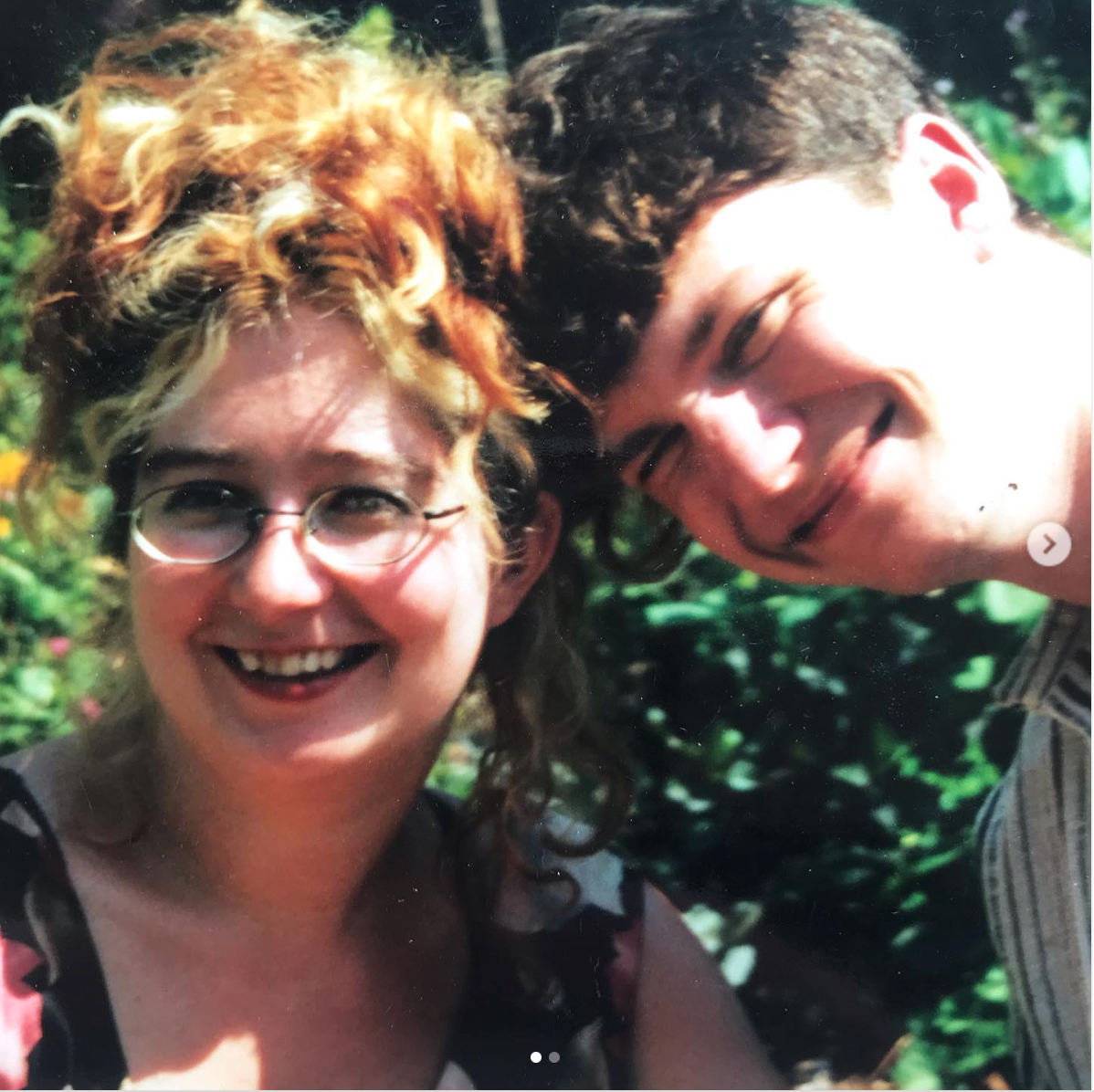
Dr and me, about 2002
Twenty years ago this evening I took the Dr - though she was not then a Dr - to the pub to pitch a modest proposal: I wanted to jack in my job as an account manager in a contract publishing company and go freelance. I thought she would be horrified; in fact, she was relieved.

The idea wasn't entirely out of the blue. I'd begun to get some paid writing work - my first feature in Doctor Who Magazine, a few things for Film Review, the odd bit of copy for the customer magazines in my day job, such as the listings magazine for ITV Digital. When ITV Digital went into administration in March 2002, it hit my workplace hard. I expected to be made redundant but the payout would have covered bills for at least a couple of months. If ever there was a moment to make the leap into freelancing, this was it...

Except that I didn't lose my job and instead got promoted. I threw myself into new responsibilities, extra training, last-minute work trips. My birthday plans were cancelled so I could go to a meeting in Leicester; delays getting back from Barcelona meant I missed the wedding of some close friends. These were among a whole bunch of frustrations at work - small stuff, petty stuff, stuff that wasn't really about the job in the slightest but all about me. It took months to admit my disappointment at not having been made redundant.

So I looked into money and I talked to people. There were those in my day job who said they would employ me as a copywriter if - rarest of rarities as freelancers went - I delivered what I was asked for and on time. People who'd been made redundant from my work had since found jobs elsewhere in publishing and some could offer me work: updating spreadsheets, fiddling with Flash animation, even things involving writing. I also knew - or now introduced myself to - people in Doctor Who fandom who worked in publishing of one sort or another. Some couldn't offer work but gave useful advice: who to pitch to, what to pitch, who might be good as an accountant...

By the time I took the Dr to the pub on 15 July 2002, I had a list of potential employers and a budget based on needing to pay £600 in bills each month. She didn't need to see any of that. Next morning, I handed in my notice and later emailed everyone I could think of seeking work. My notebook from the time is full of lists: people to contact, ideas to send them, responses received and how I would follow those up. Hungry, for pages and pages and pages. Enough people were generous, or at least took a chance on this green, eager dork, that I picked up enough jobs to get by. I've been getting by ever since.

Mostly, it's been fun - more like larking about than working, for all the hours put in. I've had a very broad-ranging career, doing all sorts of varied stuff in very different media. Some jobs have been joyous, some very challenging but rewarding. I've worked with many brilliant, talented people. There is loads I'm really proud to have been part of. But freelancing has always been precarious - and just now publishing is in a worrying state. 

This week, Eaglemoss went into administration, taking with it my regular job on the Doctor Who Figurine Collection. Seven books I've worked on are currently in limbo, my work on them either entirely or mostly done but no publication date in sight because of... well, everything at the moment. Some projects aren't cancelled but stall; they're put back a few months or a year, as is the date when I can invoice for the work I've done on them. 

It's not as if things were easy before the cost of living crisis, COVID, Brexit, paper shortages and whatever else made them harder. In many cases, freelance rates have barely risen in two decades. That's had, I think, a corresponding impact on the demographics of people in publishing.

What can be done? Well, that's been much on my mind. Last week, I was elected chair of the Books Committee of the Writers' Guild of Great Britain. I've 20 years experience of knocking about through this industry, and of being knocked about. As Leela says in the Doctor Who story The Robots of Death, "If you're bleeding, look for a man with scars." Hello, that is me.

Wednesday, February 23, 2022

Doctor Who: Chronicles - 2007

The latest issue of the Doctor Who: Chronicles (from the makers of Doctor Who Magazine) is focused on the year 2007, which in a weird, sci-fi wossname is now somehow ancient history.

For his article on the Doctor Who books published that year, Mark Wright spoke to me about writing The Pirate Loop, the one with the space-pirate badgers. The Dr still thinks that book is the best thing I've ever written, so it's been 15 years all downhill.

Saturday, February 12, 2022

The Franchise Affair, by Josephine Tey

I've been meaning to get to this mystery novel for years. The Dr is a fan of Josephine Tey, and also of Nicola Upson's series of novels in which Tey is herself the detective. 

Some time ago, we watched the 1988 TV version of The Franchise Affair, which was the last TV work overseen by Terrance Dicks and the second of two adaptations of Tey that he produced for the BBC's "Classic Serials", effectively putting this mystery writer in the same bracket as Dickens, Bronte and Thackeray. I wonder why, of all mystery writers, Dicks chose her to make canonical... 

Robert Blair is a partner in a legal firm whose "business is mostly wills, conveyancing, and services", based in the smallish town of Milford. One morning he's rung up by Marion Sharpe he has seen around the town and asked to sit in on an interview with the police. Blair heads to the Franchise, a sizeable house now past its prime, which Sharpe and her mother have recently inherited and where they live in genteel poverty. Then the police arrive with a 16 year-old girl covered in bruises. She says the Sharpes kidnapped her, held her hostage for weeks, and inflicted ruthless beatings...

It's refreshing to have a mystery that's not a murder, and the general feel of the book is unsettling intrigue. It's as much about how the neighbourhood reacts to these two women from the Franchise, and there are plenty of shrewd observations, such as when Blair speaks to a waitress. 
"'We were all discussing that case on Friday [says the waitress]. Imagine beating her half to death like that.'
'Then you think they did?' [asks Blair.]
She looked puzzled. 'The paper says they did.'
'No, the paper reports what the girl said.'
She obviously did not follow that. This was the democracy we deified.
'They wouldn't print a story like that if it wasn't true. It would be as much as their life's worth. You a detective?'
'Part time,' Robert said.
'How much an hour do you get for that?'
'Not nearly enough.'
'No, I suppose not. Haven't got a union, I suppose. You don't get your rights in this world unless you have a union.'
'Too true,' said Robert. 'Let me have my bill, will you?'
'Your check, yes." (p. 130.)
In this, there are hints of a generational divide, and an inrush of Americanisation, perhaps the result of the recent war. The book was first published in 1948 (mine is a battered copy from the following year), but there's little on the war specifically - no mention of Blair having served, for example, or that some of people's strange behaviour may be the shadow of trauma.

In fact, it's all rather lightly played, and straightforward. Blair remains convinced of the Sharpes' innocence and even falls for Marion. I was braced for some last twist or reversal that never came. It's a comic novel in many ways, with something of Wodehouse in the reactions of Blair's maiden aunt.
"A fortnight ago you would never have dreamed of putting a parcel of fish down on polished mahogany and forgetting all about it." (p. 162)
But I really felt for the Sharpes, facing prosecution and a violent response from their neighbours. I think that may be because I'm also deep in research at the moment about a real court case, the one brought 40 years ago by Mary Whitehouse against the director of the National Theatre production, The Romans in Britain - of which more anon.

And so I think the thing that really lingers from this is Marion Sharpe's sympathy at the end of the novel for the mother of her accuser, a connection felt across the gulf of the two sides.

Tuesday, September 15, 2020

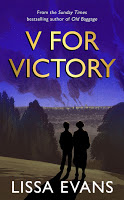
V for Victory, by Lissa Evans

V for Victory, by Lissa Evans
Entirely selfishly, I bought this for the Dr's birthday so that I could read it. It's the third in a trilogy, after Crooked Heart and its prequel, Old Baggage - both of which I adored. 

We pick up with young Noel Bostock and his adopted aunt Vee - though she's neither of those things officially. Now going under the name Mrs Margery Owens, she and Noel bugger on through the chaos of north London at the fag-end of the Second World War. At any moment of any day, a V2 might fall on them and it's exhausting - not least because the chores and home-schooling must still somehow be done. Still, there's romance kindling in the air for each of them. And then they both stumble into people who know something of their past - and might expose their secrets...

As before, there's a wealth of telling historical detail worked deftly into the breezy tale, which I knocked through in a matter of days. It's so teeming with life and emotion. We really feel the outrage of Winnie the Warden discovering that her harrowing real-life experience has been filletted by her sister for a sexy novel. Or there's Noel's infatuation with a girl who's moved away:

"Noel recognized Genevieve Lumb's neat but forceful handwriting. Even the thought that she had licked the envelope was quite physically stirring." (p. 53).

The remarkable thing is that these extraordinary, unprecedented times feel utterly real. But it's also a delight to spend time in the company of good people just trying to get by, despite all the crap going on. 

I was especially moved by the ending, where Vee and Noel face some tricky emotional stuff relating to his biological parents. It's so perfectly done, so impossible to describe here without spoiling. At one point, Vee wonders what might have happened if she'd not made a connection with this awkward teen at a critical moment, how nearly he might have been lost. But we leave them happy, the war over and a new world on the horizon. After all the devastation, what survives is the love. 

Monday, August 24, 2020

Haunting north

The removals people said they'd be here between 8 and 8.30 this morning but arrived just after 7.30 while I was still drinking tea in bed. So the Dr raced into the shower while I hauled on last night's clothes, and then we were in full boxing mode. They parked their enormous lorry in the middle of the street and none of our neighbours objected. I think that's a mark of how friendly things are here - or how pleased they are to be rid of us.

Tomorrow, we move from our house of nine and a half years, and from London where I've lived since October 1999. We're moving north for a new chapter and new life. The children are already there. So it feels momentous and yet anticlimactic. I'm glad to be going and sad to be gone.

With the house over-run by boxes, the Dr and I went for lunch round the corner at our local - the first time either of us have been in a pub since mid-March. It was strange to use the new app to order drinks and food, all part of the careful, socially distanced provisions to keep us and other punters safe, and yet otherwise pick up as if we'd never been away. And then having caught up with landlord Colin after all these months, he was busy when we had finished, so there was no chance to say goodbye.

The week has been full of notable lasts: my daughter's last day at the nursery that's been a fixture in our lives since my son started there in 2013; the last time mowing the lawn yesterday; the last time past the old landmarks. What with everything going on in lockdown, and some personal stuff too, I'm all a bit emotional at the moment, haunted by things past and things to come.

Thursday, February 07, 2019

Doctor Who Magazine #535

Out today, Doctor Who Magazine issue #535 includes my interview with Feifei Ruan, the illustrator and visual storyteller who created the extraordinary images used to promote Doctor Who in China.

I'm also a page 3 model, with my photo and short biography carefully placed to scare off readers of a nervous disposition. The Dr and the Lord of Chaos were commissioned for the special photo shoot, which included this dramatic moment.


Thursday, May 24, 2018

The Shed

It has taken months and been painfully more expensive than expected, but I now have a shed/office up and running, and my daughter no longer needs to share her bedroom with my rubbish. Here, for those who've asked, is the whole saga...

The original plan was to convert the old, World War Two bomb shelter at the end of the garden, which had been used for storing the lawnmower and old pots of paint. I was really keen to keep the bomb shelter, not least because of its place in history. This part of London was heavily bombed in the war - the pub round the corner, my daughter's nursery and the swings we go to all the time are all built in place of houses that were lost.

Although the shelter looked large and imposing from outside, the very thick brick walls meant it was pretty small inside. Those walls would make it difficult to add a window or electricity. And the heavy-set concrete roof was leaking, which would be complicated to fix.

Exterior of World War Two bomb shelter
in our garden in January
Interior of World War Two bomb shelter
in our garden in January


The compromised roof, letting water in
So, in January, and a little guiltily, we arranged for builders to come and unbuild it. It took two of them, all day, with a huge pneumatic drill and sledge hammers, just to take the roof off.

Day 1 of demolition

Day 2 of demolition
It was exhausting work. The builders got through at least one pneumatic drill, and would retire wearily at 3 pm each evening. It took longer than expected, so they were then off to other jobs, coming in when they could to destroy another section.

By the end of the first week, we'd also hit a snag: the back and right-hand walls of the bomb shelter were supporting the walls behind them, so would have to stay. There was also the issue of how low the bomb shelter sat in the ground, which had meant there was always a problem with damp.

End of second week of demolition
The builders suggested using some of the rubble they'd cleared as the base for a platform on which the shed could sit. It saved money to use the broken bits of brick - but was still an expensive addition to the plan. We tightened out belts, and as well as the platform they installed panelling to tidy the whole thing up, too.


Construction of platform for new shed 

Our cat, Stevens, supervised the construction of a step up to the platform. The crappy weather may also have done something to the concrete mix - the edge of the step is already beginning to crumble. So we might have to have another go later in the year.

Paw prints in the step

After three weeks, the builders finished with the platform complete.

Platform completed, February

With them done and gone, I was ready to order the new shed from Woodside Timber. It would not arrive for another month - in March - so we had time to tidy the garden a bit, and attempt to book in an electrician for the next stage.

The Dr, in a tiara, tidying.
A nice electrician we'd used before came round and established it would be really tricky getting a cable out to the shed, as it would need to go under the floor in our kitchen, through the back wall, under the patio and then under the garden. Not one of these things would be easy.

But by happy coincidence, she was due to be working in the next few days with our old friend, the nice bloke who fitted our kitchen and converted our loft, who we'd booked to insulate and board the inside of the shed. She said she would talk to him about exactly what could be done. I heard from him soon after, and they'd talked through who would do what. We were go - in principle, or so I thought.

In March, while I was talking at the Bath Taps Into Science festival, the shed was put up by the nice people from Woodside Timber - exactly fitting the platform for it. Hooray!

The new shed, in March
I was then on holiday - at a wedding in Vietnam, and then with the family in Majorca - and we hit the Easter holidays. So we were well into April before the nice bloke was free to put in the insulation and board. As agreed with the electrician, he put the wiring in - but didn't connect it up to the mains - and got a cable running from the shed to the house. It helped that he fitted our kitchen all those years ago and knew where everything sat. But it was still a fiddly job.

Then we hit another snag. Yes, the electrician had discussed with him what needed to be done. But she'd not actually quoted for the job because she knew she was too busy to take it on. Me and the nice bloke had both thought she'd given each other the go ahead. Oops. So I had to dash round looking for another electrician. More time lost. The soonest anyone could come just to quote for the job was now May...

In the meantime, I got on with painting the inside of the newly boarded shed, with the Lord of Chaos helping when the mood took him. Once the paint was dry, he also decorated it, on the theme of an aquarium - with added monsters.

Lord of Chaos at work
 Lady Vader also wanted in on the action, though her work is more abstract in nature.

Lord Chaos and Lady Vader at work
Towards the end of April, I made a whistlestop visit to Winchester for the christening of an old schoolfriend's new son, and was able to steal some off-cuts of carpet from my parents.

Shed now with some carpet
Then there was the matter of burying the steel wire armoured cable running from the shed to the house. This had been the bit of the job the electricians and nice bloke were all keen to dodge. So on a rainy day at the end of April, muggins here just had to get on with it, with spade and fork.

Garden before the trench
The official recommendation was to bury the wire at a depth of 600 mm, which is a lot of digging. It didn't help that very soon I was digging through broken brick and glass and tile - as if the house had been built on a rubbish tip. It was knackering.

Garden with trench
Meanwhile, with progress being made, the Dr was keen to get all my stuff out of what had been my office and is now Lady Vader's bedroom. That mean lugging the enormous desk downstairs and out. I called in a favour, having helped some friends move house over Christmas.

Desk in old office, in sight of the new shed

Desk and chair now in the shed
It was all done in time for the electrician to arrive the next day to give us a quote, as they'd need to see the trench. Job done - but I was a little sore and damaged.

A writer's hand after some real work
Lord Chaos was fascinated by the spoil heap I'd created, which meant a house full of mud. But he also diligently uncovered all sorts of treasures. We cleaned up the bits of broken tile and removed the bits of glass so he could take it all in to school for an accomplished show and tell.

Treasures from the garden
There was then a bit of back and forth with the electrician - he missed the day he was meant to come to quote, then couldn't do the actual work before the end of May. He also recommended a whole new fuse box for the house, rather than just grafting an extra bit on. It made sense, so we gritted our teeth and said yes. It might all be done by June...

At the last minute, he was able to come on the first Bank Holiday Monday, so we were suddenly ahead. I had to dash to the local DIY warehouses to pick up switch sockets and lights ready to be installed. I do not recommend this on a bank holiday weekend. It took almost for ever.

On the Monday, the electrician and his colleague worked quickly through the sunshine. They also signed off the trench I'd dug as being adequate, so - having put down a warning scroll about their being an electricity cable underneath - I could fill in the trench. That was on a very hot day, and probably harder than the original dig. The Dr felt I failed to emulate Poldark.

Not Poldark
After all that toil, I was granted a night out in the pub with some friends. Which was when the Dr discovered our downstairs lights had not been reconnected. The apologetic electrician was back the next day...

With the cables in, the nice bloke came back to fix a few last bits and pieces, and fitted the shelf brackets I'd also purloined from my parents. They had been the shelves in my bedroom in my teens, home to my run of Doctor Who books, most of which I'd long since given away... Putting up the brackets proved fiddly, because the sloping roof created an optical illusion where the middle bracket never looked right. After much swearing and use of a spirit level, we got a shelf up.
The middle bracket is at the same height as the other two
With the brackets fixed, my parents then came to babysit while I was off on a job. They arrived with my old shelves, cut to six feet exactly as I'd asked, and more off-cuts of carpet to fill the remaining gaps.

With shelves done, I began ferrying boxes of stuff over to the shed, in between trying to keep up with the work I'm behind on. Much of it was boxes of stuff that I'd hardly been able to get into in the seven years we've lived in this house. There was a happy afternoon just putting 25 years of Doctor Who Magazine in order, which will speed up a lot of the stuff I'm currently writing...

On Friday, we visited the British Heart Foundation shop in central Croydon looking for some kind of armchair or sofa that would a) fit the limited space and b) suit comfortable reading. We found the perfect thing and - miracle of miracles! - they delivered it that same afternoon. Lady Vader and her Dolly approved.

New old sofa meets Lady Vader's approval
With Lord Chaos off school with chicken pox, we've had a couple of days this week to concentrate on the shed - because he objected to me ignoring him by working on my laptop. Yesterday, we went to collect the box shelves Homebase were meant to have delivered 10 days ago. They apologised for not having a driver available in all that time and generously refunded the £3.95 for delivery.

Lord Chaos enjoyed using the gentle IKEA drill to put in the screws, and fixing the little white round things that hide the screwheads on top. He then contentedly watched me fill the shelves with all my rubbish. Last night, the Dr was delighted to see there was space for my Doctor Who DVDs, too - finally exorcising her house.


There are still bits and bobs left to do: things to unpack, a fan heater to buy, so much of it to reorganise. But it's a snug and cosy space to work in, and I'm now ripping through the stuff that for so long I have been late on. It has been well worth all the effort.