"At its worst merely silly, at its best is had been spell-binding."
John Brosnan, Peter Nicholls, Kim Newman, "Dr Who", in The Encyclopedia of Science Fiction (eds. John Clute and Peter Nicholls), Orbit 1993, p. 346.
"At its worst merely silly, at its best is had been spell-binding."
John Brosnan, Peter Nicholls, Kim Newman, "Dr Who", in The Encyclopedia of Science Fiction (eds. John Clute and Peter Nicholls), Orbit 1993, p. 346.
“The full extent of the war damage to London’s infrastructure and housing stock made reconstruction an urgent priority. The publication of Abercrombie’s Greater London Plan established a framework where issues of reconstruction and social progress combined in the utopian idealism of slum clearance, New Town development and green belt conservation.”
“The relative sophistication of these entertainments, for ordinary people, and in the context of post-war austerity, should not be discounted.”
“ubiquitous sanserif faces of the 1930s and WWII”.
“define the graphic style of the decade perfectly.”
“Britain’s status as an atomic power and the technical lead that it had in such fields as radar, computers, telecommunications, television and jet engines.”
“in essence, a large diagram depicting a flow of materials, the flow being marked out by thin glass tubes through which coloured liquid, regularly interspersed with air-bubbles, would travel along slowly."
"The main characteristic of work for the Festival was that nothing that was supposed to happen happened when it was supposed to. Our material was finished and ready on time but the building it was to go into, the Power and Production Pavilion, was, to put it simply, not there. It was eventually made available to us exactly a week before the Festival was due to open, whereupon we discovered that, for reasons we knew nothing of, the showcases had not been made according to the plans we had been working to.
There was no time to argue about this and no point in doing so because nobody was taking responsibility. Bob and I just set to and sustained by Benzedrine and knobs of sugar, worked, non-stop, night and day for the whole week.
Even then I didn't quite finish. As the King and Queen and the two Princesses came through the pavilion, viewing the exhibits on the formal Opening Day, they might have thought that all the ingenious animated displays were electrically driven. Not so; I was lying on my back underneath one of them, winding it by hand.”
“A proposal for a new 'Newton-Einstein House', which subjected visitors to extreme gravitational forces, was ultimately rejected.”
“James Bond did not take the car ferry to France. This is the one part of the journey where my plans must diverge from his. He headed instead for Lydd Ferryfield airport, in Kent, where he drove up a ramp and straight into a Bristol plane bound for Le Touquet. This used to be a regular practice for the rich until the hovercraft killed off the business in 1970.”
“Let's face it, writers are pretty boring. Writers never know how to pose for photographs – is it hand on chin, or hand not on chin? Some might get drunk and sleep around, some might shoot themselves in an effort to appear more interesting, but the fact is 99% of our lives are spent locked away in a small room with a keyboard.”
"a new Doctor Who story as told by one of the Doctor’s companions played by the actor who portrayed the role in the Classic Doctor Who TV series. Although essentially a talking book, each production includes dramatised sequences featuring a second actor and boasts sound-effects and an original music score ...Already the Internet is asking how Sara (pronounced "Sarah") can narrate something when she gets killed in the one story she's in. Bwah ha ha, etc.
With release number five, we return to the First Doctor with a story told by his short-lived travelling companion, Sara Kingdom who originally joined the TARDIS crew for the epic length TV story, The Daleks’ Master Plan. As in the original TV series, Sara Kingdom will once again be played by Jean Marsh of Upstairs, Downstairs fame. The story, entitled Dream Home, has been written by Simon Guerrier."
 Big Finish have announced details of Bernice Summerfield: Season 9. It's the first time in 15 audio adventures that I've not been involved in what the old girl's up to - that Eddie Robson is her boss and master these days. I'm on tenterhooks to hear it. Place your orders now.
Hello. If you’ve not seen old Doctor Who before, you probably need some warning. Pyramids of Mars was first shown in 1975. And some of the special effects look like they are from the mid 1970s. That’s often what most surprises people who haven’t seen much old telly. Yes, the TARDIS is dangling on a string. Yes, some of the cross-fade effects don’t quite exactly match up. But this is from two years before Star Wars and a lifetime before CGI. And as old Doctor Who goes, Pyramids of Mars is one of the best.
It tops polls and top-ten lists. It’s one Doctor Who fans show to those poor people who don’t know – or care – about the old series. Russell T Davies had clips from it in his grown-up series Queer as Folk – which caused a controversy what with its sympathetic portrayal of a Doctor Who fan.
So what makes it so good? Well. Ignoring the 70s special effects, it looks great; it’s set in 1911 and the BBC were always good at period pieces. It thieves its plot from the Hammer film The Mummy – the guy playing Professor Scarman clearly chosen because he looks a bit like Peter Cushing. And mummies make for a great monster.
But more than that. What sets it apart from other stories is that it’s Doctor Who versus a God. Sutekh is a brilliant baddie – though he spends most of his time stuck on a chair. He’s voiced by Gabriel Woolf, who was in the new series with David Tennant a couple of years ago, as the voice of the Devil. Some people think they’re the same character.
But it’s not just that Sutekh’s a God. The Doctor is terrified of him. The way Tom Baker plays it is absolutely chilling. And because the Doctor is scared, so are we.
It’s also a great story for Sarah Jane. She’s in her element here. In fact, she turns out to know a surprising amount about Egyptian mythology and how to use a rifle. She also just so happens to try on the right sort of period clothes. But again, it’s a compelling performance – always running to keep up with the Doctor, terrified but brave.
And special mention to Michael Sheard as Laurence Scarman, fantastically baffled, enthusiastic and rather moving. Sheard would later be throttled by Darth Vader in The Empire Strikes Back and played Hitler in the last Indiana Jones movie. He’s one of Doctor Who’s best ever guest actors, but is probably most famous as the dreaded Mr Bronsan in late 80s Grange Hill.
Some other things to note:
At the start the Doctor is still nominally working for the Brigadier and UNIT – as featured in the new series on Saturday.
Sarah says she’s from 1980 – five years in the future when this first went out.
Yes, when the Doctor is in disguise, it really is Tom Baker wrapped up in the bandages.
The house where it was filmed was owned at the time by Mick Jagger of the Rolling Stones.
And when Sutekh stands up in episode four… Well, keep your eyes on his chair.
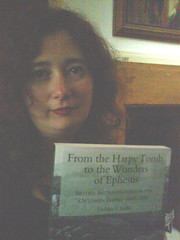 Met the Dr in Kings Cross on Saturday, where we had celebratory chips on the basis of her having a copy of her book. It's all very exciting to see it actually in print.
 The Big Finish website has posted a news story and full details of my forthcoming Doctor Who anthology, How The Doctor Changed My Life.
The schoolboy whose twin brother vanished in the night. A woman whose house teems with alien refugees. The dad who dies every evening...
All through space and time live people, ordinary people, whose lives have been turned upside down.
People who’ve lost jobs and loved ones, or seen their homes destroyed, or found themselves on whole other planets. They’ve nothing in common with one another except that their lives can never be the same.
Because they’re people who’ve met the Doctor. Featuring 25 original stories from 25 brand-new authors – the winners of a competition to seek out bold new writing talent!
Foreword by Paul Cornell
Homework by Michael Coen
Change Management by Simon Moore
Curiosity by Mike Amberry
Potential by Stephen Dunn
Second Chances by Bernard O’Toole
Child’s Play by LM Myles
Relativity by Michael Montoure
Outstanding Balance by Tim Lambert
The Last Thing You Ever See by Richard Goff
The Shopping Trolleys of Doom by Caleb Woodbridge
The Final Star by Chris Wing
The Man on the Phone by Mark Smith
The Monster in the Wardrobe by James C McFetridge
Suns and Mothers by Einar Olgeirsson
Taking the Cure by Matthew James
Those Left Behind by Violet Addison
Evitability by Andrew K Purvis
£436 by Nick May
Time Shear by Steven Alexander
Running on Empty by JR Loflin
Swamp of Horrors (1957) – Viewing Notes by Michael Rees
Insider Dealing by Dann Chinn
The Andrew Invasion by John Callaghan
Stolen Days by Arnold T Blumberg
Lares Domestici by Anna Bratton
Competition rules
Competition feedback
“no fun at all in a weightless environment.”
Andrew Smith, Moondust, p. 163.
The unglamorous realities of space travel have long been reported – kids queued up at the space museum in Washington DC was astronauts’ toilet, which I think was from a space shuttle. But that strange looking contraption was modern, extravagant comfort compared to the first pioneers. As early as 1973, Buzz Aldrin’s book Return to Earth revealed,“That the condoms they’d used for collecting urine were a great source of anguish because ‘our legs weren’t the only things that atrophied in space’… [and] that hydrogen bubbles in the water supply they used to rehydrate food had given them the farts and Columbia’s interior didn’t smell so good (there was ‘a considerable fragrance’) by the time they got home.”
Ibid., p. 101.
It changes our view of these healthy American heroes, filled to the gills with the “right stuff”, to hear of leaks in the condoms that resulted in reeking, “blobbing globules of piss”. (What a brilliantly vivid image; it makes me think of weightless Klingon bleeding in Star Trek VI, or the title sequence of Friday Night With Jonathan Ross.)“This happened to Gordon Cooper on his Mercury flight and all he could do was herd them together every so often, so that he knew where they were. The rubbers on Apollo had the same problems, but were connected through a hose and valve directly into space. Not only was it easy to catch yourself in the mechanism, but opening the valve brought the hungry tug of absolute vacuum.”
“Defecation was the real deal. To do this on Apollo, you had to climb to the lower right side of the craft while your crewmates moved as far away from you as they possibly could – which anyone who’s seen one of the capsules will appreciate wasn’t far. There, you got completely naked, removing rings, watches, everything, because you couldn’t be sure what was going to happen next; then you positioned a special plastic bag as best you could, and went, hoping that everything went in it. Remember that you’re floating; the bag is floating; your shit is floating. Charlie [Duke] says: ‘Anything you can imagine happening… happened.’ Thus there is the tale of the stool that went freelance on one flight … So unspeakable was the hour-long process of dumping and getting cleaned up afterwards that I heard rumours of one astronaut dosing himself with Imodium, which enabled him to hold it for eight whole days.”
“Even I find it hard to imagine men and women of his generation sharing these experiences.”
“Bizarre as it sounds the solution … is to decrease velocity, so sinking to a lower, shorter, faster orbit, then to gradually transfer back up to the original one at precisely the right point to meet the target. This stuff is called ‘orbital mechanics’ and it manifestly is rocket science.”
“earnest young engineers, their holstered slide rules slapping against their belts.”
“eldest son was born prematurely when one of the first V-2 rocket-bombs von Braun designed during World War II fell on Sydenham.”
“To begin with, his thick accent and mouth full of metal teeth were ‘quite revolting for the viewer’, but one day Reg turned round and, lo, the engineer was speaking perfect English through a gallery of gleaming white teeth.”
“Prior to his flight, [Apollo astronaut Edgar] Mitchell spent a week sharing a house with the rocket scientist [von Braun] and Arthur C. Clarke, who was by then regarded as one of the most influential futurist thinkers on the planet, because for that brief period sci-fi was seen as something more than escapism.”
“nuclear rockets assembled in Moon bases, to reach the red planet in the early 1980s.”
“1 in 455 chance of humanity failing to see out the next century … You’re about ten times more likely to get killed in a civilization-ending event than you are of getting killed on a commercial airline flight.”
“After the director we went to see the chief of staff, Dr. Fathi.
Dr Fathi: ‘Ma’am, we’ll do what we can. We are terribly strapped at the moment.
‘Look in this room. They’re all victims of chemical weapons.
‘The Germans sell chemical weapons to Iran and Iraq. The wounded are then sent to Germany to be treated. Veritable human guinea pigs.’
Marjane’s auntie, shouting: ‘Why are you telling me this?! I couldn’t care less. I want my husband to get well!’”
Marjane Satrapi, Persepolis, p. 122.
There’s a constant undercurrent of incredible violence. Deaths and beatings are part of daily life even before the war with Iraq. Marjane’s family are descended from the deposed royals (the surname “Satrapi” is a clue to that) and she goes to see her favourite uncle in prison the night before he is executed."It wasn't very good and it didn't interest me very much."
 Hooray! I have as of this morning my copies of Defining Patterns, which have been sat in the Post Office awaiting my collection. It’s a thrilling looking book, with my story, “The Great Escapes” alongside some cracking stuff. There’s competition winner Michael Coen and the Big Finish debut of Ace creator Ian Briggs. What more could you possibly want?