Friday, March 08, 2013

Doctor Who: 1963

Episode 1: An Unearthly Child
First broadcast: 5.15 pm on Saturday, 23 November 1963

One of Doctor Who's most striking images is the result of the production team trying to save money.

As Susan explains in the second ever episode, the TARDIS can normally change its shape to blend in invisibly where and whenever it lands. The show's co-creator Sydney Newman had, brilliantly, insisted that the Ship should at first look like a police box – a familiar, everyday sight at the time. But the police box prop was expensive so, in what was meant to be a temporary measure to spread the cost across more episodes, the TARDIS was stuck as a police box.

Hence the series' very first cliffhanger: an ordinary, everyday object, familiar to everyone watching, but on a stark and alien landscape.


It's such an effective, eerie juxtaposition – the ordinary with the strange - that the show's used it ever since. Everyday objects come suddenly to life, famous landmarks serve alien armies, snowmen come horribly to life...

It also helps that this first cliffhanger is so well earned, using a neat mix of the ordinary and strange to sell us the idea of the TARDIS. The episode teases us right from the start that something odd is going on. There's the spooky theme music and opening titles, and then a policeman wandering through eerie fog. And we're shown something he doesn't see – an ordinary police box making a weird noise.

Even then, there's nothing to suggest the kind of strangeness to come. The first half of the episode is played very real. An ordinary pair of school teachers in an ordinary school discuss one of their pupils whose homework has recently got worse. Barbara is frightened as she and Ian follow Susan home, 'as if we're about to interfere in something that is best left alone,' but Ian is more pragmatic – Susan might just be meeting a boy.

The tension mounts as the two teachers explore the junk yard, director Waris Hussein picking out the unsettling, mangled face of a mannequin. Then we meet the Doctor – a suspicious old cove who asks lots of questions but answers none. The horrible suggestion is that he's locked Susan in the police box. The way it's been played, this "mundane" explanation - a story they might have done on Z-Cars - seems far more likely than what we're about to find out.

But all this ordinariness is setting up the episode's great revelation. Ian and Barbara shove their way past the Doctor and into the impossible, bright TARDIS. The darkness, the fog, the ordinariness of everything up to this point, help make it all the more striking.

Again, ordinary things are used to explain the strangeness. The Doctor likens the TARDIS to the way television works, and Ian's disbelief to a Red Indian's first sight of a steam train (Westerns were a lot more familiar in 1963). Ian's reaction, struggling to understand the incredible space, helps sell the idea to us, too.

The ordinariness of Ian and Barbara also presents the threat – they'll tell the police about the Doctor and Susan, or they'll at least tell their friends. Ian and Barbara want to escape from the strangeness. Susan wants to go with them, back to her ordinary life, but the Doctor decides there can be no going back, and spirits them all away...

As the TARDIS takes off, we again see the strange pattern of lights that made up the title sequence. By recognising it, by realising what it is, we're buying into the whole concept. The strange has just become familiar – and we believe that a thing that looks like a police box standing in a junk yard can move anywhere in time and space.

All of this is set up extremely simply. There are just four speaking parts – our leads – and just eight other people are named in the credits (plus the BBC's Visual Effects Department and Radiophonic Workshop). Telling the story through Ian and Barbara, keeping it close and immediate, really helps sell the idea.

But there's another master stroke in the cliffhanger: a shadow moves into frame. It's not just that the police box stands in a strange and alien landscape, but that someone is outside, waiting...


Next episode: 1964

Monday, March 04, 2013

Doctor Who: The Library Of Alexandria

Out next month is a new Doctor Who adventure by me, The Library of Alexandria, performed by William Russell as Ian Chesterton and Susan Franklyn as Hypatia.


"The port of Alexandria, 5th Century AD. The Doctor, Ian, Susan and Barbara have taken a break from their travels, and are enjoying a few weeks in the sunshine – and the chance to appreciate the magnificent Library of Alexandria. They know that the library will soon be lost to history. What they are about to discover is the terrifying reason why…"

To whet your appetite, here's Carl Sagan wandering the Library of Alexandria in 1980 for his history of science series Cosmos:

Saturday, March 02, 2013

The Psychology of Power

Prompted by wise Matthew Sweet, whose radio programme on the life of Alex Comfort, Stop Calling Me 'Doctor Sex' is still up on iPlayer, I've been reading Comfort's Authority and Delinquency (1950) - that link takes you to scans of the entire book, though I've also bought one off Abebooks.

It's packed full of interest which I shall endeavour to blog about another time, but given Eastleigh and the AAA rating this week, the following rather chimed:
"One very characteristic - indeed, defining - character of persistent criminals is their baffling ineducability by experience, which leads not only to a repetition of the crime but of the details which led to their detection and arrest. In other words, their behaviour is compulsive. There is an analogous ineducability in government, among the advocates of 'strong' policies. Experience and argument did not prevent successive British 'strong' men (not all of one party) from repeating in Palestine, Cyprus, India and Suez the identical attitudes and errors which lost them Ireland, not Marxists from repeating the aberrations of the Czars. The reasons are identical in the two cases - these are examples of stereotyped behaviour, the actions are performed for the immediate emotional satisfaction they give not for their supposed purposes; other characteristics are unjustified self-confidence, total disregard of others and the substitution of vague objectives such as prestige or revenge for concrete gain, which, even if unelevated, is at least reality-centred. Long-term objectives - national advantage or the victory of an ideology nearly always give place in the event to the overwhelming cathexis of 'strong' action for people in office - the policy is then doggedly persisted in to maintain the illusion of purpose, under the guise of maintaining law and order. To the 'strong' man, as to the persistent thief, it is pointless to argue that crime does not pay - it is the act, not the policy or the thing stolen, which is the true motive. He will 'show them', regardless of whether it pays or not."
Alex Comfort, Authority and Delinquency - A Study in the Psychology of Power (1950), pp. 29-30.

Friday, March 01, 2013

My first ever rejection letter

Excitement! I have found my first ever rejection letter, received in April 1992 from Gary Russell, then editor of Doctor Who Magazine. I was 15 at the time, and it was just a few months since Gary's interview with novelist Paul Cornell (in issue #181, December 1991) had made me realise that being a writer was something I might actually do, not merely something to dream of like being an astronaut or pop star.

I sent Gary a terrible short story in which the Fourth Doctor and Romana land somewhere and, er, that's it, and surprisingly the response was a form letter:


I've had a lot of form letters since. They're the usual response to unsolicited on spec submissions. It took me a long time to realise that collecting rejection letters - forms ones, then form ones with notes on your submission, then ones with notes on your submission that invite you to try again - is a big part of being a writer.

I mustn't have been too disappointed by this first response as I sent Gary more stories. You can see how much better they were by the response I got six months later:


At the same time I also sent a script for a Judge Dredd story to 2000AD, and the form rejection letter I got back wasn't even signed (though someone had asterisked the paragraphs I should pay attention to).

Over the next few years, I continued to send things to Doctor Who Magazine and 2000AD, and also sent in proposals anywhere else I could think of. My first rejection letter from the publisher of Doctor Who books in 1994 was so detailed, generous and encouraging that I probably owe my career to it.

I finally got commissioned by Doctor Who Magazine at the end of 2001, with a two-part feature published in early 2002. Later that year, I also got commissioned to write a Doctor Who short story, in Big Finish's Short Trips: Zodiac. That was edited by Jacqueline Rayner, overseen by Gary Russell. That led to me writing lots for Big Finish, and a couple of years later I helped Gary write form letters in response to submissions.

2000AD turned me down, again, with a form letter just last year.

(Thanks to Gary for permission to post these.)

Tuesday, February 26, 2013

On finishing a notebook


Last night I finished a notebook I've kept since 29 December 2011 (when I was in Egypt). I've kept notebooks since I was in my teens, and find them very useful to refer back to – pinching ideas from my past to pitch anew to unsuspecting bosses. It's not a diary, but flicking through this latest volume reminds me what I was working on and having ideas about, and what preoccupied the insides of my head.

There are the day-to-day notes as I wrote one novel, 10 plays and three short films, marking down new clever wheezes or things I'd need to go back and fix. There are pitches for yet more plays, films and comics, notes on what I was reading or watching (much of it later blogged here), fragments of conversation – real and imagined – and turns of phrase or interesting words or ideas.

As an insight into the terrible mess of my brain, here is a selection:

21/1/12
Lord Wallace of Tankerness is asked if he knows of a case of suicide in a young offenders' institution and responds, “I associate myself with expressions of regret” - [House of Lords, 24/1/12; col. 987.]

12/5
Page 21 of A Bullet in the Ballet (1937) refers to “con. men” - NB the full stop.

Undated
Do we know what we vote for? Have we read the manifestos, interrogated the data and understood the arguments? Generally, no; we are lazy. We buy newspapers and follow Twitter accounts that confirm our opinions. We avoid complex or counterintuitive issues and the testament of evidence in favour of the glib and easy. We elect a smile, a soundbite, a cipher, not a problematic and uncertain truth. Rule so we don't have to think about it – that is your mandate, nothing more.

10/6
Doctor Who - The City in the Clouds ([Rough idea for a Companion Chronicle set in Season 1, but beaten to it by clever Jonny and his Voyage to Venus)
In space, maybe on zeppelins linked together to create a city in the temperate zone on Venus – a city in the clouds.
All a bit Dan Dare (which Ian has read, confiscated from his pupils), and they realise that this futuristic world is in the early 17th Century, the same time as Galileo is on Earth recording the phases of Venus for the first time.
Barbara falls in love and Ian has to take her back to the TARDIS (he uses her mum Joan to convince her to leave). Her lover will think she died.
They have to get down to the planet's surface – the hottest place in the Solar System – to recover the TARDIS. Need local people's help. They don't use money there, it's all about reputation and respect – like crowdsourcing, or your number of followers on Twitter. So the Doctor and Susan etc. have to be storytellers, scientists, busking their way in the society, getting themselves known – and only for the right reasons. Loss of face can ruin everything. That's where we meet them at the start of part one, the Doctor as a Punch and Judy man.
[Before I knew about Jonny's story, I realised that was too much like Patrick Troughton's role in The Box of Delights before I knew Matt Smith would do some Punch and Judy business in The Snowmen.]

21/8
Video going round of a guy mocking iPhone users for taking photos of their food. We're often fooled into thinking we're part of something because we consume it. There are all the tweets and fan activity involved in watching a TV show (a passive experience), or the adverts that sell the idea that by eating a burger or drinking a fizzy drink we're part of the Olympics.

21/10
After the accident, people would say to him, 'Do you dream you'll walk again?'
And he would consider – as if it were the first time he'd been asked – then say, 'No, only of being able to fly.'

14/11
We used to tease her
That in the freezer
Below the croquettes and fish fingers and peas
She kept the bodies of one or two geezers
Who thought they'd got lucky
When she invited them home.

But we were very wrong -
It wasn't one or two.

Something inside her
Moved like a spider
Spinning them in and dispatching them
Then cooking them up for her guests
Despite her reservations that these men
Could be counted as fair trade.

She liked the big-boned ones
Who made lewd remarks
And promised not to treat her respectably.
Their steaks were good for marbleising
And she saw putting them on the menu
As a service to women her age.

27/12
Rewatching The Snowmen. Why does Madame Vastra look a bit different from how she did in A Good Man Goes To War? She's a lizard and sheds her skin, so looks a little different after each shedding. (Also, it's considered rude to point that out.)

4/1/13
Billy Connolly, interviewed by Mark Lawson, describes “middle class” as “the kind of people who had dressing gowns as children”.

7/1
Michael Rosen on Radio 4's Word ofMouth investigating stenography and Hansard (in the Commons). Stenography machines are phonetic and you press keys simultaneously. Need 200+ words a minute to be accurate and keep up with speech. Some stenographers are certified to 250 words. The quality is “down to a price, not up to a standard”.

Tuesday, February 19, 2013

Three forthcoming conventions

I shall be escaping my writing hutch next month to do some showing off. Why not come along and say hello?

Saturday 16 March: Blue Box 2, Tunbridge Wells
Starring Leela, Mike Yates, Dorium, K-9 and the insides of the Daleks. I'll be there with Brother Tom to show and discuss my short films Revealing Diary and The Plotters.

Saturday 23 March: Big Finish Day 3, Barking
Starring the Fourth Doctor, his granddaughter Susan, Professor Litefoot and K-9. I'll be there in the afternoon.

Sunday 7 April: Phonicon, Exeter
Starring Lord Edward Dark and the insides of the Daleks. Again, I'll be showing and talking about my short films.

Also, clever Ed Stradling filmed highlights of the Gallifrey One convention in LA this weekend, which have only made me all the more miserable not to be there.

Wednesday, February 13, 2013

Defined by my Coasters

In the summer of 2000, when dinosaurs still roamed the streets of south London and there were only eight Doctors Who, I hefted my possessions from my sister's flat and moved in with Nimbos. To help us chase the estate agents working on our behalf, I signed up for my first ever mobile phone - a chunky grey thing with a flip-open cover that made me feel achingly trendy. My trusty pager, with a handy clip attachment for fixing to my belt, was never seen again.

I worked for a internet start-up and the bubble hadn't yet burst, so for the first time in ever I had money in the bank. As well as showing off to my new girlfriend and taking her for meals in Pizza Express, I also bought an hilarious set of items for my new home with Nimbos.

Six coasters showing the roundel from the title sequence of Mr Benn.

I'd never owned coasters before and I still don't really see the point of them, but they were the pride and joy of that flat. They really tied the room together. People would call by our flat and comment on those coasters and we'd beam magnanimously back.

When I left that flat to move in with the Dr a year later, I took the coasters with me. People still commented on them, but more in the way on enquiring how long the Dr would put up with my all dorky nick-nacks. And then something very odd happened indeed. People started thinking of me as a Man With Coasters, and went and bought me more.


The above picture shows just a small part of my collection. You'll note the six Mr Benn ones aren't included - they're in a cupboard somewhere, along with the set showing specimens of ancient Greek sculpture and ones with quotations from Winston Churchill. You can see the thought that's gone into the selections: booze and Daleks suit me rather well, and designs by William Morris and the Greek stuff goes down well with the Dr. Those ones of buildings were hand illustrated by an architect chum and are really rather lovely. It would be churlish to be anything but grateful to have such thoughtful and generous friends.

And yet.

If I am defined as a Man With Coasters, it's because I already have them.

Saturday, February 02, 2013

Coming soon: Wizard, a film by the Guerrier brothers

A team of hardened professionals assembled in central London earlier today to make Wizard, the fourth short film by the amazing Guerrier brothers - coming to an internet near you in April, I should think. In the mean time, here are some jolly exciting pictures of people in an office, with helpful links to them on Twitter.

AD Natasha Phelan and director Thomas Guerrier film David Warner, Lisa Bowerman, William Hughes and Lisa Greenwood.
Matthew Sweet behind the camera with director Thomas Guerrier, filming Lisa Bowerman, David Warner and Lisa Greenwood.
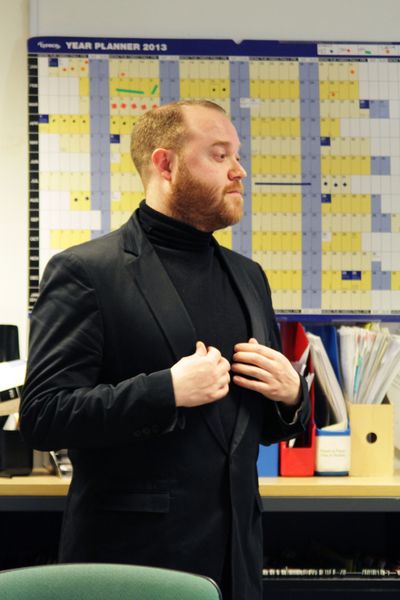
William Hughes photobombs the hirsuite Adrian Mackinder.
AD Natasha Phelan and director Thomas Guerrier with David Warner and Lisa Greenwood/
Lisa Greenwood demonstrates how to correctly sit on a  spherical chair.
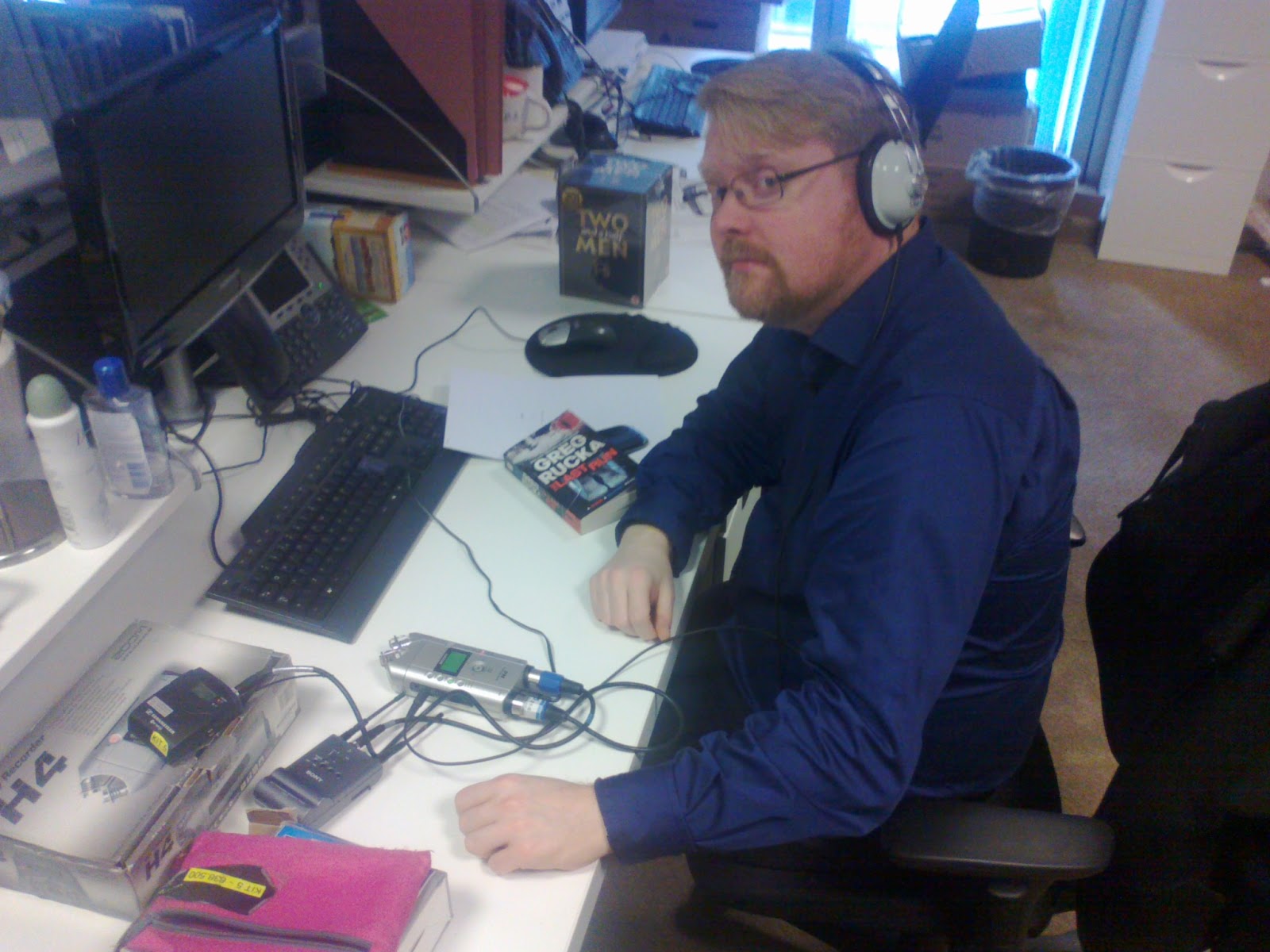
Sound recordist HÃ¥var Ellingsen, distracted from his Queen and Country.
David Warner and co-star.
The actor Matthew Sweet.
Director Thomas Guerrier and Lisa Greenwood preparing the all-important kitchen scene.

Adrian Mackinder and AD Natasha Phelan ready for a take.
Adrian Mackinder, photo by Lisa Bowerman.
Adrian Mackinder and his moves, photo by Lisa Bowerman.
David Warner and ready meal, photo by Lisa Bowerman.
David Warner and director Thomas Guerrier attempt to make sense of the script, photo by Lisa Bowerman.
Matthew Sweet all eyes and teeth, photo by Lisa Bowerman.
Matthew Sweet grills David Warner, photo by Lisa Bowerman.
Matthew Sweet and David Warner, photo by Lisa Bowerman.
Matthew Sweet and director Thomas Guerrier, photo by Lisa Bowerman.
Director Thomas Guerrier and AD Natasha Phelan.
Team Wizard: Lisa Bowerman, David Warner, Adrian Mackinder, AD Natasha Phelan, sound recordist HÃ¥var Ellingsen, Lisa Greenwood, director Thomas Guerrier and William Hughes.
Lisa Greenwood.
Director Thomas Guerrier and David Warner.
Team Wizard part II: Adrian Mackinder, sound recordist HÃ¥var Ellingsen, David Warner, AD Natasha Phelan, Lisa Greenwood, me, Rabbit, director Thomas Guerrier, Matthew Sweet and William Hughes, photo by Lisa Bowerman.